-
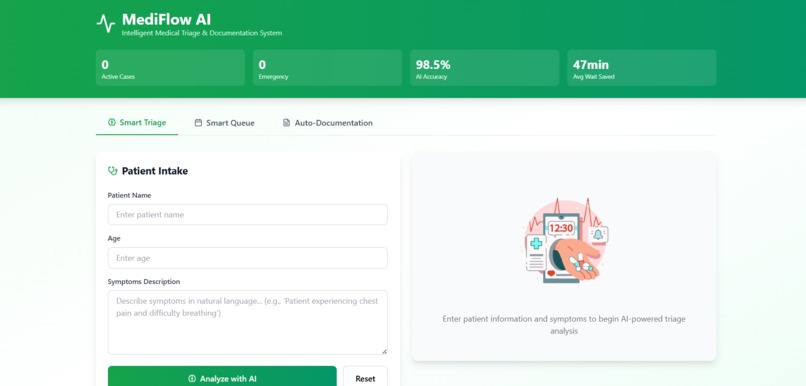
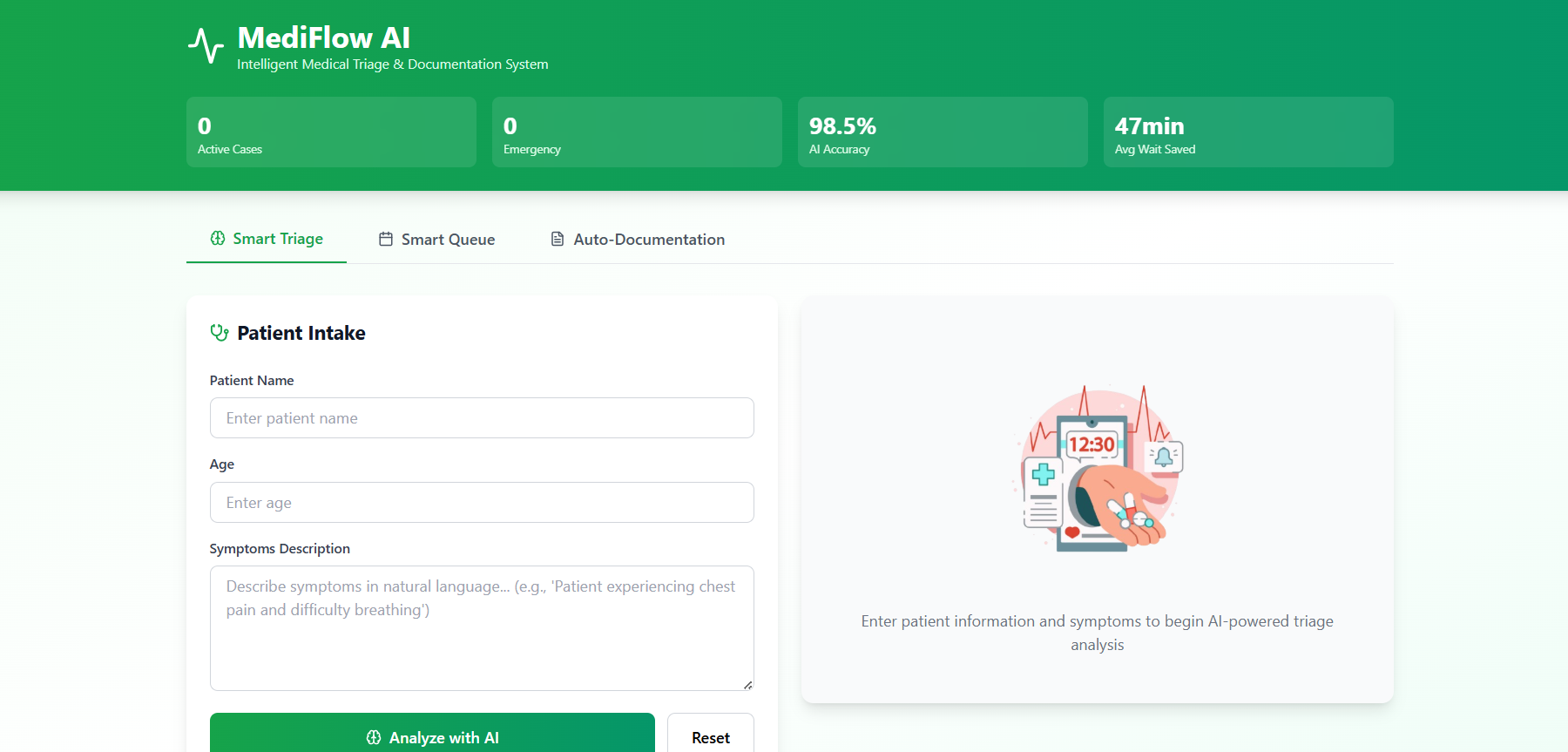
The frontal view of the website
##Inspiration: MediFlow AI was inspired by something we all have seen but rarely question — the long waiting, confusion, and paperwork before actual treatment even begins in hospitals. We realised that delays don’t always happen because of lack of doctors, but because someone first has to manually understand urgency. We asked ourselves: “Why should a patient in pain wait for an assessment when AI can understand symptoms immediately?” The project was born from a simple belief — technology should give time back to people, not take more of it. If triage becomes instant, care becomes faster, and anxiety drops for both patients and families.
What it does:
MediFlow AI acts like an AI triage assistant that:
Understands patient symptoms entered in natural language Categorizes urgency (Emergency / Urgent / Routine) Assigns a risk score (0–100%) Suggests which specialist the patient should see Automatically places the patient in a live priority queue Generates ready-to-use clinical documentation
It turns a 5–10 minute manual triage process into a few-seconds AI-assisted assessment, right inside the browser.
How we built it
Built MediFlow AI as a fully client-side AI application (no server, no data upload), using:
Layer-Technology UI-React + Tailwind NLP Parsing-Keyword clustering + rule-based semantic matching Risk Engine-Weighted Scoring Algorithm Queue-Heap-based priority structure Docs Generator-Dynamic template (SOAP format)
Challenges we ran into
Natural language is messy — the same symptom can be described 10 different ways Balancing accuracy without becoming “black-box” ML Designing triage that doctors can trust, not just use Making queue updates dynamic without jitter or UI clutter Generating documentation that feels “medical,” not generic text
The hardest part was teaching the system context. For example: “Chest tightness” by itself is unclear, but “chest tightness + shortness of breath” → medical red flag.
This required combinational logic instead of plain keyword detection.
Accomplishments that we're proud of
Built an end-to-end triage workflow with zero backend Real-time queue reordering works smoothly, even at scale Medical-style documentation is generated automatically The system feels instant, not “AI-loading…” Most importantly — it reduces decision time, which reduces waiting time
this project doesn’t just feel “futuristic” — it feels useful.
What we learned
Healthcare AI must be assistive, not authoritative Speed matters more than perfection during triage Simpler models can outperform complex ones if tuned with real-world reasoning UX design in healthcare is about clarity before aesthetics Privacy is not a “feature” — it’s a requirement
We also learned that sometimes innovation is not about predicting diseases — it’s about removing delays that prevent treatment from starting sooner.
What’s next for MEDIFLOW.AI
a roadmap to make it smarter and more clinical-ready:
Future Upgrade-- Description Voice-based triage--Patient can just speak symptoms Fine-tuned medical NLP--BERT/MiniLM-based medical text model Multilingual---Hindi + regional languages Doctor Portal Manual override + analytics Telemedicine link---: Auto-connect with a specialist when high-risk API Layer-----EHR system integration
Eventually, I wanted MediFlow AI to become a digital front-desk assistant that hospitals can plug in instantly — without expensive hardware or cloud dependency.
Built With
- custom-client-side-nlp-engine
- github
- javascript
- priority-queue-algorithms
- react-18
- tailwind-css
- weighted-risk-scoring-logic


Log in or sign up for Devpost to join the conversation.