-
-
Intro
-
Market
-
Problem explained
-
Solution


Inspiration
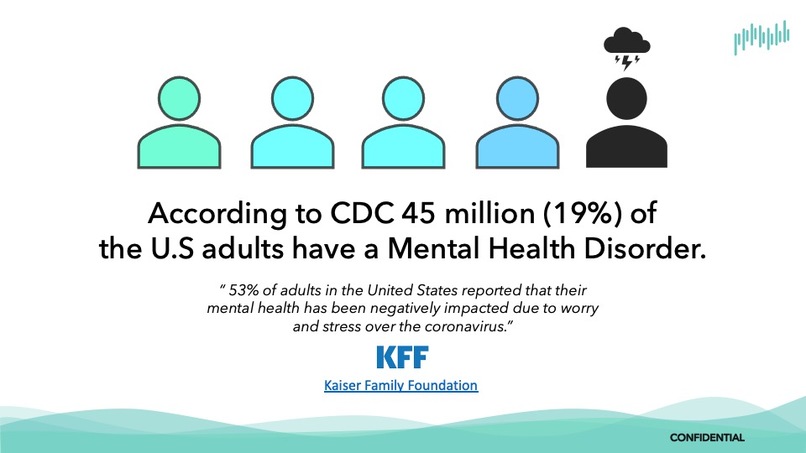
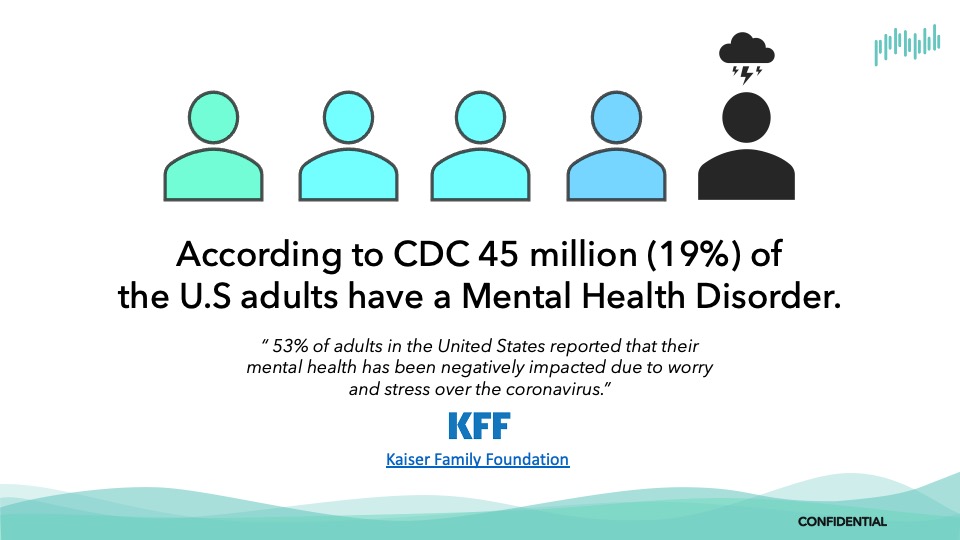
Mental health disorders are a real issue for both professionals and patients due to the complexity of the disease and limited resources. Unfortunately, COVID19 is a great challenge for mental healthcare and the demand for effective digital healthcare has peaked.
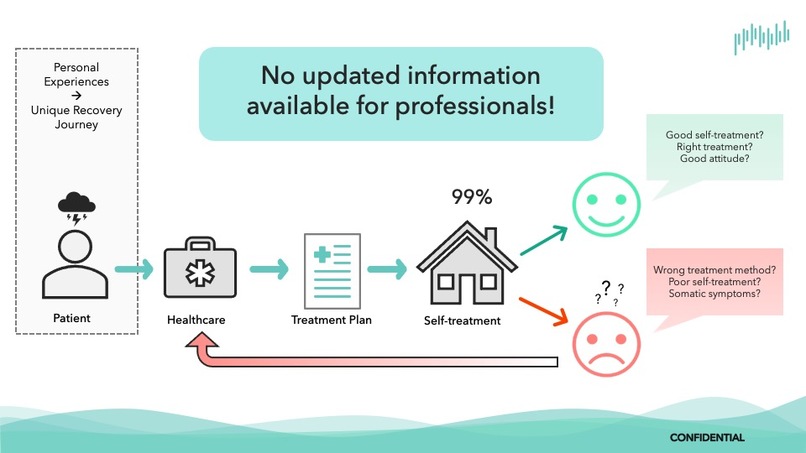
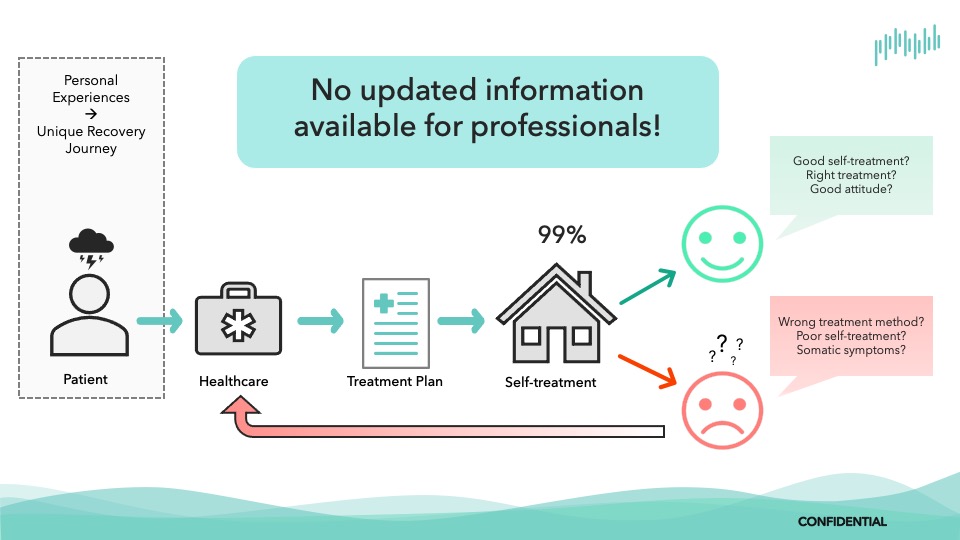
Clinicians (including physicians, nurses, and psychologists) can’t effectively monitor patient mental health treatments and base the treatment decisions on accurate data. Current data gathering methods are outdated, inefficient, and prone to human errors leading to patients receiving non-personalized and unoptimized care.
What it does
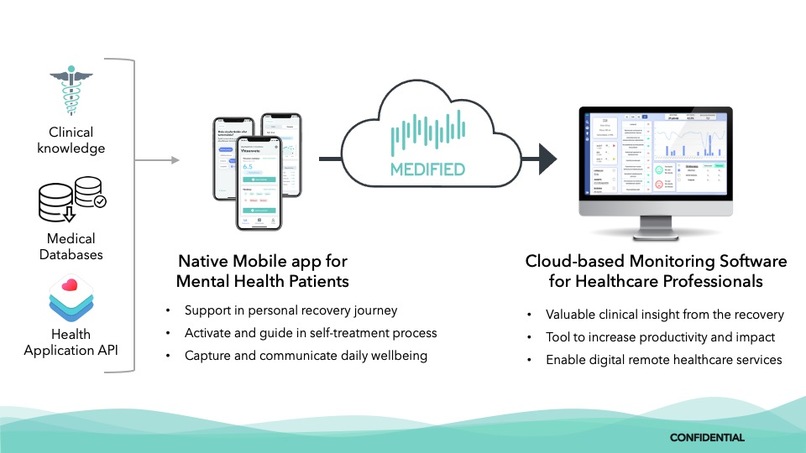
The patient’s personal mental health recovery process is captured in an accurate and secure way. Our SaaS has two components: We offer more personalized treatment decisions and continuity of care for mental health patients through the mobile app while providing clinical insights for healthcare professionals and enabling more productive telehealth services with our professional dashboard. Treatment data can be analyzed and utilized to optimize care, develop diagnostics, and allocate resources.
How we built our MVP
Any mental health patient can capture personal mental health in a precise and secure way with a native mobile application (React Native). The free to use app intensifies treatment and offers support with AI automated psychoeducational features. With the use of novel technologies (such as NLP), we are able to capture individuals' needs to provide better care without causing extra workload. Patient data is pseudonymized and handled according to the GDPR.
The healthcare professional dashboard provides valuable insight to use in clinical decisions. The dashboard is a SPA, i.e. “Single page application”, which means that the browser retrieves the application from the server, after which the browser no longer reloads the site, but communicates with the server program via HTTP requests.
The architecture is built around the services provided by the Amazon Web Service (AWS). The software running on the server is built with Node.js technology. The Node software includes a REST interface to which client applications connect. The Node software responds to client application requests, for example, by adding or modifying data about a server running on a PostgreSQL database.
In addition to our own services, ie the web application and the Node.js server software, the server runs open-source software Nginx, Sentry, PostgreSQL, GraphQL, InfluxDB, and Telegraf. All software runs inside its own containers.
Challenges I ran into
Mental health patients can be tricky to engage. The biggest challenge is to create a solution that provides value for both patients by being easy to use and intuitive to use. We utilize psychoeducational features based on patient input to maintain user retention and make the application more autonomous. The app the information should also be clinically relevant for healthcare so it can be used for better care. It is a balance between being clinical and basic B2C mental health software.
To tackle these challenges. We have interviewed and made surveys for almost a hundred healthcare professionals and the same amount of patients to find out what are the specific needs and current issues. Using these methods have enabled us to iterate the solution to match user need as agile as possible.
Accomplishments that I'm proud of
We have already been able to create a positive impact on the user's mental health according to the feedback from the pilots. We have also a development collaboration with the Finnish Central Mental Health Association (over 17 k members) where we can actively develop and test the new features. It has been extremely rewarding to be able to develop a solution that generates traction and improves mental wellbeing.
The diversity and competence of the team are optimal for the future of health tech since we have a unique competence cocktail of medical, tech, data, and business knowledge.
What We learned
The complexity of the mental health issues is great and even though problems are prominent it is not easy to identify underlying issues that have created the problem. Identifying these problems requires a lot of groundwork and work with the stakeholders. In order to tackle these issues, we need multidisciplinary collaboration and partners. But still, minor improvements can make a huge impact on individuals, and those rewarding user stories and comments have truly empowered our development. We are still in a very early phase but the direction is right.
What's next for Medified
We are developing market-ready MVP that have AI features. We are looking for international partners in the sector of NGOs, Healthcare providers, and research institutions. Our primary target is the US market. We have an initial proof-of-concept from pilots conducted in Finland, but we know the problem is global so we want to set sights early on making a global level impact.


Log in or sign up for Devpost to join the conversation.