\section*{Inspiration}
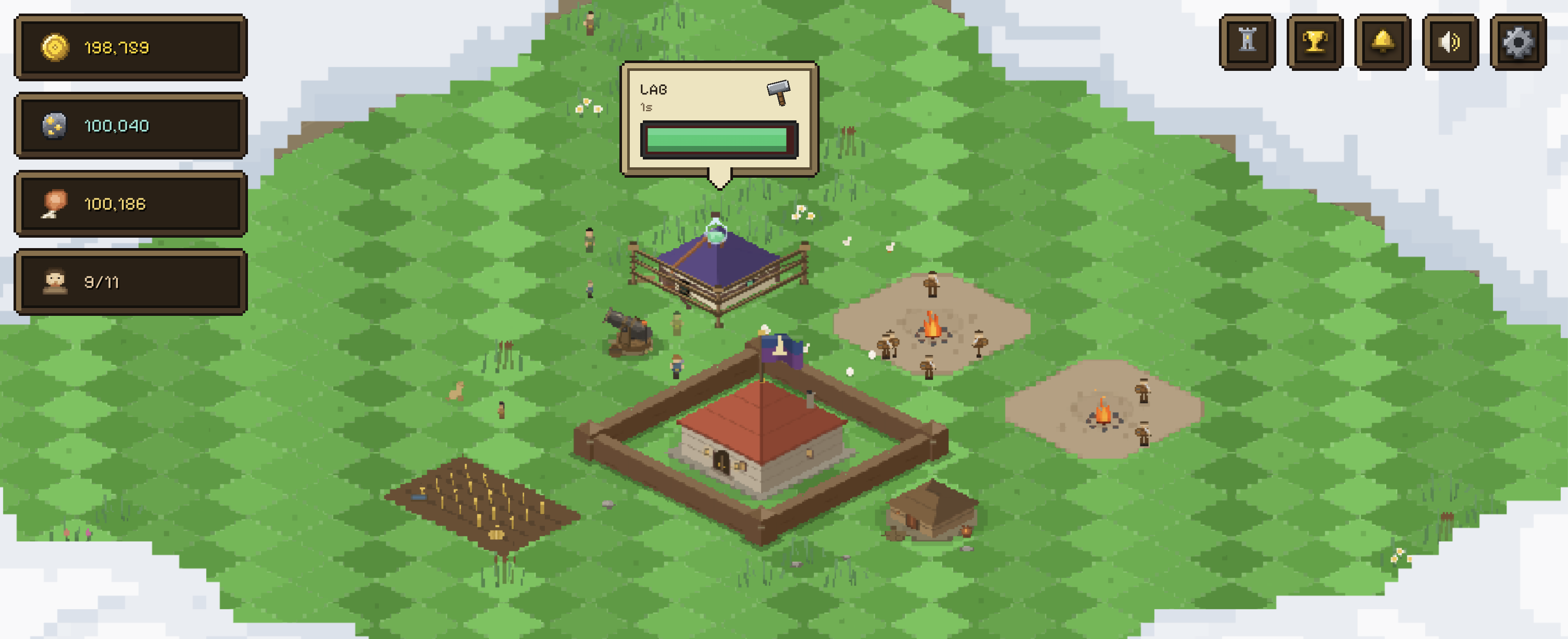
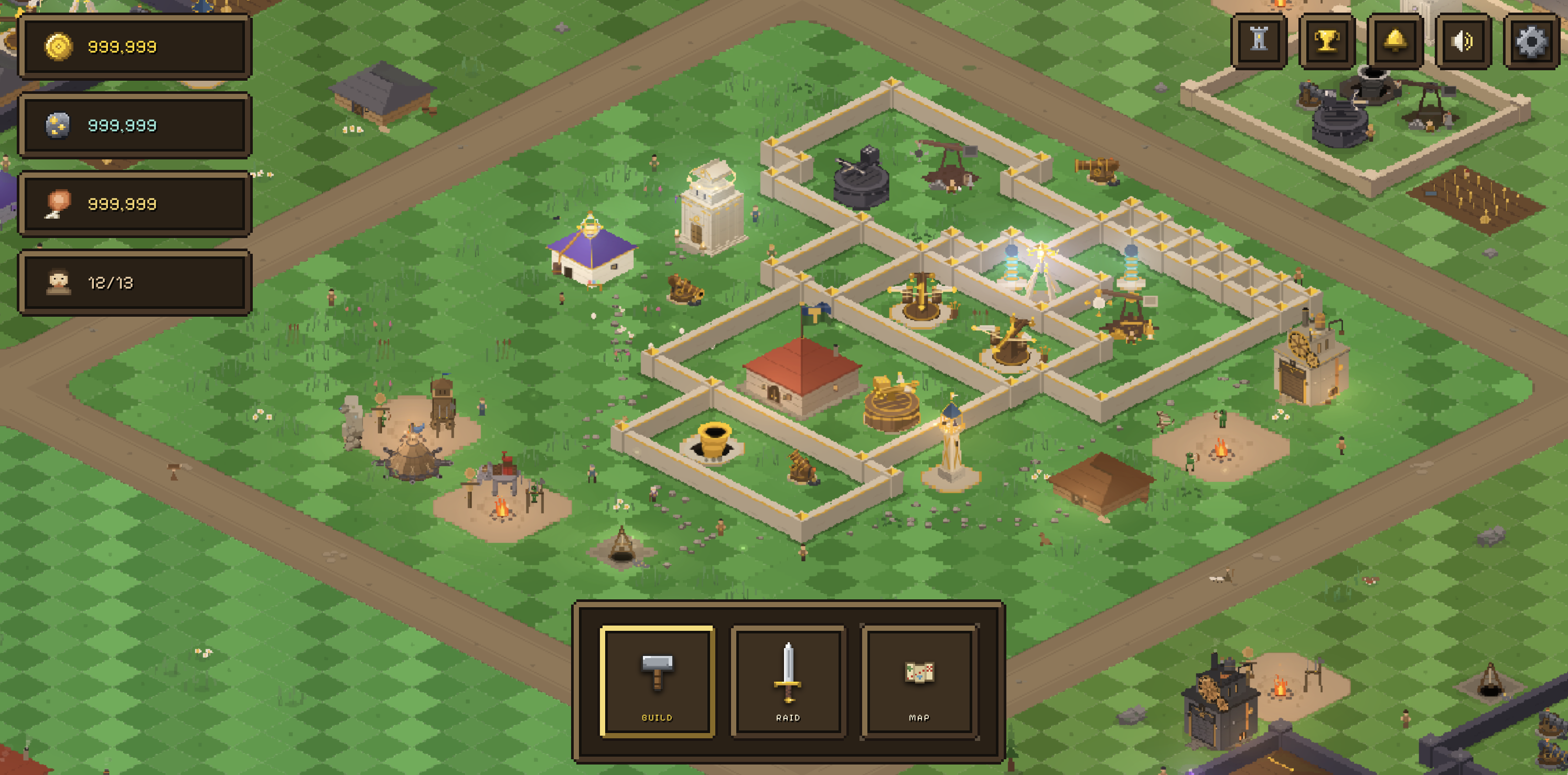
This project is \textbf{an art and design project at its core}. I initially wanted to benchmark the original Codex on GPT-5.1 when it was released. I took heavy inspiration from \textit{Clash of Clans}, but I wanted to make it an MMO where you could see thousands of villages on a shared map and trade with or attack other players in a browser.
The goal was to have \textbf{every visual asset designed by Codex}. Every building, troop, and effect in the game is designed as vector code by Codex and baked into a pixel-art sprite with edge cleanup through a workflow that Codex developed.
\section*{What It Does}
Allows you to build a village, attack your friends, and trade with traveling merchants.
It is a \textbf{full frontend and backend application}, running online with a React/Phaser frontend and an authoritative Node.js/PostgreSQL backend.
Includes \textbf{18 trainable troops}.
\section*{How We Built It}
Used GPT-5.6 through Codex as a visual designer, gameplay engineer, backend architect, QA engineer, and production-tool developer.
Built the frontend with React 19, TypeScript, Phaser 3, Vite, Canvas, and WebGL.
Built the backend with Node.js, PostgreSQL, domain-focused services, transactional persistence, and deterministic simulation.
Created the \textbf{fully automated Design Arena}, which launches multiple isolated Codex designers from the same mechanics-only contract.
Kept \textbf{human judgment as the final taste gate}: automation generates and validates the options, but a human chooses what ships.
Built Puppeteer and FFmpeg tools that direct, capture, validate, and edit the real game into a \textbf{60 FPS trailer}.
\section*{Challenges We Ran Into}
Maintaining architectural coherence across \textbf{tens of millions of tokens} of development.
Handling isometric depth, connected walls, shadows, projectiles, effects, and ground layers without visual popping, while automating the nuanced layering so that it did not require human editing.
Keeping deterministic animation timing synchronized between authored vectors, baked frames, runtime playback, and replays.
\section*{Accomplishments That We're Proud Of}
Created the \textbf{Design Arena}, a methodical agentic design process that automates creative exploration while deferring final taste to humans.
Produced \textbf{37,371 verified pixel-art frames across 100 manifests} from Codex-authored vector source.
Created a \textbf{reproducible 60 FPS demo-video pipeline} using actual gameplay rather than staged pre-renders.
\section*{What We Learned}
\textbf{Codex becomes more valuable when it is allowed to build the machinery around its own output.}
\textbf{Human taste becomes more important as the cost of generating options approaches zero.}
Long-horizon AI development works best when decisions are encoded into guides, automated gates, and executable workflows instead of relying on memory.
\section*{What's Next for Medieval MMO}
Add player-to-player trading, alliances, diplomacy, coordinated wars, and regional events.
Add more social systems that make neighboring villages feel like members of the same world.

Log in or sign up for Devpost to join the conversation.