MediConnect AI
Inspiration
Healthcare accessibility remains a challenge, especially for people in remote areas or those who struggle to get timely medical attention. Waiting weeks for a doctor’s appointment, not having proper records in one place, or being unable to identify early warning signs from medical images often leads to delayed treatment.
We wanted to solve this by creating a platform where patients and doctors can connect instantly, supported by AI-driven insights that make consultations faster, smarter, and more reliable.
What it does
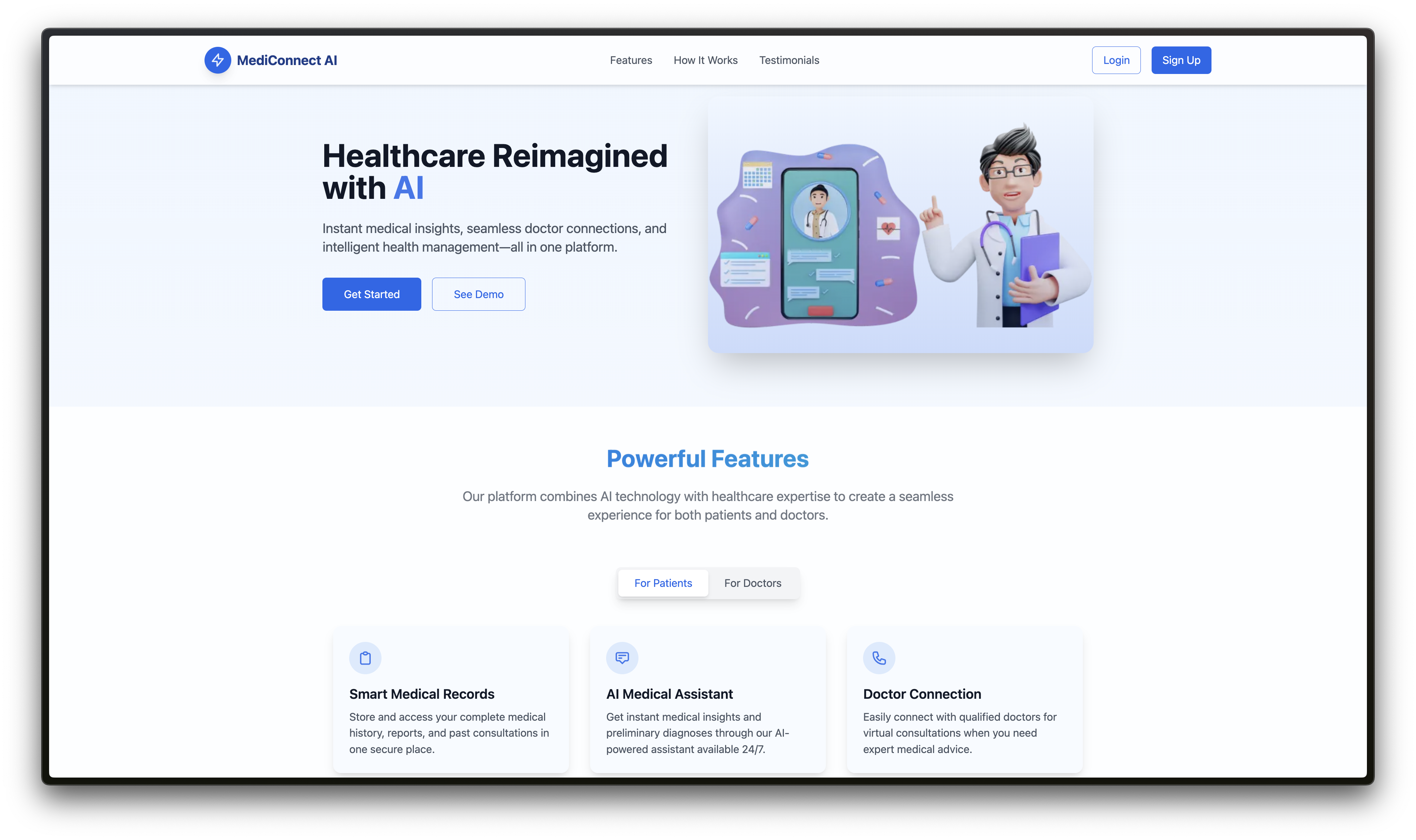
MediConnect AI is a web-based healthcare platform that bridges the gap between patients and doctors through AI-powered features and dedicated dashboards for each role:
Patient Dashboard
- Real-time video consultations with doctors (with live chat + speech-to-text transcription).
- Post-call reports: prescriptions, summaries, and follow-ups downloadable as PDFs.
- AI-powered assistant to analyze symptoms, suggest possible conditions, and recommend doctors.
- Visual Diagnosis (OpenCV-powered): upload medical images (e.g., skin rashes, wounds) for AI-based analysis and recommendations.
- Medical Records Hub: secure storage of prescriptions, diagnostics, and consultation history.
- Appointments: easy booking, rescheduling, or cancellation.
- Nearby Doctors: geolocation to find and connect with available doctors nearby.
Doctor Dashboard
- Patient demographics and analytics (conditions, appointment frequency).
- Consultation Management: schedules, fees, and payments.
- AI-assisted triage: doctors receive preliminary AI-generated insights for patient cases.
- Revenue and fee tracking with financial reports.
In short, MediConnect AI provides an end-to-end consultation experience with AI assistance, real-time communication, and centralized health data.
How we built it
- Frontend: React + TypeScript for a scalable, modern interface.
- Backend: Node.js + Express with MongoDB for data storage.
- Real-Time Communication: WebRTC for video calls, Socket.IO for live chat.
- AI/ML Integration:
- NLP models for chatbot-style symptom analysis.
- OpenCV for medical image analysis.
- Speech-to-Text & Text-to-Speech APIs for accessible consultations.
- Authentication: JWT for secure patient/doctor login.
- PDF Generation: pdfkit for downloadable medical reports.
- Geolocation APIs for locating nearby doctors.
We followed an MVP-first approach, prioritizing features that directly impact patients and doctors in real healthcare scenarios.
Challenges we ran into
- Integrating AI into real workflows: Making the AI assistance accurate enough to provide useful triage suggestions without replacing the doctor’s authority was tricky. We had to fine-tune how AI responses are presented to avoid misleading patients.
- Visual Diagnosis via OpenCV: Medical images vary in quality (poor lighting, phone cameras, etc.), so we had to implement preprocessing techniques to improve reliability.
- Real-time video stability: Ensuring smooth consultations over unstable internet connections was a challenge — WebRTC required a lot of testing and optimization.
- Data privacy: Designing the system so that sensitive medical records remain secure while still being easily accessible for the patient.
Accomplishments that we're proud of
- Built separate dashboards for patients and doctors, making the experience tailored to each role.
- Successfully implemented end-to-end video consultation with live chat + automated PDF reports.
- Integrated OpenCV visual diagnosis, giving patients AI-powered first-look insights before consulting a doctor.
- Created a centralized medical record system that feels like a personal health vault.
- Managed to bring all these features together in a working MVP within hackathon timelines.
What we learned
- Designing for healthcare is very different from building a regular web app — usability and trust are as important as technical features.
- AI can augment doctors’ work, but it must always be positioned as assistive, not authoritative.
- Handling multimedia data (images, live video, audio transcription) in real time taught us a lot about scaling web apps.
- Building for inclusivity (multilingual support, text-to-speech, easy record downloads) makes the app accessible to a wider audience.
What's next for MediConnect AI
- Mobile App version to make consultations even more accessible.
- Expand visual diagnosis models to handle a broader range of conditions (dermatology, dental, radiology).
- Build a smart recommendation system that matches patients with the best doctors based on condition, history, and location.
- Integrate EHR interoperability so existing hospital systems can connect with MediConnect AI.
- Stronger data encryption and compliance with healthcare standards (like HIPAA/GDPR).
Built With
- express.js
- geolocation-api
- json-web-tokens-(jwt)
- mongodb
- mongoose
- nlp-models
- node.js
- opencv
- pdfkit
- react
- socket.io
- speech-to-text-api
- tailwind-css
- text-to-speech-api
- typescript
- webrtc

Log in or sign up for Devpost to join the conversation.