-
-
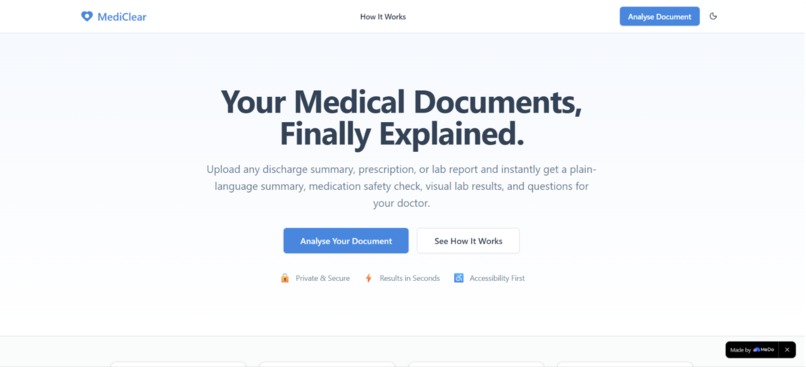
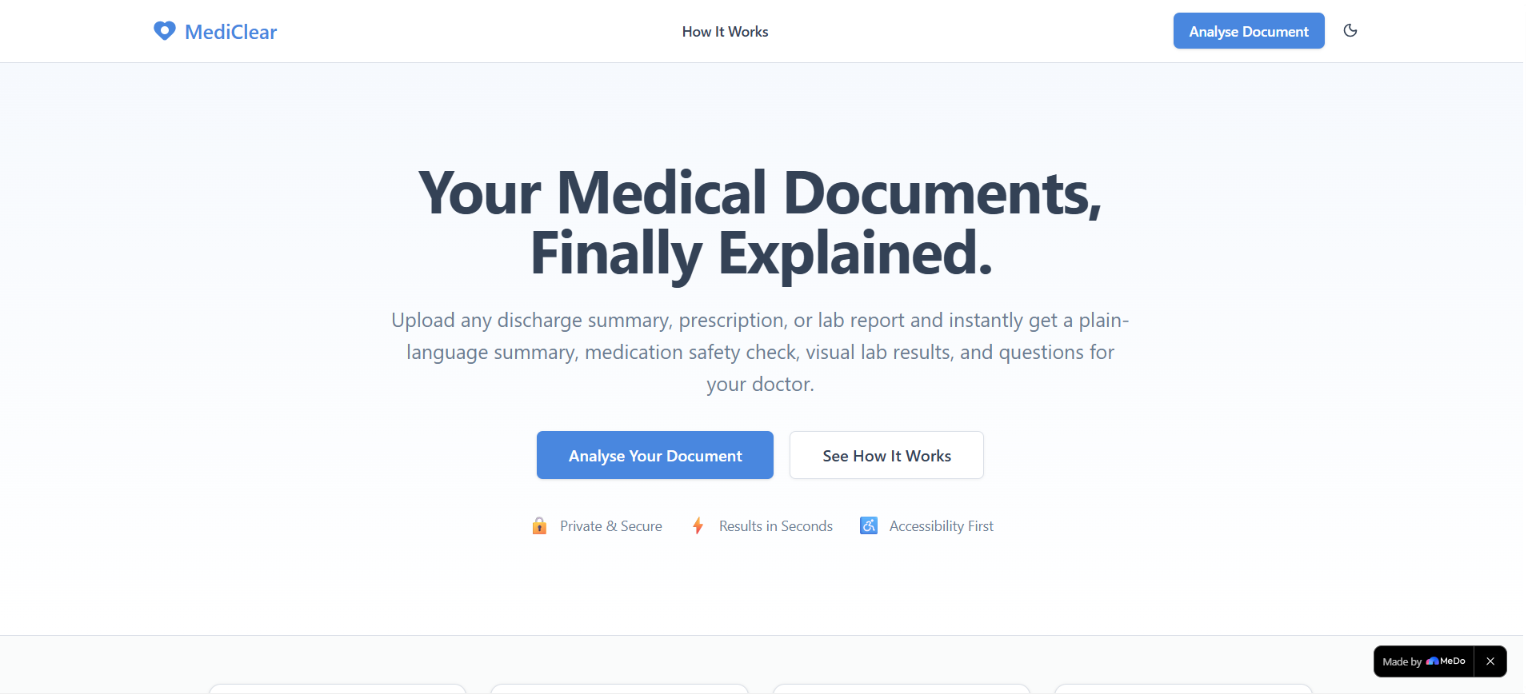
Home Page
-
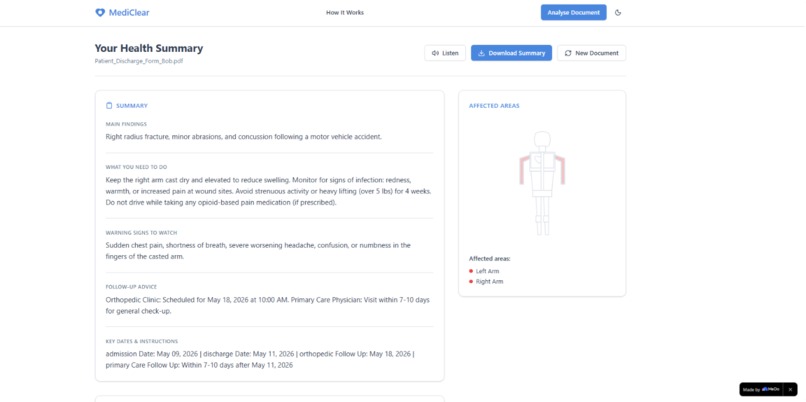
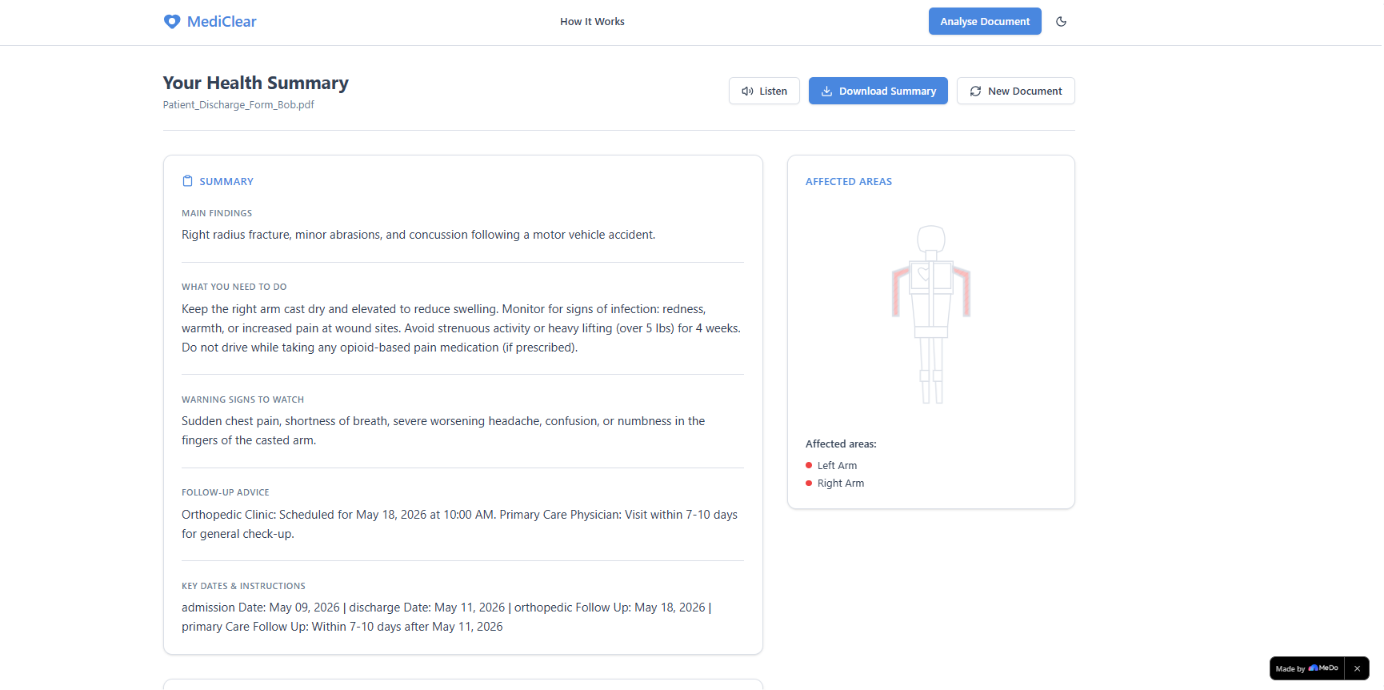
Summary Page
-
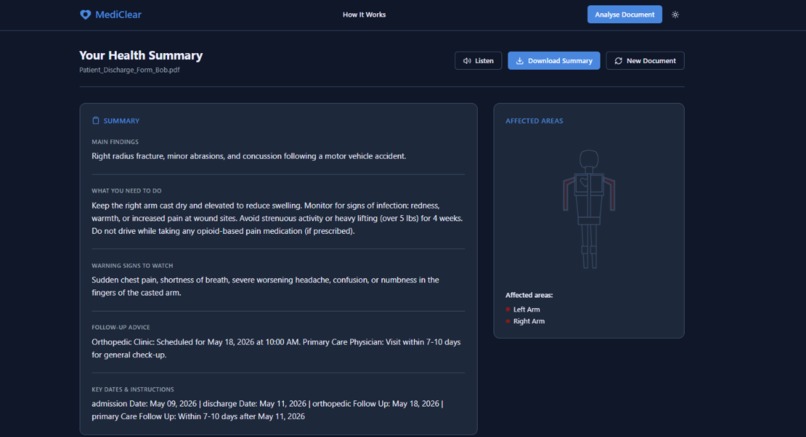
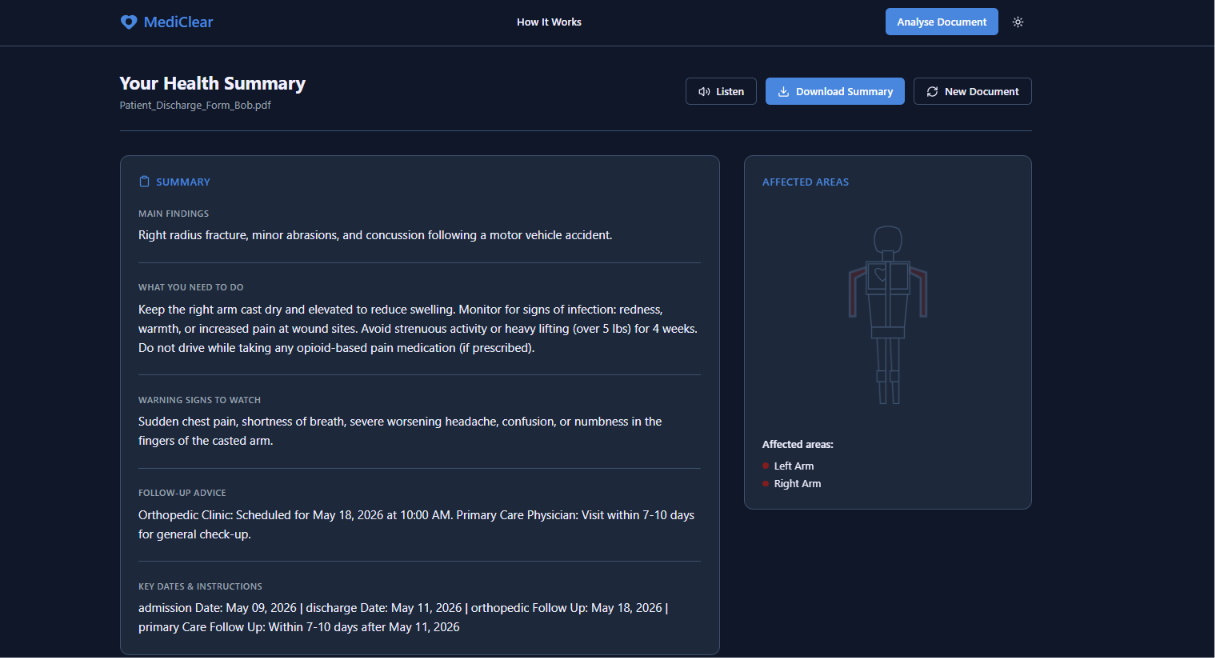
Summary Page Darkmode
-
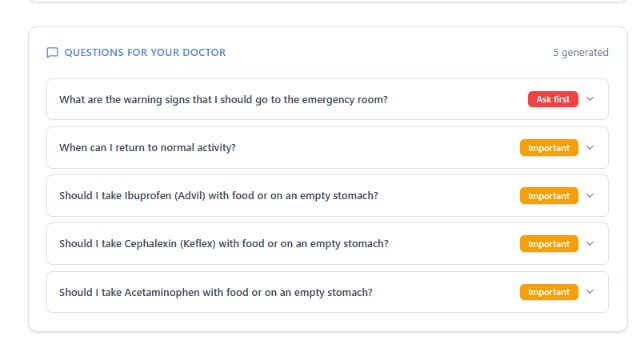
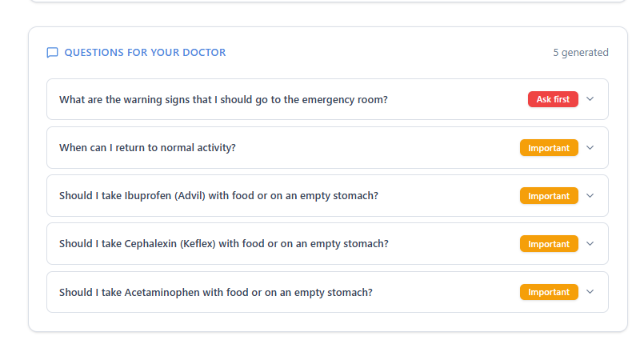
Questions for Doctor Section
What MediClear Does
MediClear is a patient-facing AI health assistant that makes medical paperwork understandable for everyone. You upload a document — a discharge summary, prescription, lab report, or even a photograph of a handwritten doctor's note — and MediClear immediately gives you everything you need to understand it and act on it.
In seconds, you receive a plain-language summary of the key findings, a medication table with safety flags for duplicates or missing information, lab results displayed as visual gauges with clear normal and abnormal ranges, an anatomical body diagram with the affected areas highlighted, clickable definitions for every piece of medical jargon, a personalised list of questions to bring to your next appointment, and a downloadable summary pack to take with you.
The Problem
Medical documents are designed for doctors, not patients. A discharge summary after heart surgery might be the most important document a patient has ever received — and it is almost always incomprehensible to them. Patients miss medication instructions. They miss follow-up dates. They arrive at appointments not knowing what to ask. This is not a patient failure. It is a systemic gap in how health information is communicated, and it has a real human cost.
What Inspired This
The image of someone sitting in a hospital waiting room, holding a piece of paper they cannot understand, at the most stressful moment of their life. That moment does not need to feel as frightening as it does. That is what MediClear is designed to change.
How We Built It With MeDo
MediClear was built entirely on the MeDo platform using natural-language descriptions to generate and iterate the full-stack application. MeDo's multi-turn chat editor allowed us to build each feature module incrementally — describing the exact behaviour we needed, reviewing the generated output, refining the details, and moving to the next component.
The Baidu LLM Plugin was central to the document understanding layer. We integrated the Baidu AI Studio ERNIE and PaddleOCR models for text extraction from images and handwritten documents — handling the diverse range of medical document formats that patients actually receive, including photographed prescriptions and handwritten clinic notes.
Feature build sequence in MeDo:
- File upload component with validation for PDF, TXT, DOCX, JPG, PNG, and GIF formats, with preview and clear error messages
- Side-by-side reading view — original document alongside a plain-language interpretation generated by the AI layer
- Medication extraction table with name, dose, frequency, and a confidence score, plus safety flags for duplicates, missing doses, and inconsistent instructions
- Lab result visualisation with colour-coded gauges, reference ranges, trend arrows, and short explanations for each value
- Interactive SVG anatomical body diagram that highlights regions mentioned in the document (lungs, heart, knee, etc.) with clickable tooltips linking back to the relevant explanation
- Jargon decoder — any medical term in the document becomes clickable and shows a plain-English definition with context
- Doctor discussion guide — AI-generated prioritised questions based on the specific content of the uploaded document
- Voice mode — the summary reads aloud using the speech synthesis integration, supporting users with visual impairments or those who prefer audio
- Dark and light mode toggle with theme persistence
- One-click export — the full summary, medications, lab concerns, and doctor questions packaged into a downloadable visit summary
What MeDo Made Possible
MeDo allowed us to build a production-quality, fully deployed, multimodal health application in a fraction of the time traditional development would have required. Features that would typically take days of frontend work — the animated SVG diagram, the lab gauge components, the side-by-side reading layout — were generated, reviewed, and refined in hours.
The integration of the Baidu plugin extended the platform's native capabilities to cover real OCR use cases, handling the kind of messy, real-world medical documents that patients actually deal with.
What Makes MediClear Different
Most health apps are built for people who already understand their health. MediClear is built for the moment of confusion — the moment after a hospital discharge, the morning after a difficult diagnosis, the afternoon before a follow-up appointment you do not know how to prepare for.
It is not a chatbot. It does not require the user to know what to ask. It reads the document and gives the user everything they need, automatically.
What We Learned
That the most powerful thing AI can do in healthcare is not replace clinical expertise — it is extend access to understanding. MediClear does not diagnose. It translates. And for millions of patients, that translation is the difference between feeling informed and feeling lost.
Accessibility Commitment
MediClear was built with accessibility as a primary constraint, not an afterthought. Large fonts, full keyboard navigation, screen reader support, high-contrast mode, colour-blind friendly anatomical highlights, and voice output are all core features. A health tool that excludes people with visual or cognitive impairments has failed at the most fundamental level.
Built With
- ai-multimodal-document-understanding
- baidu-llm-plugin
- css
- medo
- svg-anatomical-diagram
- tailwind
- web-speech-api

Log in or sign up for Devpost to join the conversation.