-
-
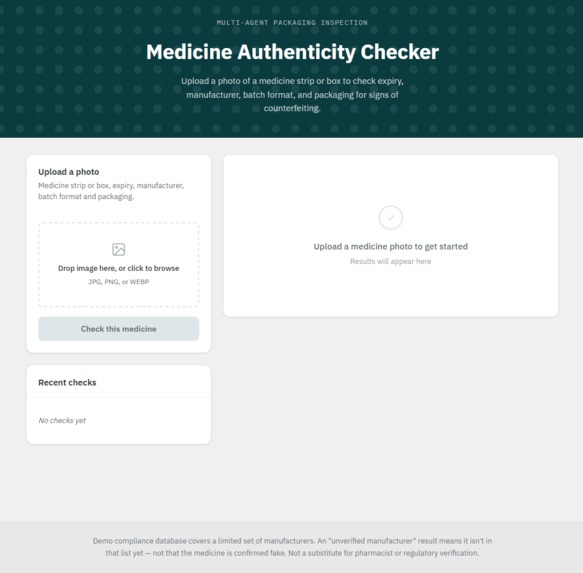
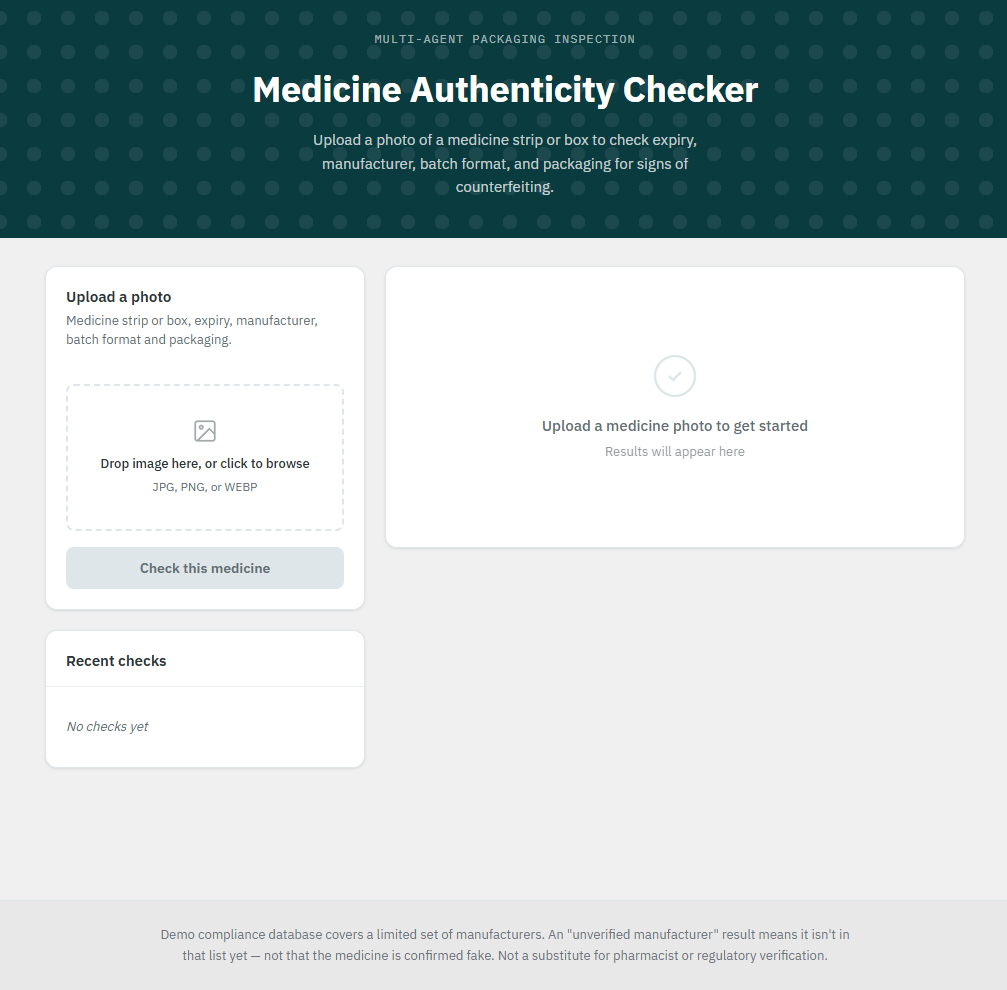
Clean, responsive UI ready for a user to upload a photo of their medicine strip for instant AI verification.
-
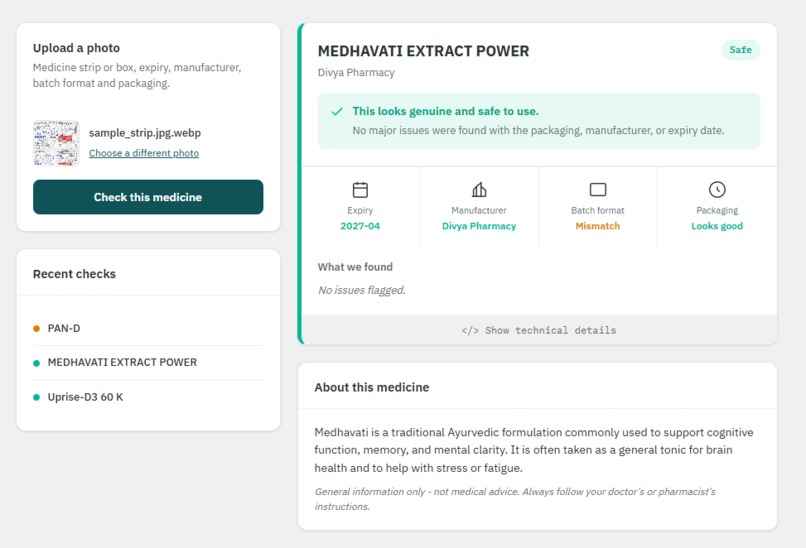
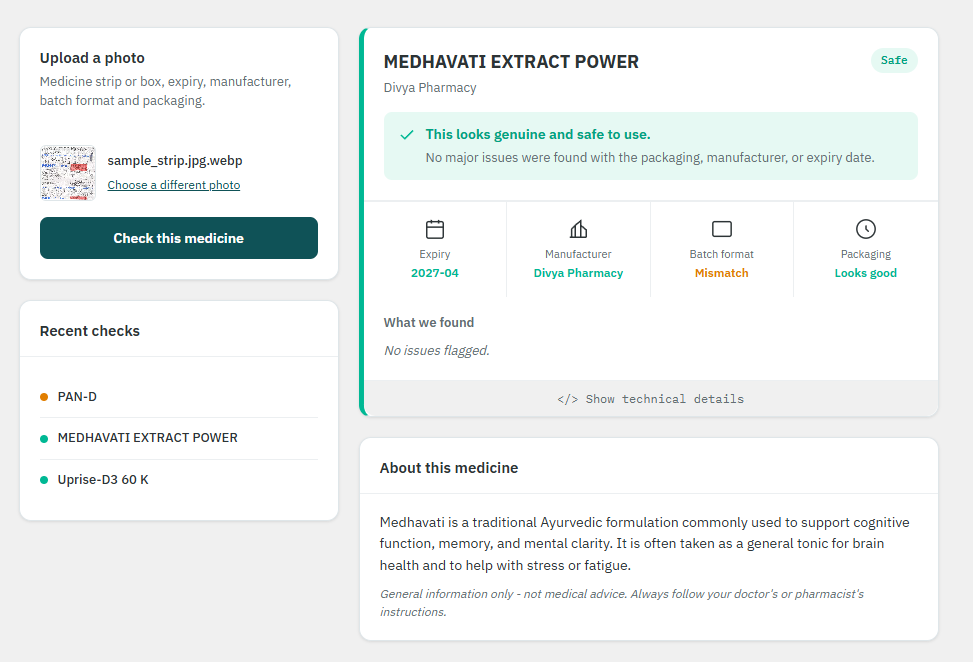
A verified medicine! The AI checks the expiry, batch format, and manufacturer to give a definitive Safe verdict.
-
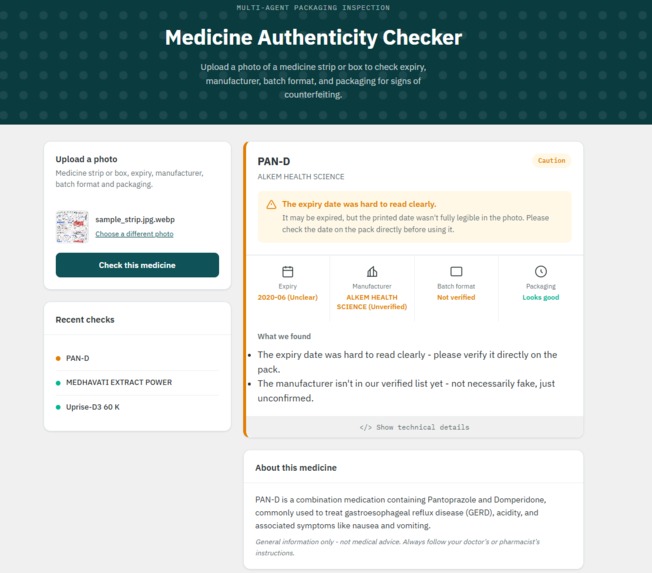
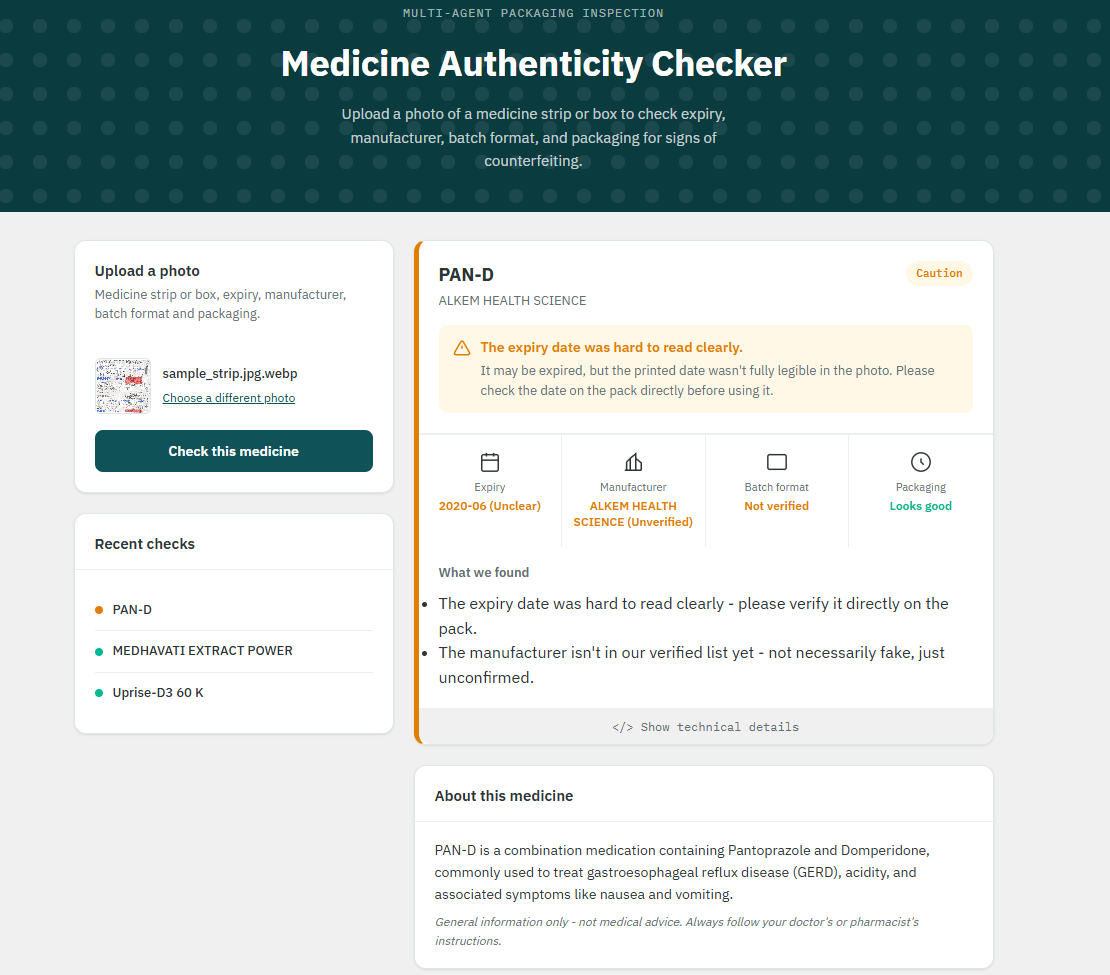
Flagging a suspicious medicine. If the manufacturer isn't in our database, the AI warns the user immediately.
-
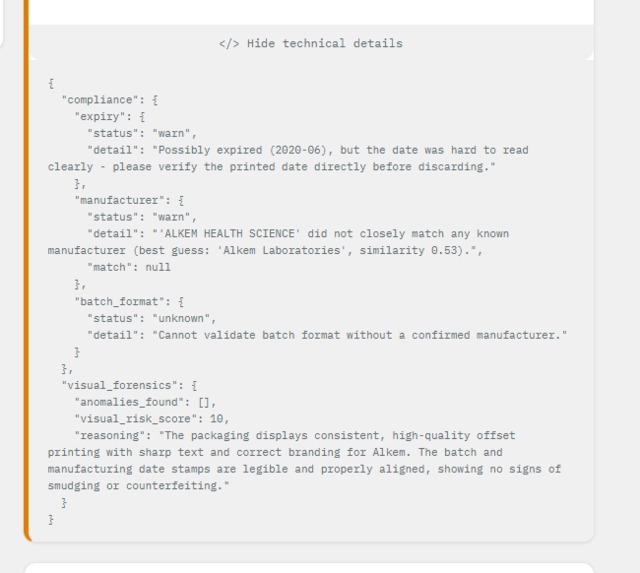
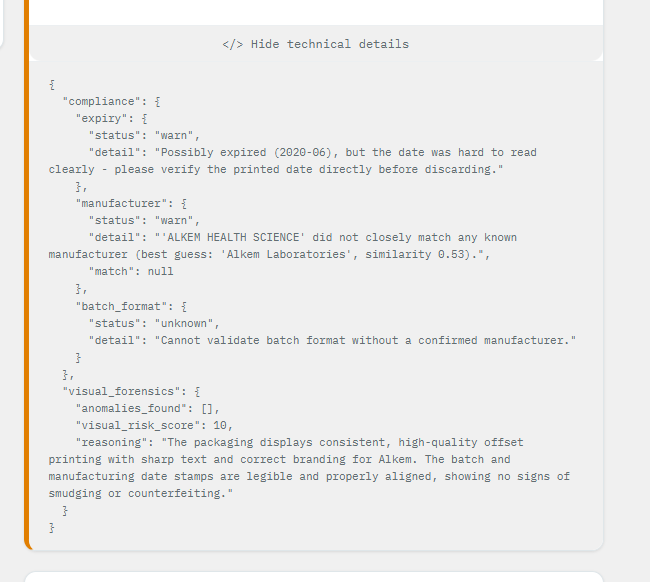
Transparent AI reasoning. Expand the technical details to see the raw JSON output and confidence scores from the agents.
-
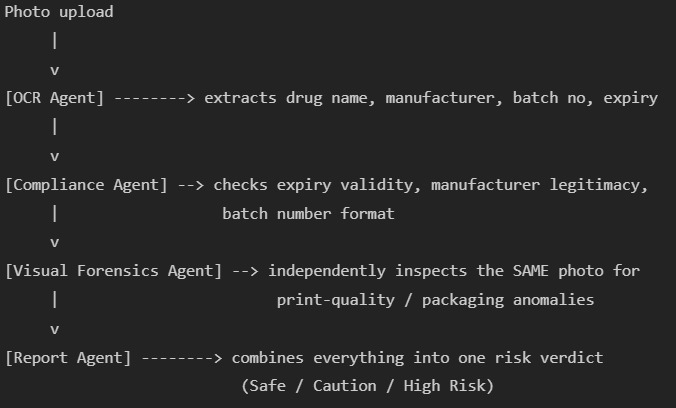
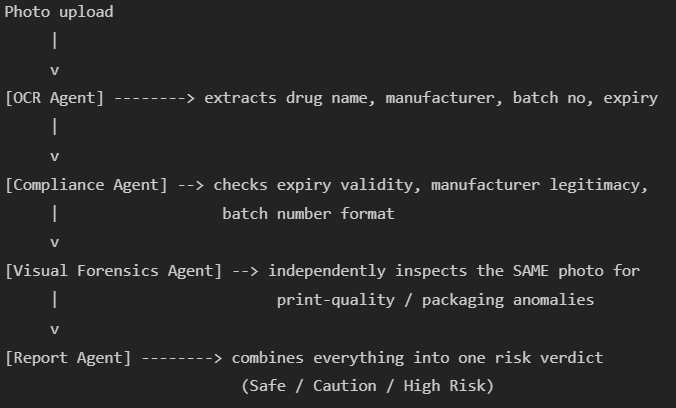
Our multi-agent pipeline: OCR extracts text, Compliance checks rules, Visual Forensics inspects quality, and Report aggregates.
Inspiration
Counterfeit medicines are a growing global health crisis — the WHO estimates that 1 in 10 medical products in low- and middle-income countries is substandard or falsified. We wanted to build a tool that lets anyone verify their medicine's authenticity using just a smartphone photo.
What it does
Medicine Authenticity Checker is a multi-agent AI system that inspects a photo of a medicine strip or box and flags possible counterfeit or expired stock. It runs four specialized agents in sequence:
- OCR Agent — extracts drug name, manufacturer, batch number, and expiry date from the image using vision LLMs
- Compliance Agent — checks expiry validity, fuzzy-matches the manufacturer against a verified database, and validates batch number format
- Visual Forensics Agent — independently inspects the same photo for print-quality and packaging anomalies
- Report Agent — combines all findings into a single risk verdict: Safe, Caution, or High Risk
How we built it
- Backend: Python + FastAPI orchestrating four agents, each powered by Groq's fast LLM inference API
- Frontend: A single-page HTML/CSS/JS interface with a two-column card layout for uploading photos and viewing results
- Compliance Database: CSV-based manufacturer registry with fuzzy string matching and regex-based batch format validation
- Architecture: Pipeline pattern — each agent processes independently, and the Report Agent aggregates everything into a user-friendly verdict
Challenges we ran into
- OCR accuracy on foil strips — glossy, curved medicine strips are difficult for vision models. Lighting and angle matter a lot.
- Manufacturer name variations — the name printed on a strip (e.g., "Alkem Health Science") often differs from the registered corporate name ("Alkem Laboratories"). We solved this with alias matching and substring containment checks.
- Batch format data — real manufacturer batch-numbering formats aren't publicly documented. Our patterns are demo placeholders — we've clearly labeled this in the project.
What we learned
- Multi-agent architectures are powerful for breaking complex verification into specialized, independently testable steps
- Fuzzy matching with confidence thresholds is more honest than binary pass/fail for real-world OCR data
- Being transparent about limitations (like the demo compliance database) builds more trust than overpromising
What's next
- Expand the manufacturer database with verified real-world batch patterns
- Add a mobile-optimized camera capture flow for on-the-spot verification
- Integrate with public drug registry APIs (like India's CDSCO) for live manufacturer verification
Built With
- css
- fastapi
- groq
- html
- javascript
- python
- uvicorn
- vision


Log in or sign up for Devpost to join the conversation.