Inspiration
In Renaissance Florence, wealth and influence moved through intricate networks of merchants, banking houses, and powerful institutions. Understanding who benefited often required looking beyond individual transactions to the relationships connecting them.
Inspired by this era, we built Medici Web around a modern question: when public money changes hands, can we trace the evidence behind who benefits and who may be left bearing the cost?
Public procurement records contain valuable information, but tender anomalies and corporate relationships are often examined separately. We wanted to bridge that gap and make complex procurement data easier to investigate.
What it does
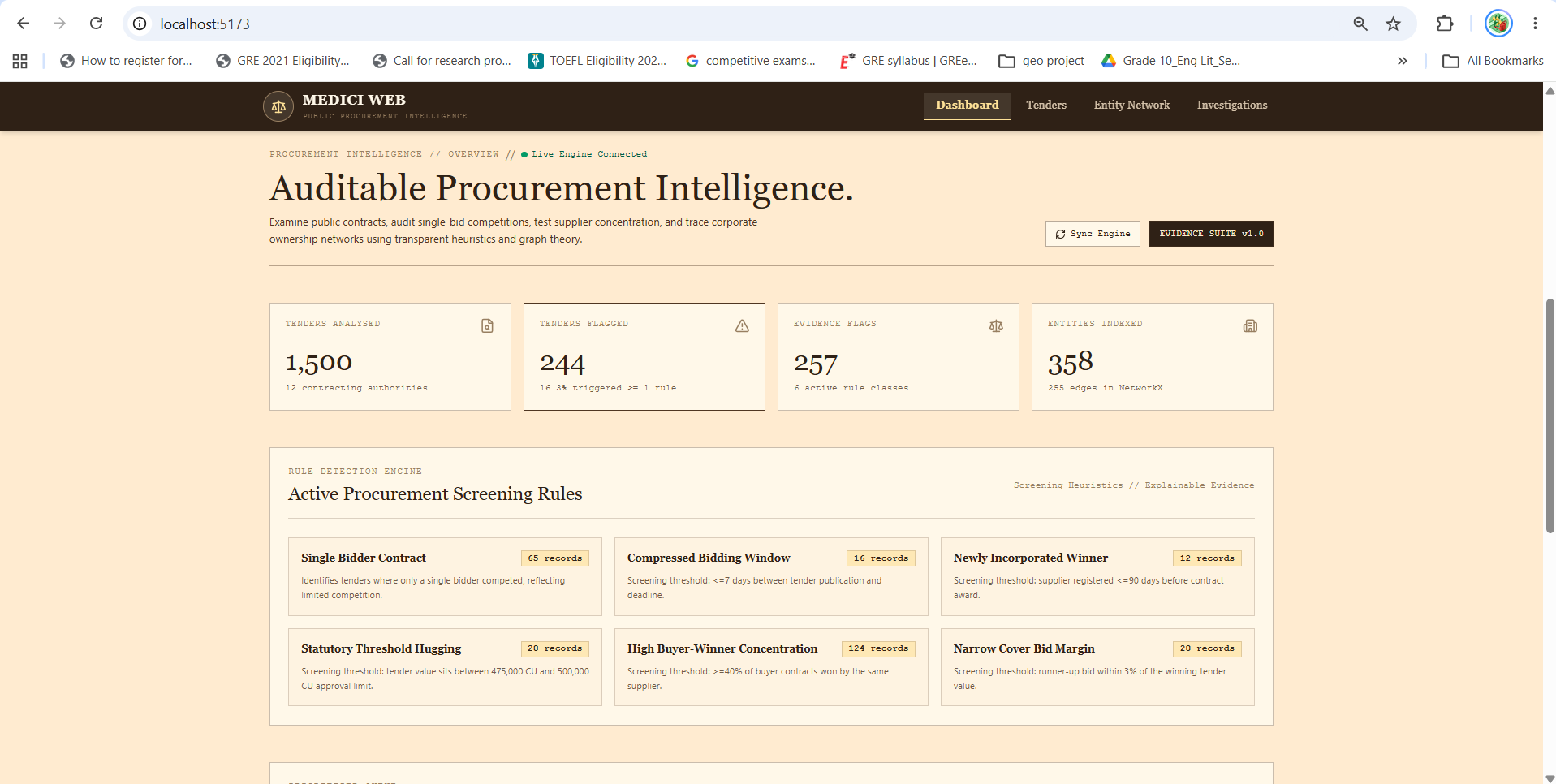
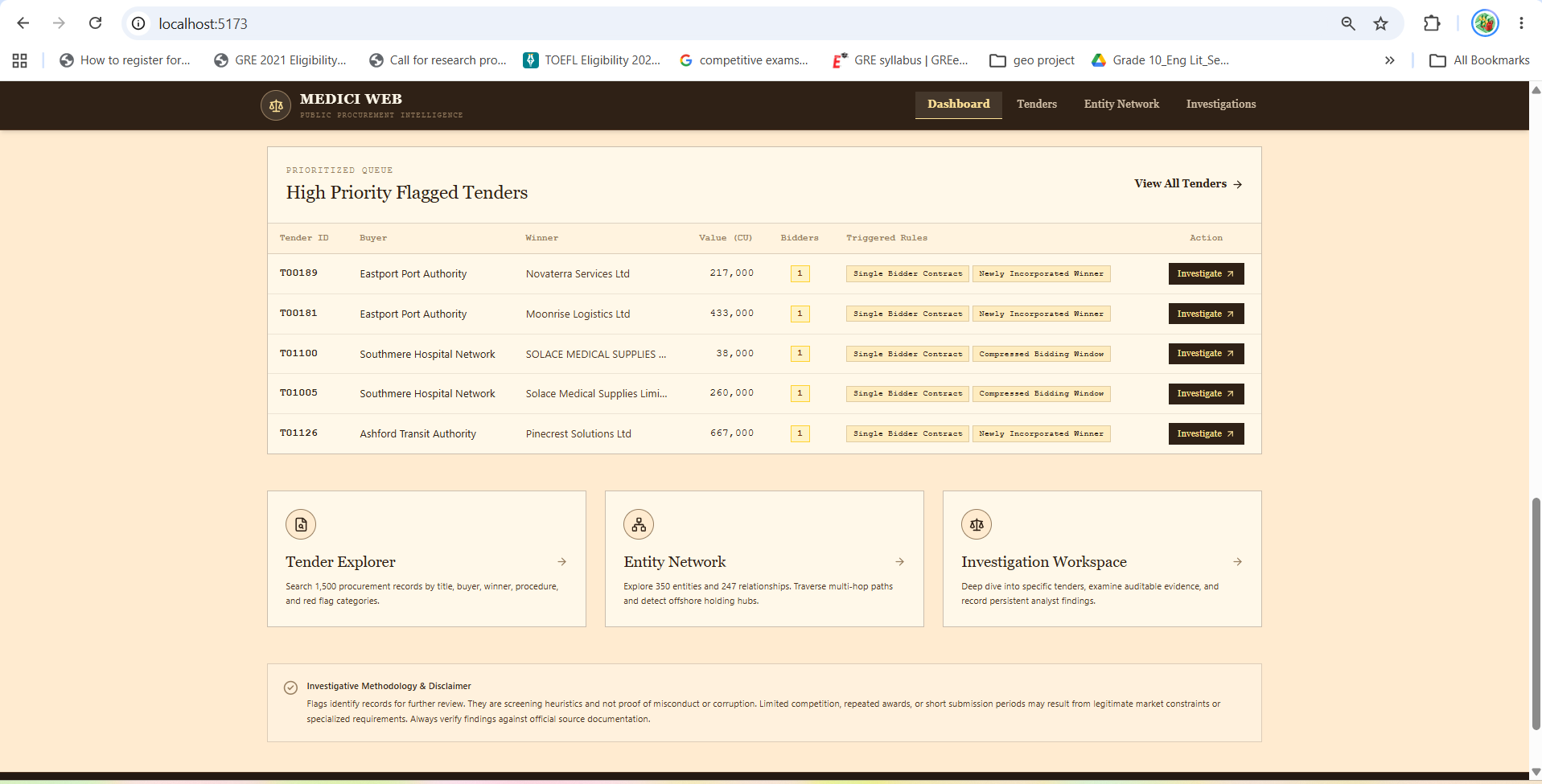
Medici Web is a public procurement intelligence platform designed to connect suspicious tender patterns with corporate relationship analysis.
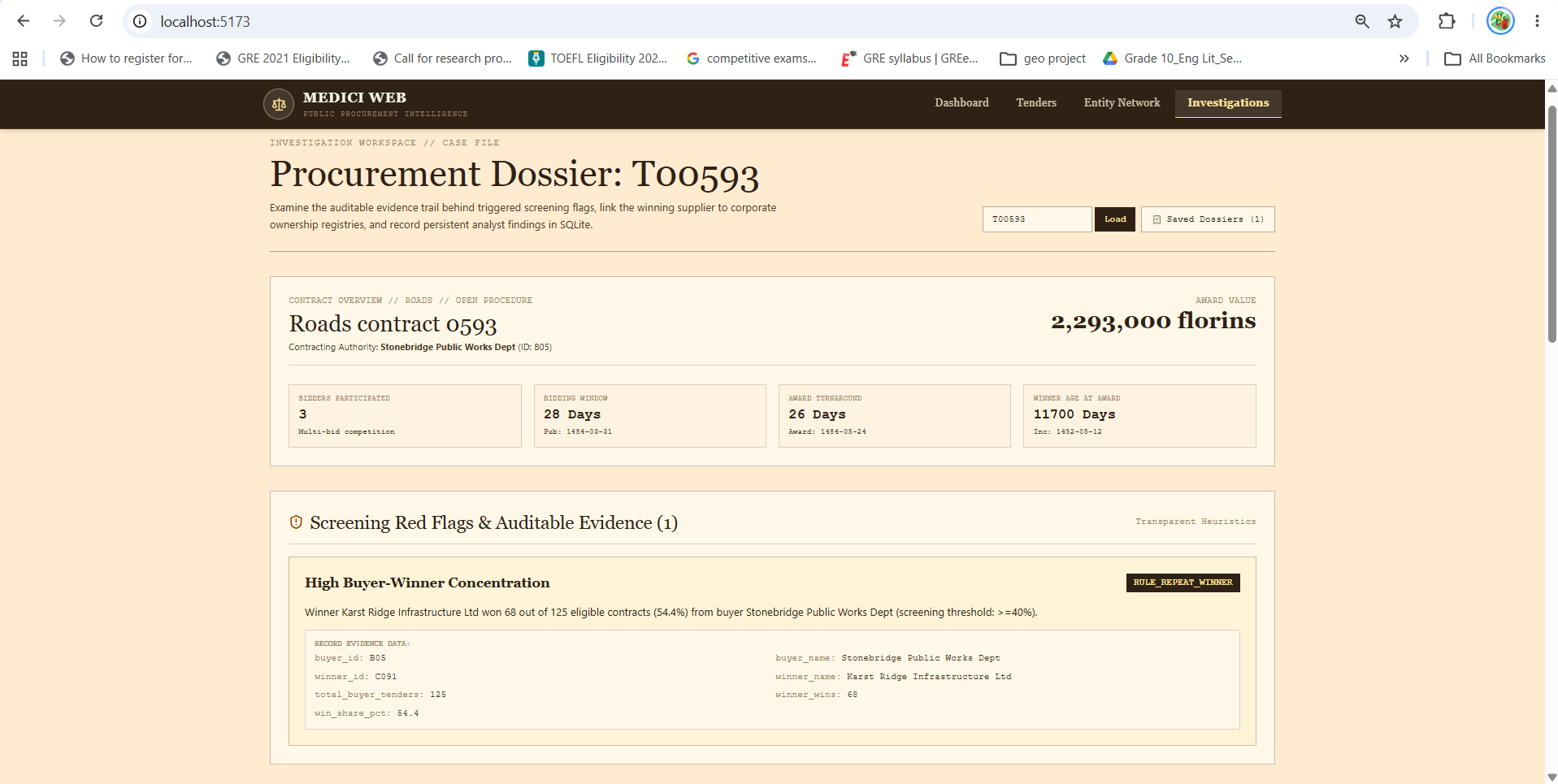
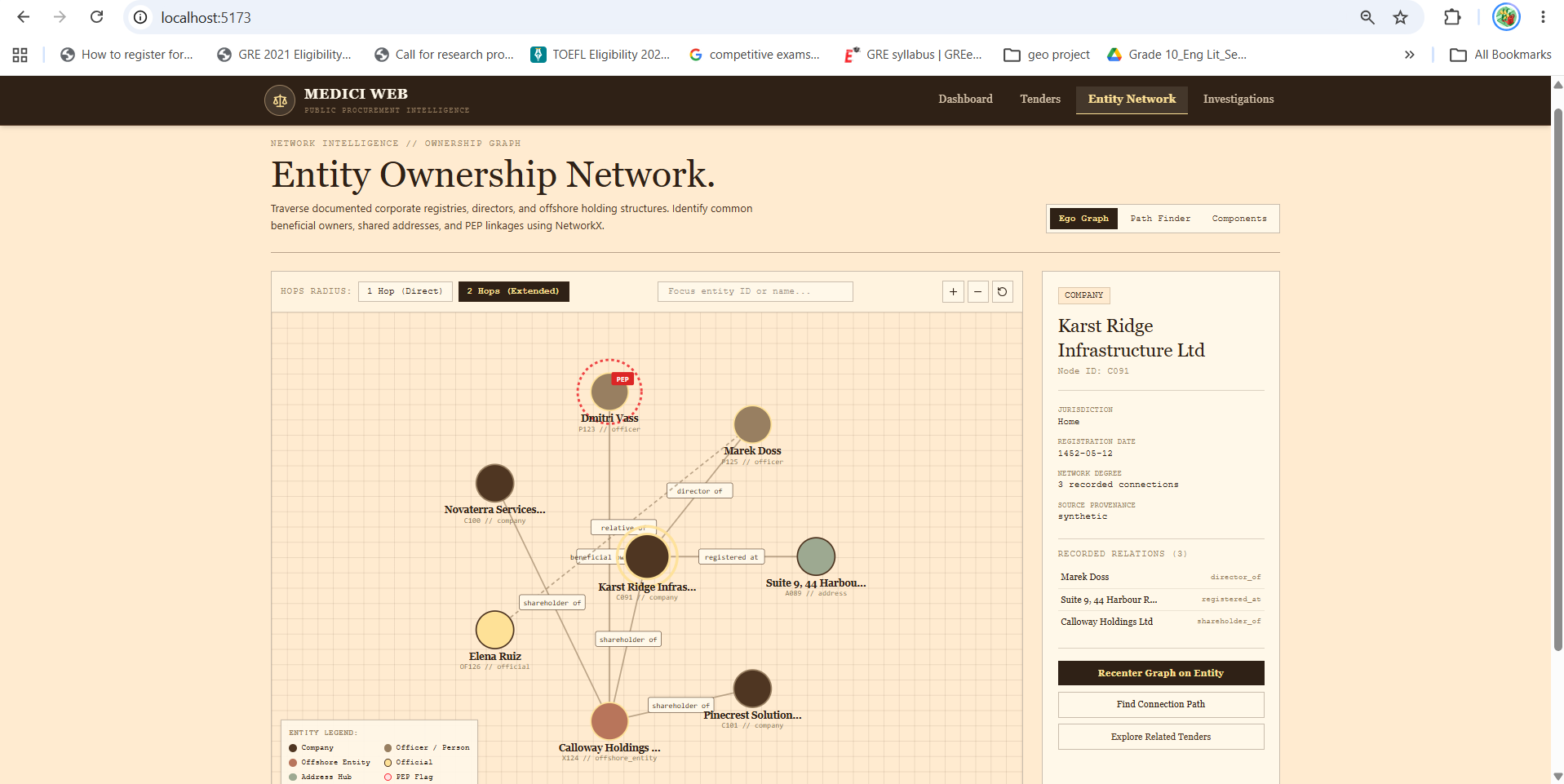
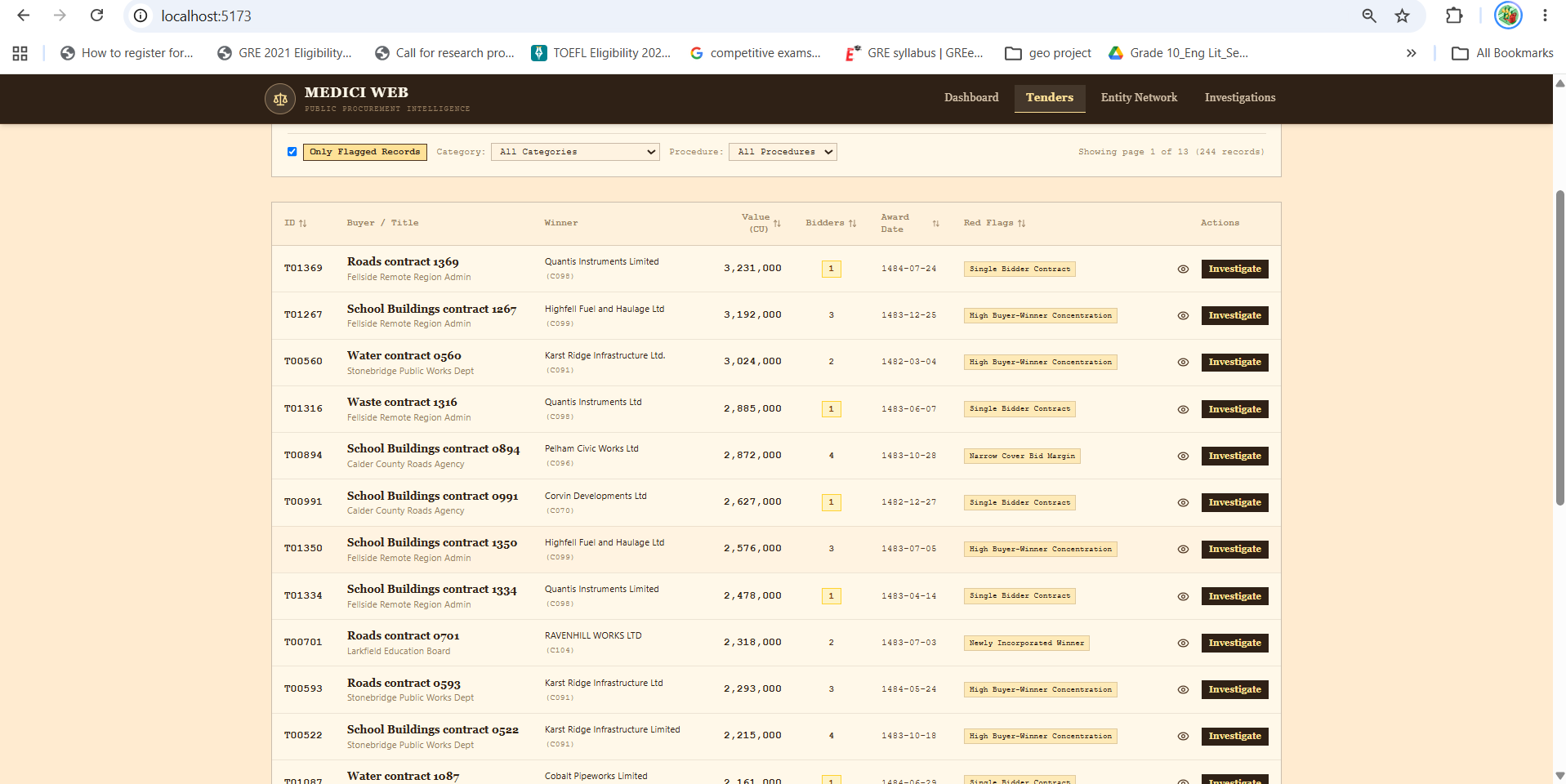
It uses explainable rules to identify procurement patterns that may warrant further scrutiny, such as single-bidder tenders and repeated award concentration. It then connects tender winners to recorded entity information and uses graph analysis to explore relationships between companies and other entities.
By bringing tender evidence, entity matching, and relationship networks into one investigation workflow, Medici Web aims to help investigators identify meaningful leads without manually piecing together disconnected records.
Our guiding principle is simple: a red flag should lead to evidence, not an accusation.
How we built it
We built Medici Web using React, TypeScript, Vite, and Tailwind CSS for the interface, with Python and FastAPI for backend processing.
Pandas supports structured tender-data processing, while NetworkX is used for modeling entity relationships and exploring graph structures such as connected components, neighboring entities, and paths between nodes.
Our approach prioritizes transparent, rule-based analysis rather than opaque predictions. Entity matching distinguishes identifier-based matches from uncertain name-based candidates, and the system is designed to preserve the evidence supporting its findings.
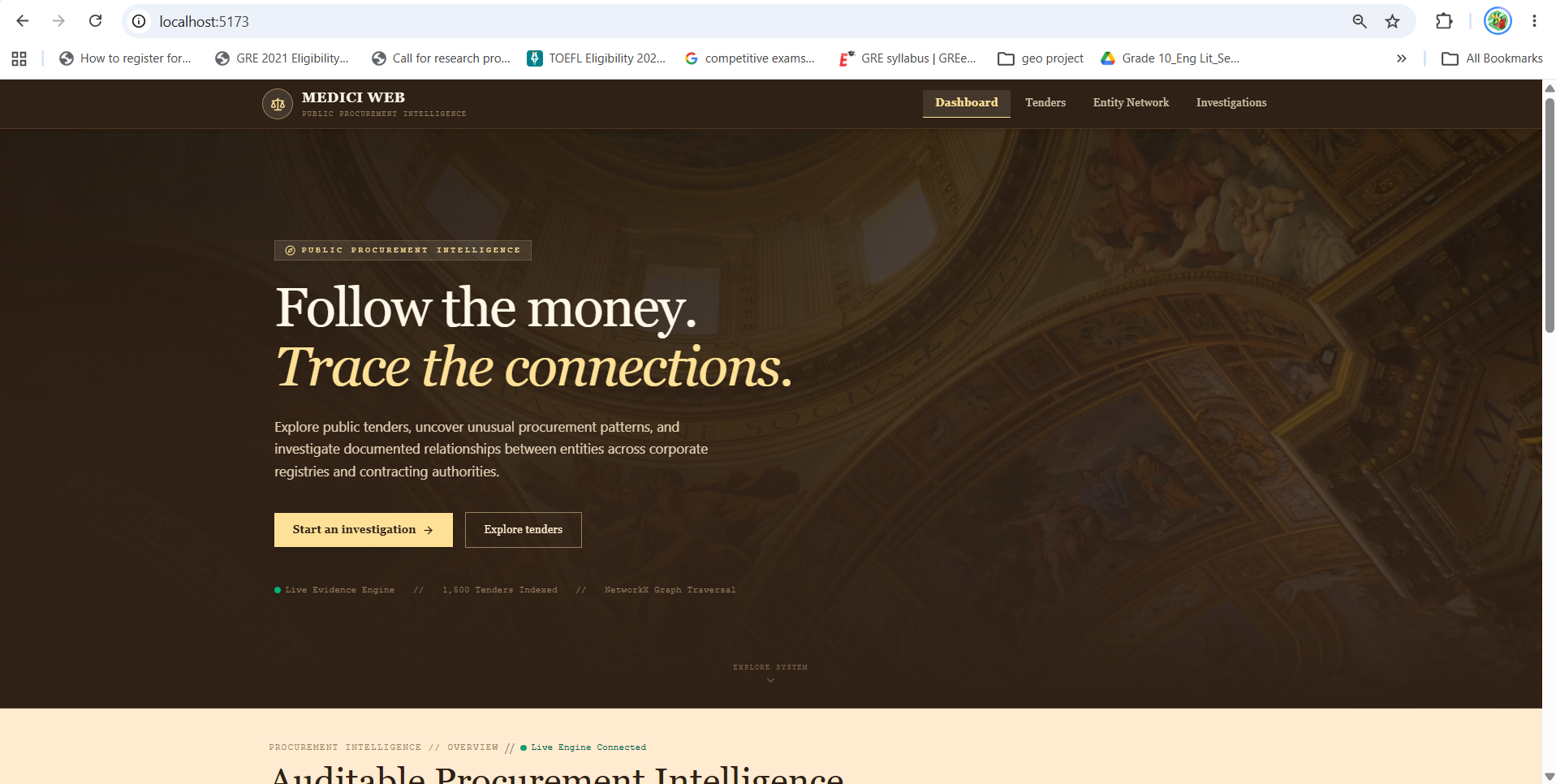
The visual identity draws from Renaissance Florence through parchment tones, dark walnut, muted gold, and an archival aesthetic, while presenting the analysis through a modern investigative interface.
Challenges we ran into
One of our central challenges was connecting two different forms of evidence: procurement anomalies and corporate relationships. A tender can appear unusual without any documented connection to other entities, while a company can have numerous relationships without anything suspicious occurring.
We also faced the challenge of matching tender winners to entity records when identifiers or names may be incomplete or ambiguous.
Another challenge was building a useful investigation experience without overstating what the data proves. We needed to distinguish recorded facts, calculated patterns, and possible leads, while avoiding false matches and unsupported conclusions.
Accomplishments that we're proud of
We established the foundation for an investigation platform that goes beyond displaying procurement statistics.
Medici Web brings together tender analysis, entity relationship exploration, and an evidence-led approach to investigation within a unified interface.
We are particularly proud of the project's core direction: connecting the question of what looks unusual with the question of what recorded relationships might help explain it.
The Renaissance-inspired identity also gives the platform a distinctive visual language that reflects its focus on wealth, institutions, and networks.
What we learned
We learned that detecting an anomaly is only the beginning of an investigation. A useful system must explain why a record was flagged, identify the supporting evidence, and help investigators determine what to examine next.
We also learned that graph connectivity does not automatically imply wrongdoing. Relationship types, source quality, identity verification, and context matter as much as the graph itself.
Most importantly, we learned to treat transparency as a core engineering requirement: every meaningful finding should be traceable to data, and uncertainty should be visible rather than hidden.
What's next for Medici Web
Our next step is to strengthen the automated investigation engine so it can analyze the available datasets, cross-reference tender flags with verified entity relationships, and generate ranked investigation leads with transparent explanations.
We aim to expand data-quality checks, improve entity resolution, support richer graph queries, and produce structured investigation reports that show the underlying tender evidence and recorded relationship paths.
Longer term, we envision Medici Web as a tool for journalists, auditors, researchers, and oversight organizations seeking to make public procurement easier to scrutinize.
Follow the money. Trace the connections. Let the evidence speak.
