-
-
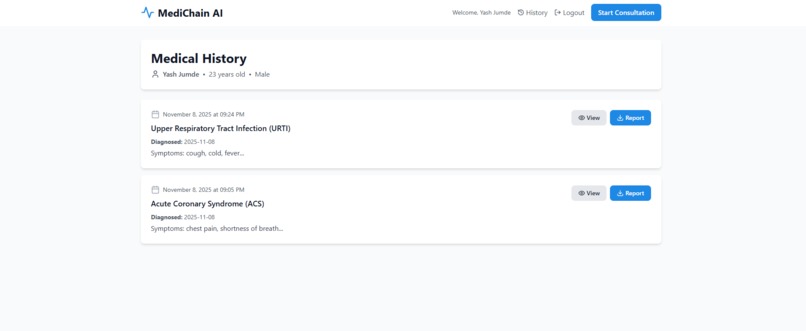
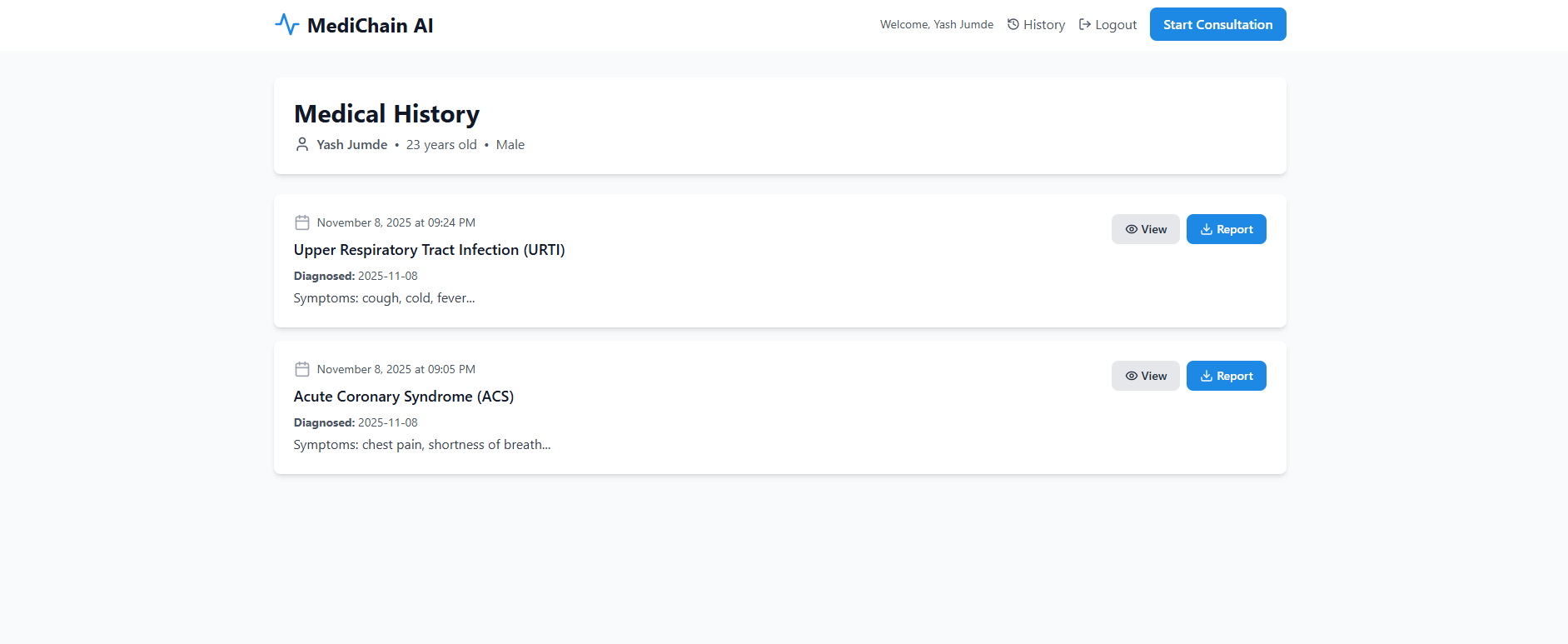
History of the patient
-
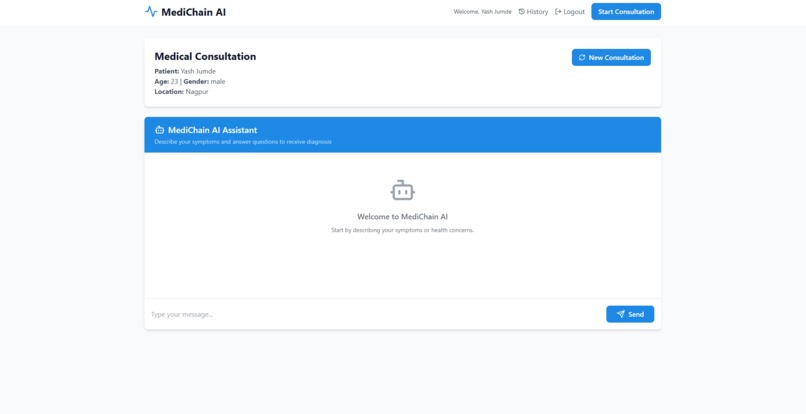
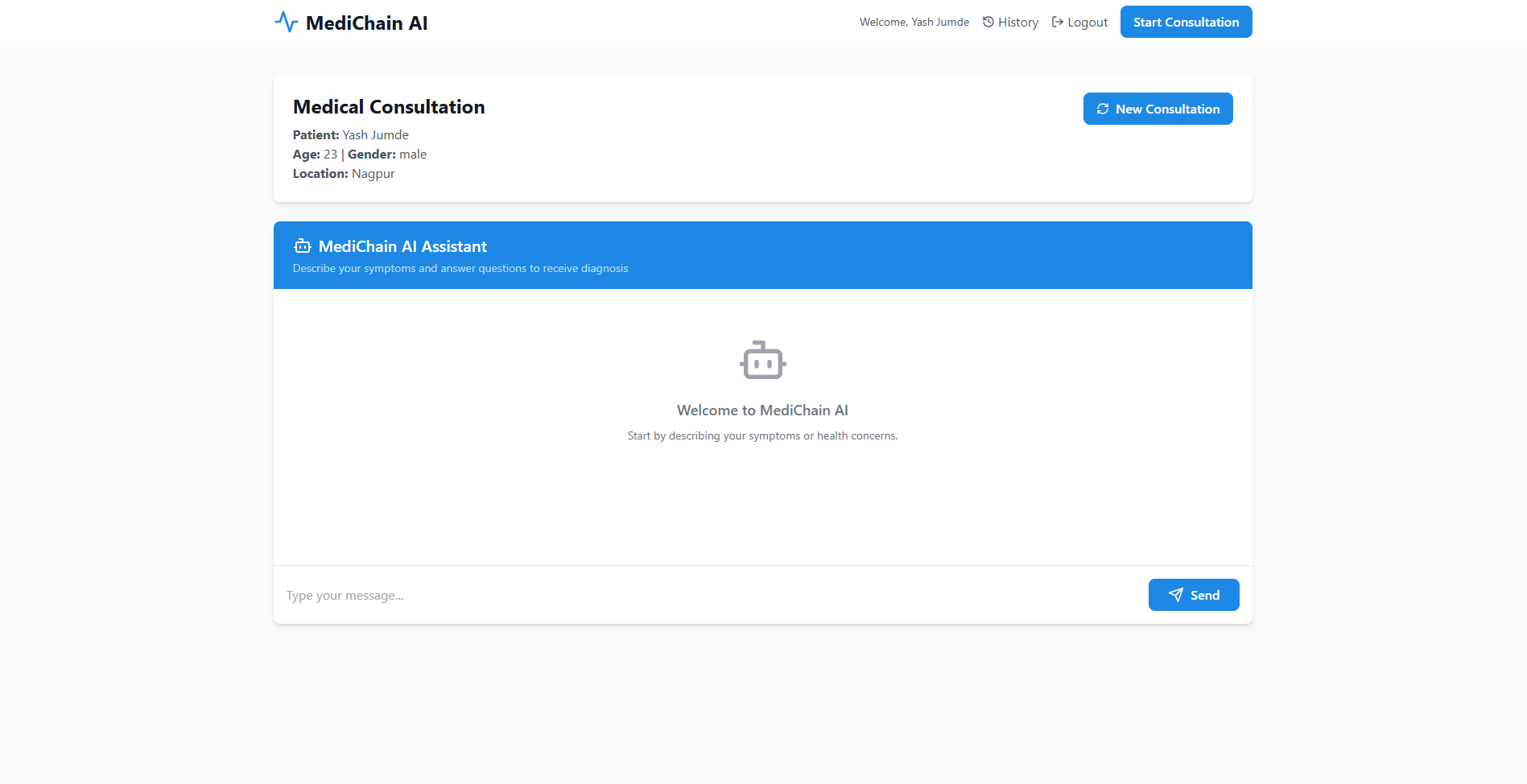
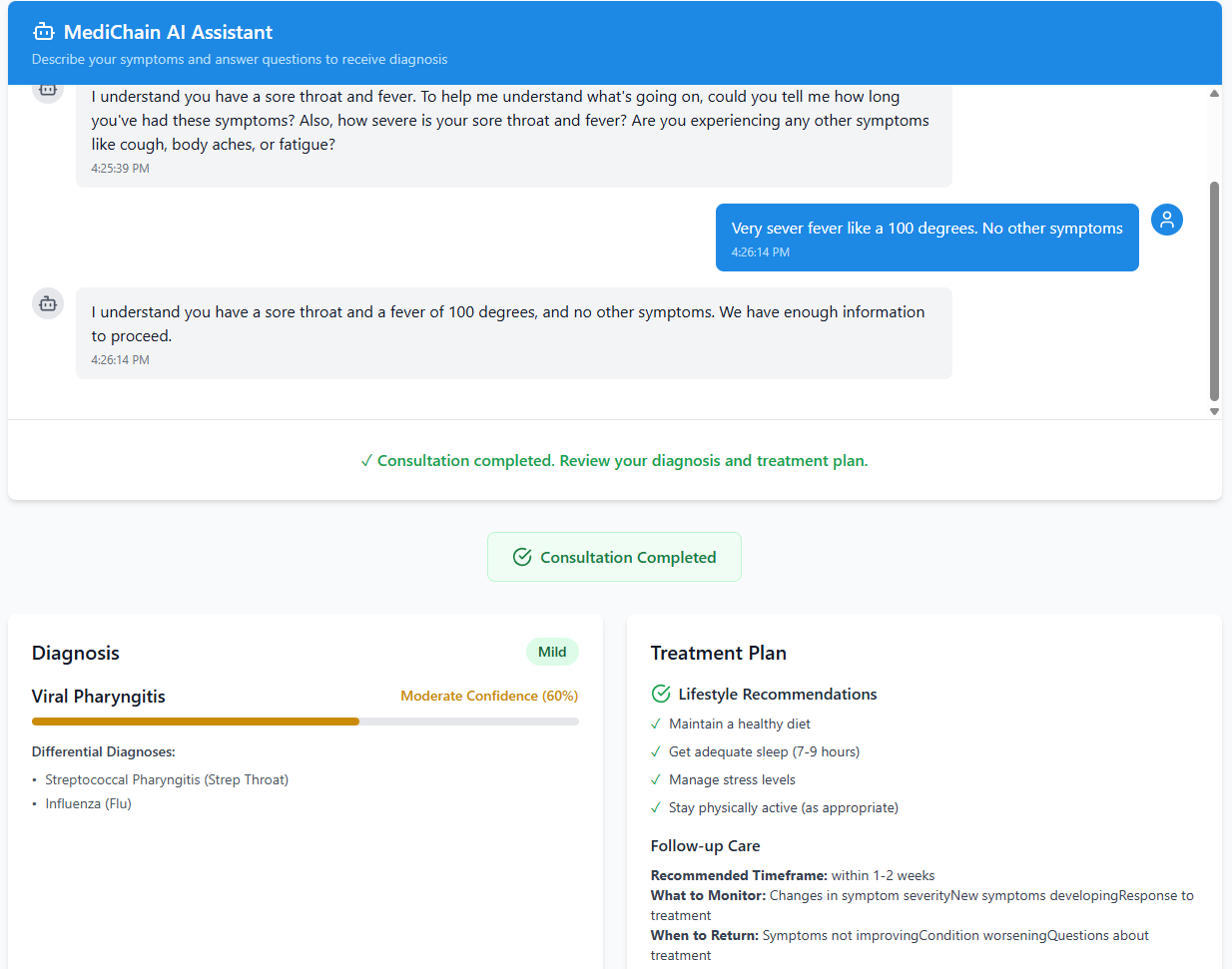
Chat/consultation page
-
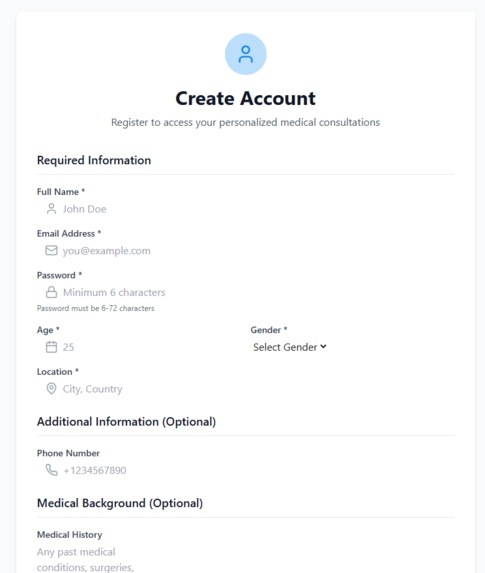
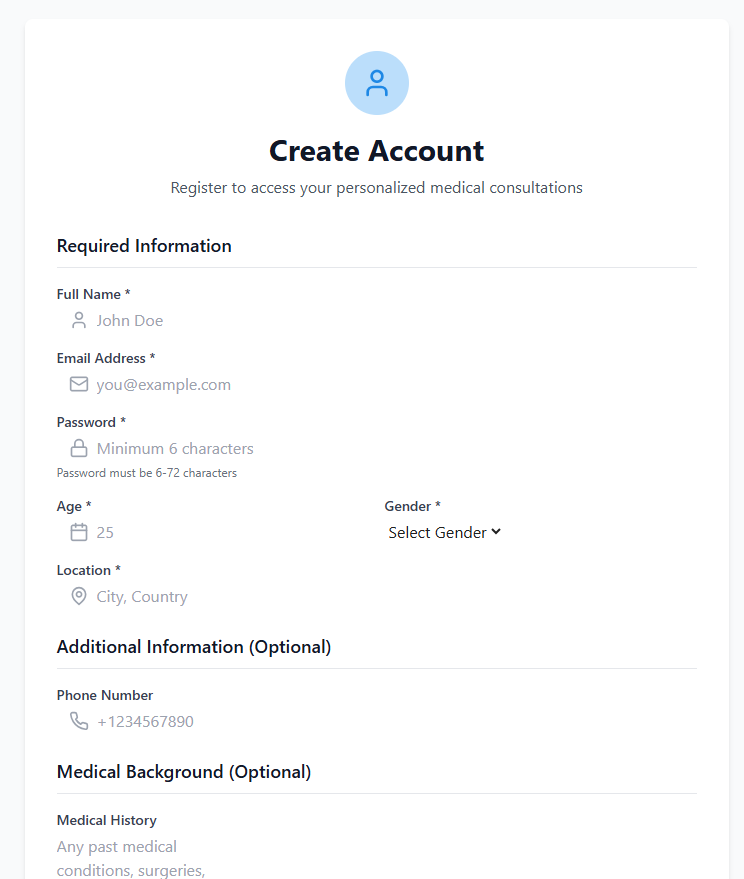
regiser new user page
-
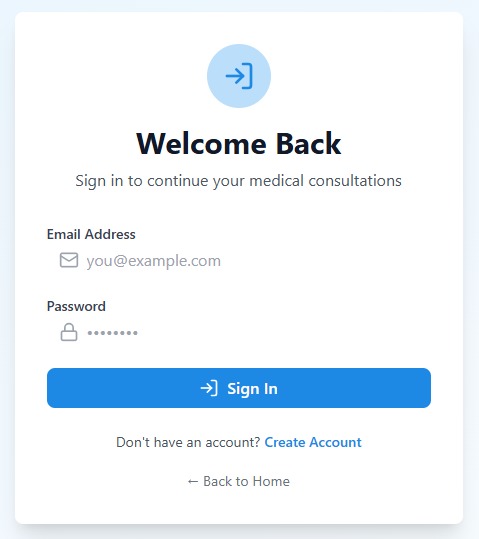
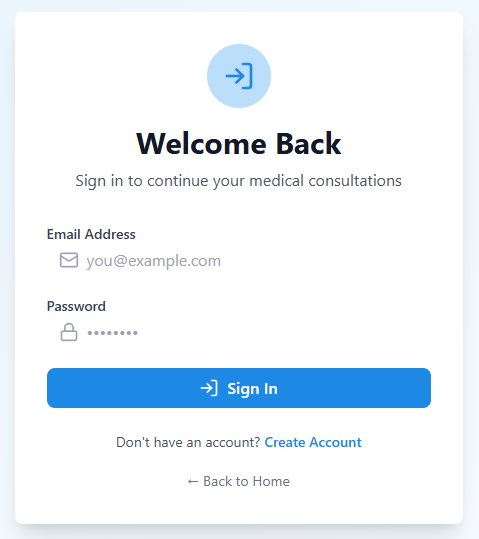
sign in page
-
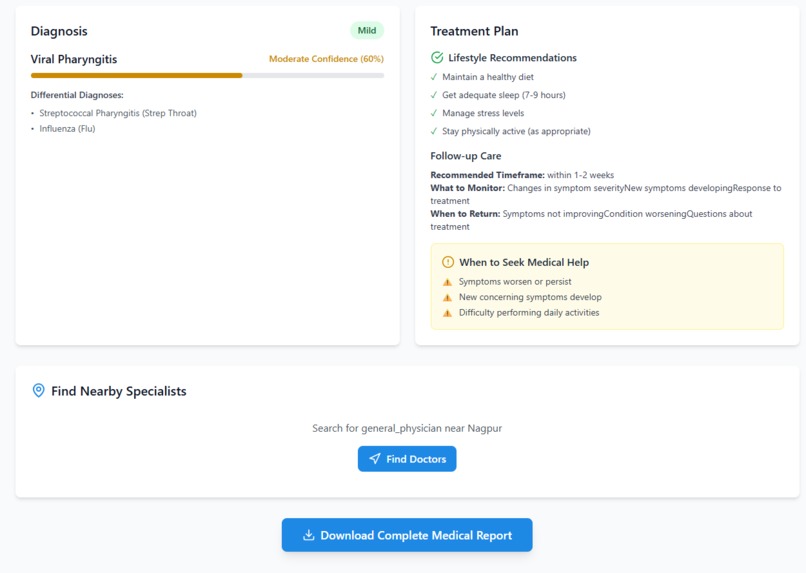
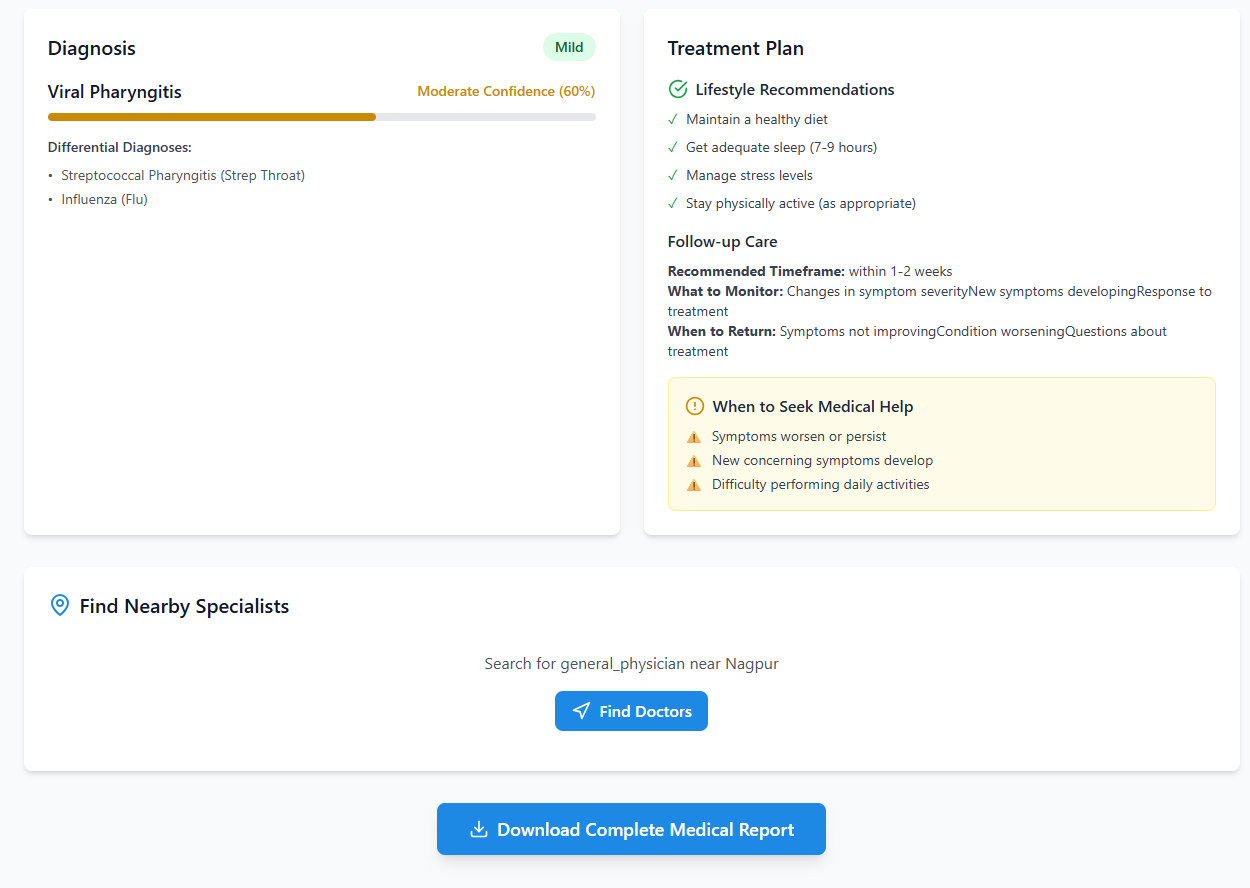
After chat/consultation diagnoses and recommendations
-
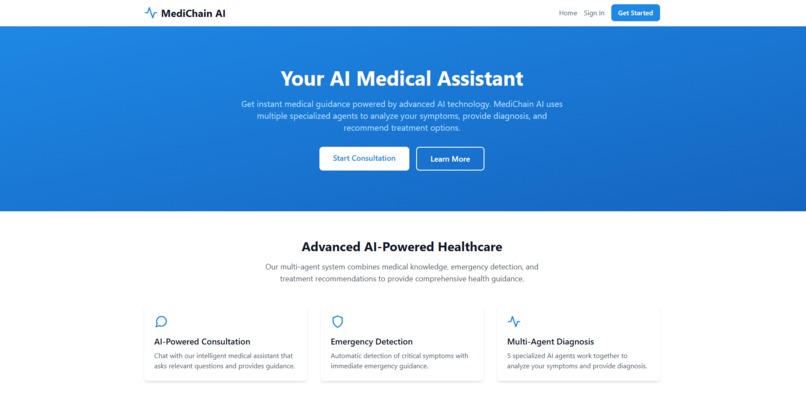
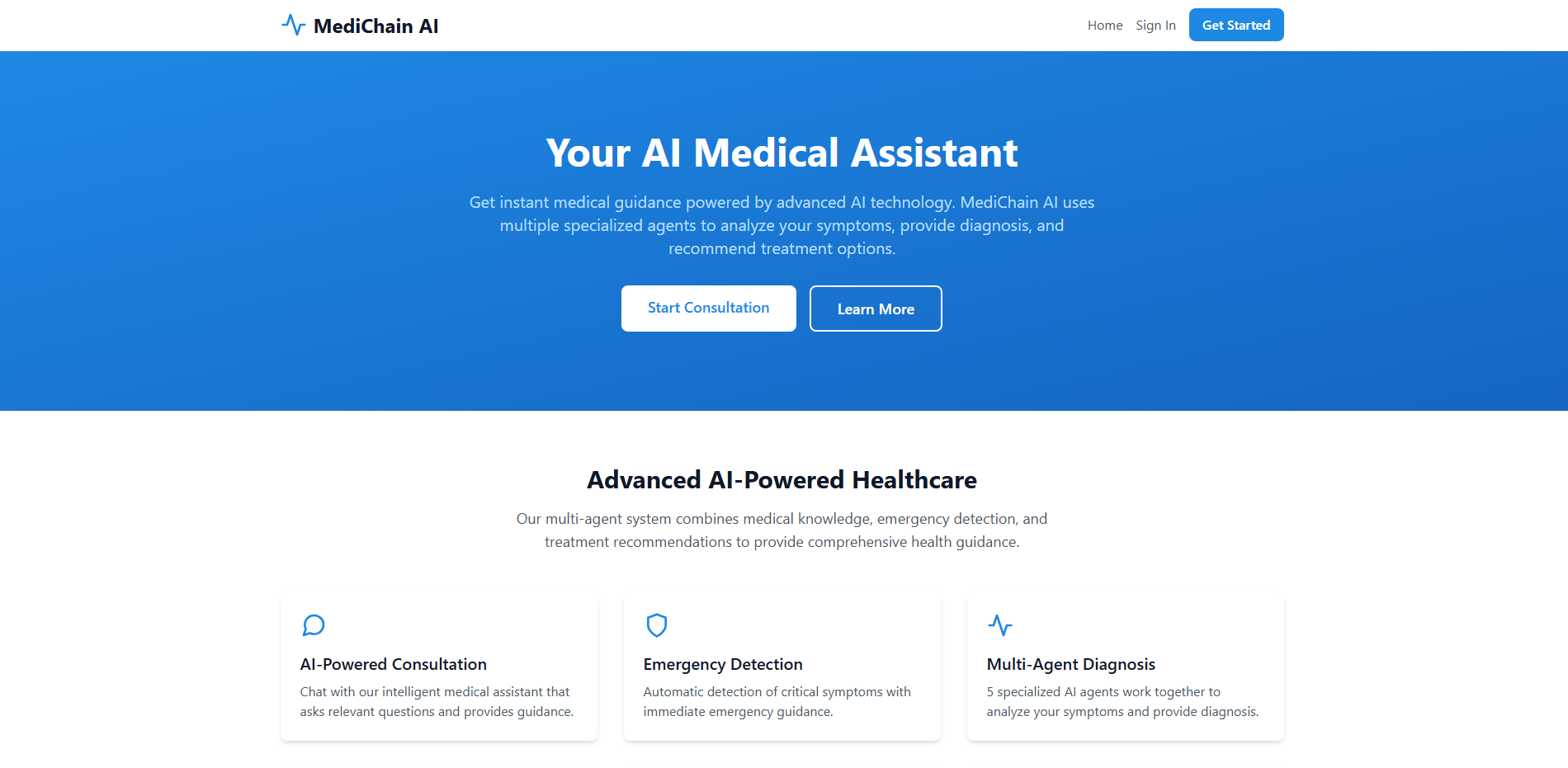
Landing page
-
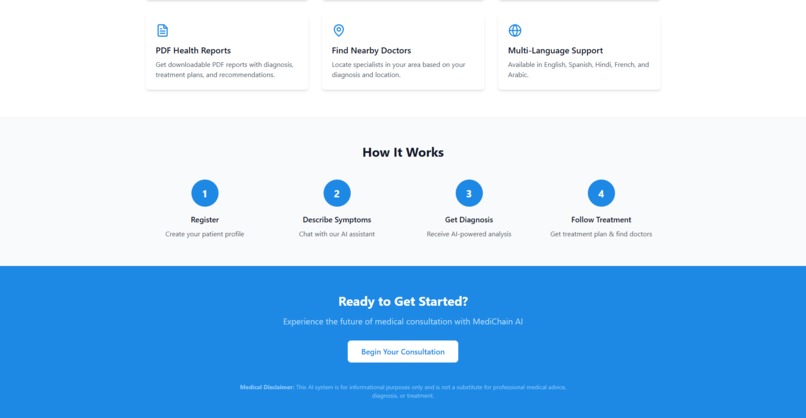
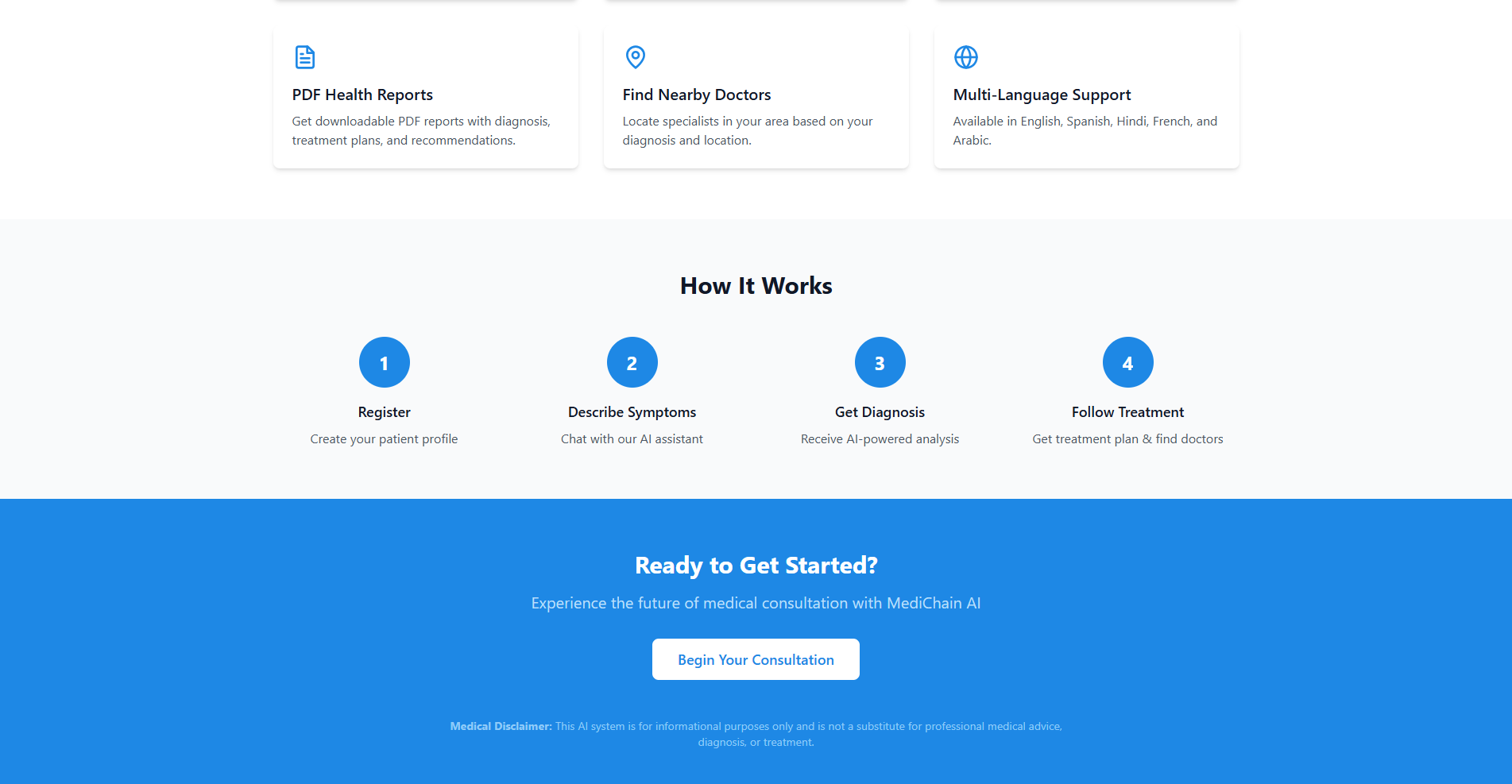
Landing page - 2
-
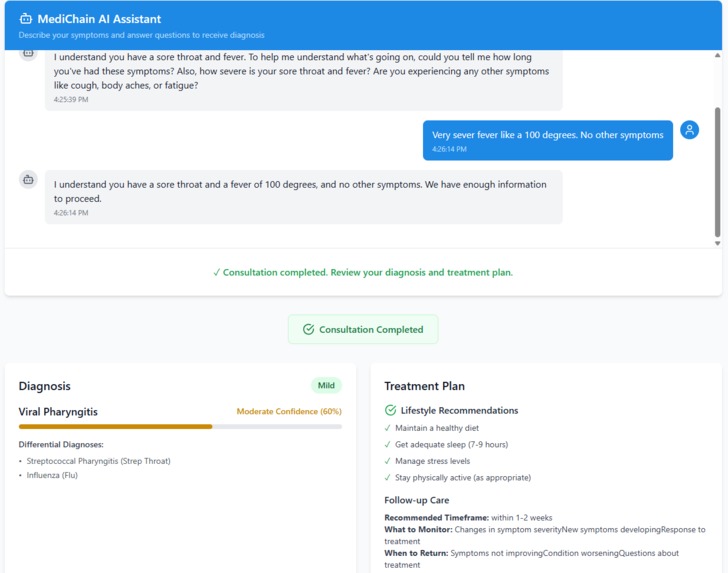
After chat/consultation diagnoses
-
MediChain AI: Building a Multi-Agent Healthcare Consultation System The Spark The inspiration for MediChain AI came from a deeply personal experience. During a late-night medical emergency with a family member, I found myself desperately searching for medical guidance, only to realize that quality healthcare advice was neither accessible nor affordable when we needed it most. The nearest clinic was closed, telehealth services were expensive, and online symptom checkers provided generic, often contradictory information that only heightened our anxiety.
This experience exposed a fundamental problem: millions of people worldwide face barriers to healthcare access—whether due to geography, cost, language, or simply the constraints of traditional clinic hours. I became fixated on a question: could artificial intelligence bridge this gap? Not by replacing doctors, but by providing intelligent, preliminary guidance that could help people understand their symptoms, recognize emergencies, and make informed decisions about seeking care?
The Vision I envisioned a system that would simulate a comprehensive medical consultation through specialized AI agents, each handling a distinct aspect of healthcare delivery. The goal was ambitious: create an intelligent platform that could conduct patient interviews, research medical conditions, formulate differential diagnoses, recommend evidence-based treatments, and identify when specialist referral was necessary—all while maintaining the empathy and thoroughness of a human healthcare provider.
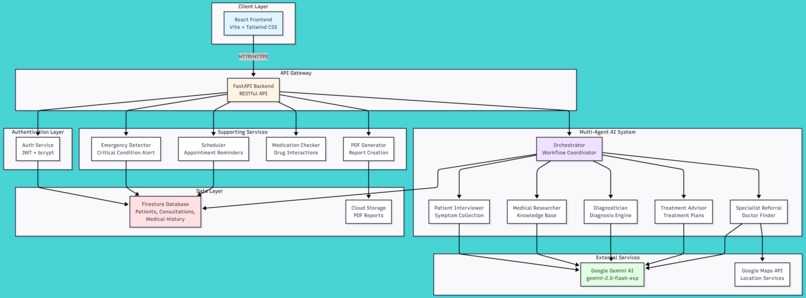
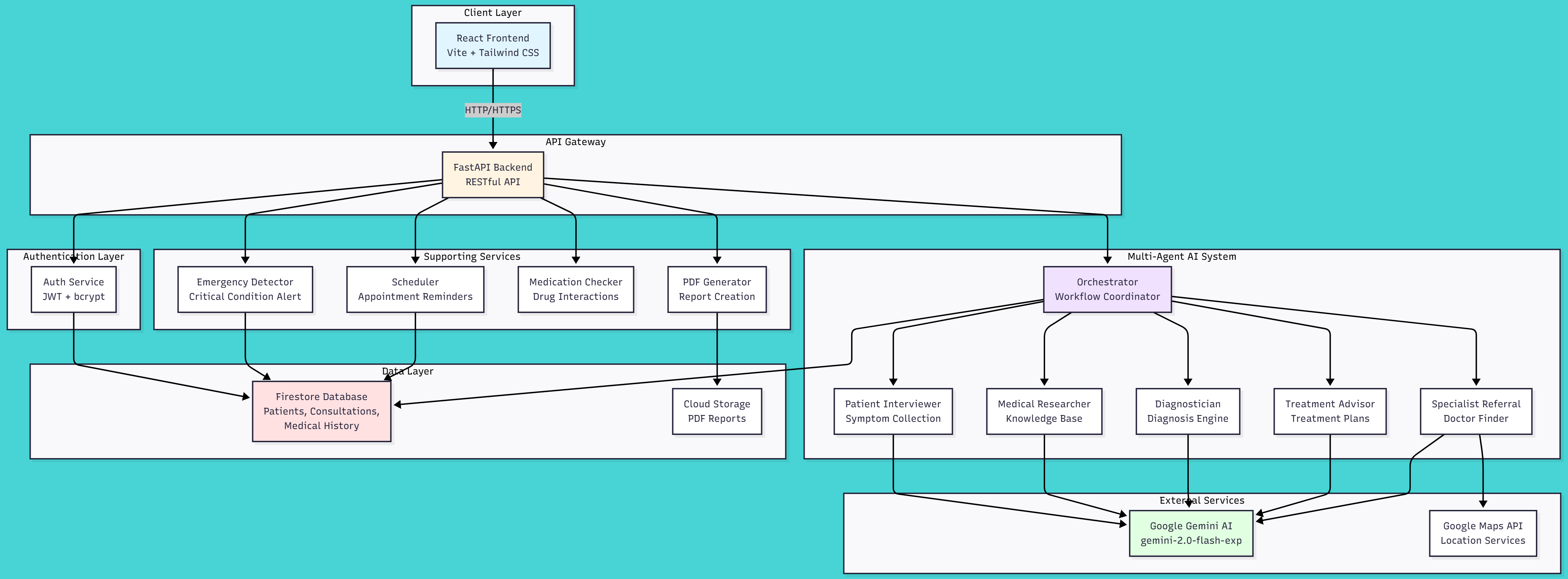
The Architecture Building MediChain AI required architecting a sophisticated multi-agent system, a decision that proved both challenging and rewarding. I chose to implement five specialized agents, each powered by Google's Gemini AI model:
The Patient Interviewer conducts the initial symptom assessment through natural conversation, asking contextually relevant follow-up questions based on patient responses. This agent needed to balance thoroughness with efficiency, extracting critical information without overwhelming users.
The Medical Researcher analyzes symptoms against medical databases and research, providing the knowledge foundation for diagnosis. I designed this agent to consider not just common conditions but also rare diseases that might present with similar symptoms.
The Diagnostician synthesizes information from previous agents to formulate differential diagnoses with confidence levels. This was perhaps the most technically challenging component, as it required implementing probabilistic reasoning and ensuring the AI acknowledged uncertainty rather than presenting false confidence.
The Treatment Advisor generates personalized treatment plans, including medication recommendations, lifestyle modifications, and self-care instructions. I incorporated medication interaction checking to ensure safety recommendations.
The Specialist Referral agent determines when professional medical intervention is necessary and uses Google Maps API to locate nearby healthcare providers, considering specialty requirements and geographic proximity.
An Orchestrator coordinates these agents, managing the consultation workflow and ensuring seamless information flow between components. This centralized coordination proved essential for maintaining context and preventing redundant queries to the AI model.
Technical Foundation I built the backend using FastAPI for its native async support and automatic API documentation generation. Python's async/await patterns were crucial for managing multiple AI agent calls without blocking operations. The frontend leveraged React with Vite for fast development iterations and Tailwind CSS for responsive design that works across devices.
Google Cloud Firestore served as the database, chosen for its real-time capabilities and seamless integration with Google Cloud's ecosystem. I structured the data model around patients, consultations, and medical history, with careful consideration for query patterns to avoid expensive composite indexes.
Authentication presented an interesting challenge. I initially implemented JWT tokens using passlib for password hashing, but encountered cryptic compatibility issues between passlib and bcrypt versions. After hours of debugging initialization errors, I made the pragmatic decision to use bcrypt directly, bypassing passlib's abstraction layer. This taught me an important lesson: sometimes simpler is better, and additional abstraction layers can introduce unexpected failure modes.
Challenges and Breakthroughs The most significant technical challenge involved managing Firestore queries efficiently. My initial implementation used composite indexes for filtering and sorting medical history, but creating and managing these indexes proved cumbersome. I realized I could achieve the same functionality by filtering on a single field and sorting in memory with Python's built-in sorting. For the relatively small datasets typical in individual patient histories, this approach was both simpler and more maintainable.
Handling emergency detection required careful prompt engineering. I needed the system to identify life-threatening conditions without triggering false alarms that would erode user trust. I developed a keyword-based detection system augmented by AI analysis of symptom context, finding that this hybrid approach balanced sensitivity and specificity effectively.
The multi-agent orchestration presented coordination challenges. Initially, I attempted to run agents in parallel, but this led to context confusion where agents made assumptions based on incomplete information. I restructured the system to run agents sequentially with explicit context passing, sacrificing some performance for reliability and coherence.
Deploying to Google Cloud Run introduced new complexities. The containerization process required careful attention to dependencies, particularly native extensions like bcrypt that needed compilation. I learned to leverage multi-stage Docker builds and to respect Cloud Run's specific requirements around port configuration and authentication handling.
Personal Growth This project fundamentally changed my understanding of AI systems in healthcare. I entered with naive optimism about AI's capabilities and emerged with nuanced appreciation for both its potential and limitations. AI excels at pattern recognition, information synthesis, and conversational interaction, but it lacks the clinical judgment that comes from years of medical training and experience.
I learned that responsible AI development in healthcare requires constant acknowledgment of uncertainty and clear communication of limitations. Every response includes disclaimers, every diagnosis is presented as differential rather than definitive, and emergency detection always errs on the side of caution. The technology should empower users, not create false confidence.
The experience also deepened my appreciation for prompt engineering as a discipline. Crafting effective prompts for medical AI agents required understanding not just technical AI capabilities but also medical reasoning, clinical workflows, and patient psychology. Each agent's system prompt went through dozens of iterations, balancing specificity with flexibility.
Reflections and Future Directions Building MediChain AI taught me that effective healthcare AI isn't about replacing human expertise—it's about augmenting human capabilities and democratizing access to preliminary medical guidance. The system succeeds when it helps users understand their symptoms well enough to make informed decisions about seeking care.
If I had more time, I would enhance several aspects of the system. Integration with electronic health records would provide agents with complete patient histories, enabling more personalized recommendations. Incorporating medical imaging analysis would expand diagnostic capabilities beyond symptom-based reasoning. Implementing multi-language support more comprehensively would increase accessibility for non-English speakers.
I would also invest in more rigorous validation, potentially partnering with healthcare professionals to evaluate diagnostic accuracy and treatment recommendations against clinical standards. Machine learning models for predicting patient outcomes based on historical consultation data could help identify high-risk cases requiring urgent attention.
The medication interaction checker could be enhanced with real-time pharmaceutical database integration, ensuring recommendations reflect the latest drug safety information. Telemedicine integration would enable seamless handoff to human providers when the AI determines professional intervention is necessary.
Perhaps most importantly, I would focus on making the system more explainable. Users should understand not just what the AI recommends, but why—the reasoning process, the evidence considered, and the confidence levels behind each conclusion. Explainability builds trust, and trust is essential in healthcare.
Conclusion MediChain AI represents my attempt to address a fundamental inequity in healthcare access using modern AI technology. The journey from concept to deployment taught me as much about the human aspects of healthcare—empathy, uncertainty, trust—as it did about technical implementation. The project succeeds not because it replaces doctors, but because it empowers patients to navigate their health concerns more effectively.
The experience reinforced a lesson applicable far beyond this project: the most impactful technology isn't always the most sophisticated. Sometimes, the greatest value comes from making existing capabilities more accessible, more understandable, and more aligned with real human needs. MediChain AI aims to do exactly that—bringing quality preliminary medical guidance to anyone with an internet connection, regardless of time, location, or economic circumstances.
Built With
- axios
- cloudrun
- css3
- docker
- fastapi
- firestore
- gemini
- google-maps
- html5
- javascript
- postcss
- python
- react
- tailwind
- vite

Log in or sign up for Devpost to join the conversation.