-
-

Banner.png
-

Logo
-
Thumbnail
-
social-card
-

Data flow



SmartDocFlow: AI-Powered Intelligent Document Processing
🌟 Inspiration
The inspiration for SmartDocFlow came from a recurring problem: dealing with unstructured documents spread across multiple formats. From research papers in PDF, scanned invoices as images, to plain text reports, valuable insights were hidden but not easily retrievable. Traditional keyword search often failed to capture semantic meaning, leading to wasted time.
I wanted to build a platform that not only ingests and organizes documents but also understands their context, performs multi-step AI analysis, and finally triggers actions automatically—turning static data into actionable intelligence.
📚 What I Learned
- The importance of vector databases like TiDB Serverless for semantic search.
- How to design multi-step AI workflows that combine extraction, analysis, and automation.
- Using Large Language Models (LLMs) for summarization, entity recognition, and reasoning across documents.
- Integrating AI workflows with external APIs to connect insights with real-world productivity tools.
- Challenges of OCR accuracy when processing images and scanned PDFs.
- Optimizing embedding storage for high recall in similarity search.
💡 Key takeaway: AI-powered document processing is not just about information retrieval—it’s about enabling knowledge-driven workflows.
⚙️ How I Built It
The project follows a modular, pipeline-based architecture:
🔹 Ingest & Index
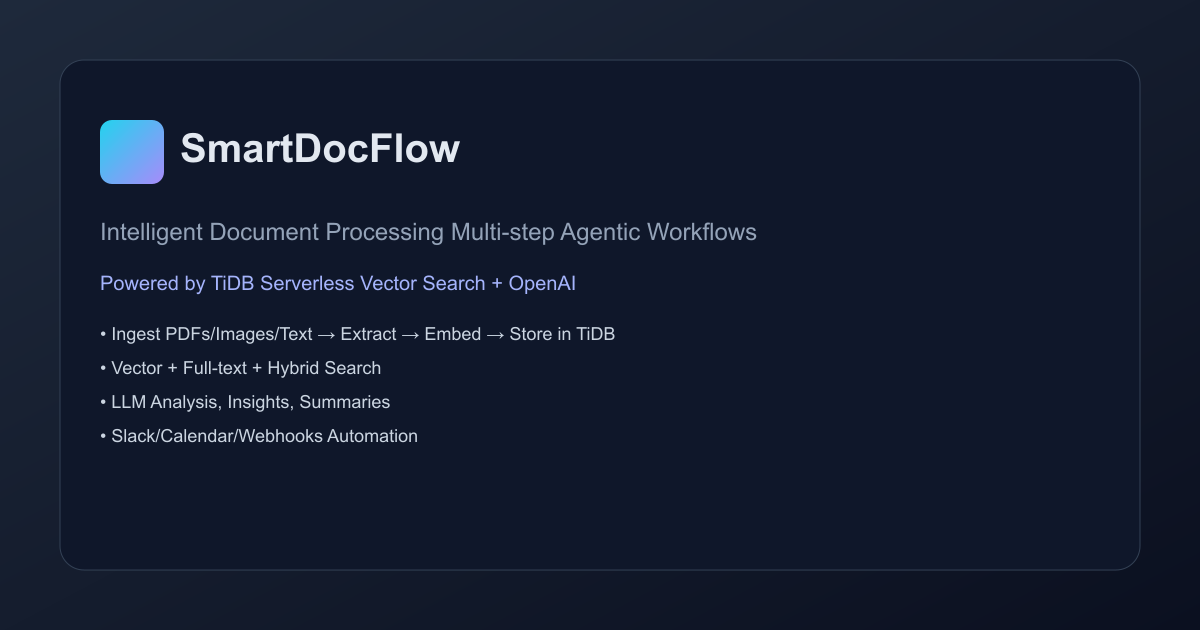
- Upload documents (PDFs, images, text files).
- Use OCR for scanned files.
- Extract raw text, generate embeddings using an LLM embedding model.
- Store embeddings + metadata in TiDB Serverless.
🔹 Search & Analyze
- Perform vector similarity search to find related documents.
- Use full-text search for keyword queries.
- Enable semantic clustering to group related knowledge.
🔹 LLM Processing
Apply GPT-based workflows for:
- Summarization
- Key information extraction
- Question answering
- Pattern discovery
For example, given a dataset of invoices, the system automatically computes statistics like:
$$ \text{Total Spend} = \sum_{i=1}^n \text{Invoice Amount}_i $$
🔹 External Actions
- Send notifications (Slack/email) for critical findings.
- Create tasks in Google Calendar / Trello for deadlines.
- Push structured data into connected database

Log in or sign up for Devpost to join the conversation.