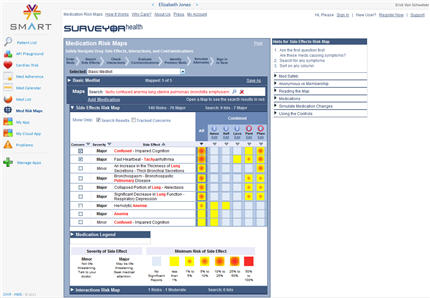
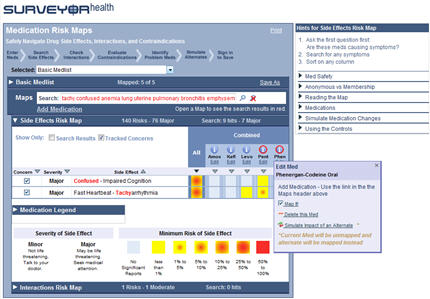
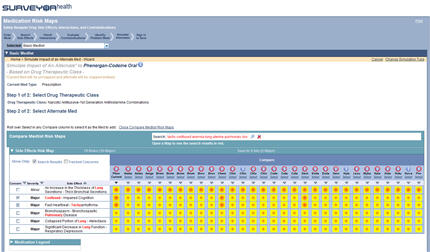
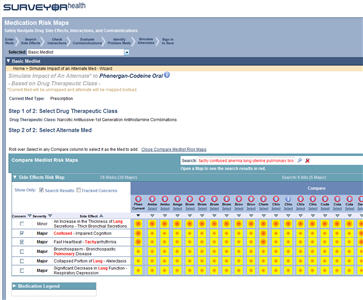
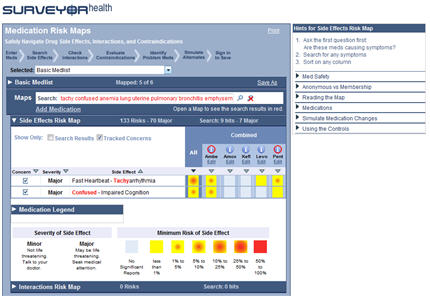
SURVEYOR Health Corporation (www.surveyorhealth.com ) has integrated its Medication Risk Maps cloud app into the SMArt Apps EMR container. Medication Risk Maps goes far beyond drug interaction checkers by making the evidence actionable at the point of care to identify and manage the risks of Adverse Drug Events and, critically, their trade-offs. Adverse drug events are believed to be responsible for as many as 4,000 deaths in the US each week and between $177 and $359 Billion each year in ER visits, additional and extended hospitalizations, diagnostics and prescription cascades. For the challenge we’ve integrated meds with the SMART container; in actual production deployments we also integrate problem lists, presenting symptoms and chief complaints. Applying data from First DataBank, Medication Risk Maps reveals at a glance the correlation between a patient’s presenting symptoms, chief complaints and past medical history on the one hand and the risks posed by their medication regimen on the other. These risks arise from interactions and contraindications but also from additive toxicities that Medication Risk Maps uniquely evaluates; drug interaction checkers do not. Also identified at a glance are the primary and secondary risk factors – the meds that pose the greatest risk of the patient’s symptoms and problems. But SURVEYOR Health believes it’s important to do more than a better job flagging potential adverse drug events and generating more alerts – it’s important to help resolve those events and the risks behind them. Medication Risk Maps enables the user to play “what if?” analyses, supporting the evaluation of changes of prescription In Silico before trying a change on the patient In Vivo. Altogether, Medication Risk Maps helps identify, diagnose and resolve adverse drug event risks, and does so in all major browsers, the iPad and the iPhone. Try it out with sample patient Elizabeth Jones and search on her presenting symptoms of "tachy cardia and confused", find the highest risk contributor to her symptoms and try finding an alternate med that poses lower risk of her symptoms. SURVEYOR Health recognizes the importance of 1) visually embedding new application functionality within existing and new HIT to minimize impact on existing clinical workflows, and 2) supporting data interoperability using RDF with its unambiguous designation of resources, dynamic schema, ability to cross industry standards, e.g., CCR and CCD and multiple coding systems and support additional logical constraints, e.g., via OWL. (Note to iPad and iPhone users: when integrated in the SMART container please configure your mobile Safari browser to accept all cookies.) Contributors to this effort include Linda Von Schweber, Erick Von Schweber, Shawn Kessler and Patrick Mebine, all of SURVEYOR Health.
Medication Risk Maps for SMArt
Updates

Leave feedback in the comments!
Log in or sign up for Devpost to join the conversation.