-
-
Project intro
-
Demo Page - FindCare
-
Demo Page - Hospitals
-
Demo Page - Cost Estimation
Inspiration
Access to quality healthcare can depend heavily on where a patient lives. In Singapore, advanced treatment is widely available, but private medical care can be prohibitively expensive. In Indonesia, patients may face uneven access to specialist expertise, modern medical equipment, and internationally oriented hospital services. Long appointment or treatment waiting times can add further stress, especially when care is urgent.
China presents a compelling alternative. Its leading hospitals offer advanced medical technology, experienced specialists, and a broad range of treatments at costs that can be more competitive than Singapore and other major medical destinations. China’s transport infrastructure and growing international patient services also make it possible to combine treatment, recovery, and travel in one journey.
We created MedTour AI to make this opportunity easier to navigate. Instead of leaving patients to compare unfamiliar hospitals, prices, insurance requirements, and travel logistics on their own, the platform turns their needs into a practical, personalized medical-tour plan for China.
What it does
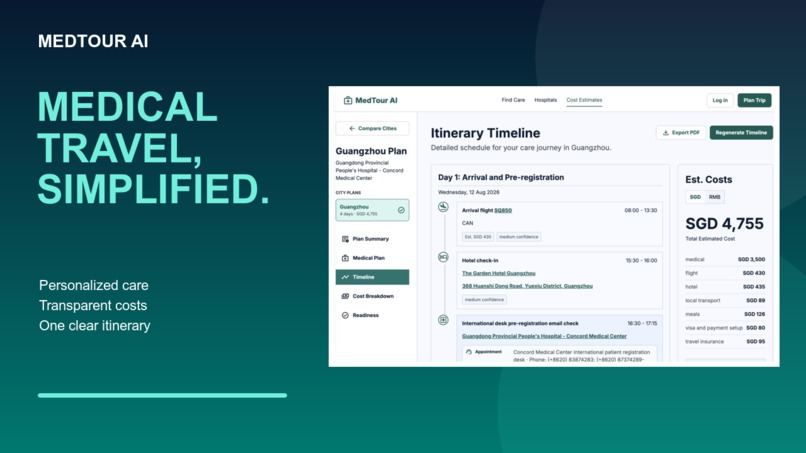
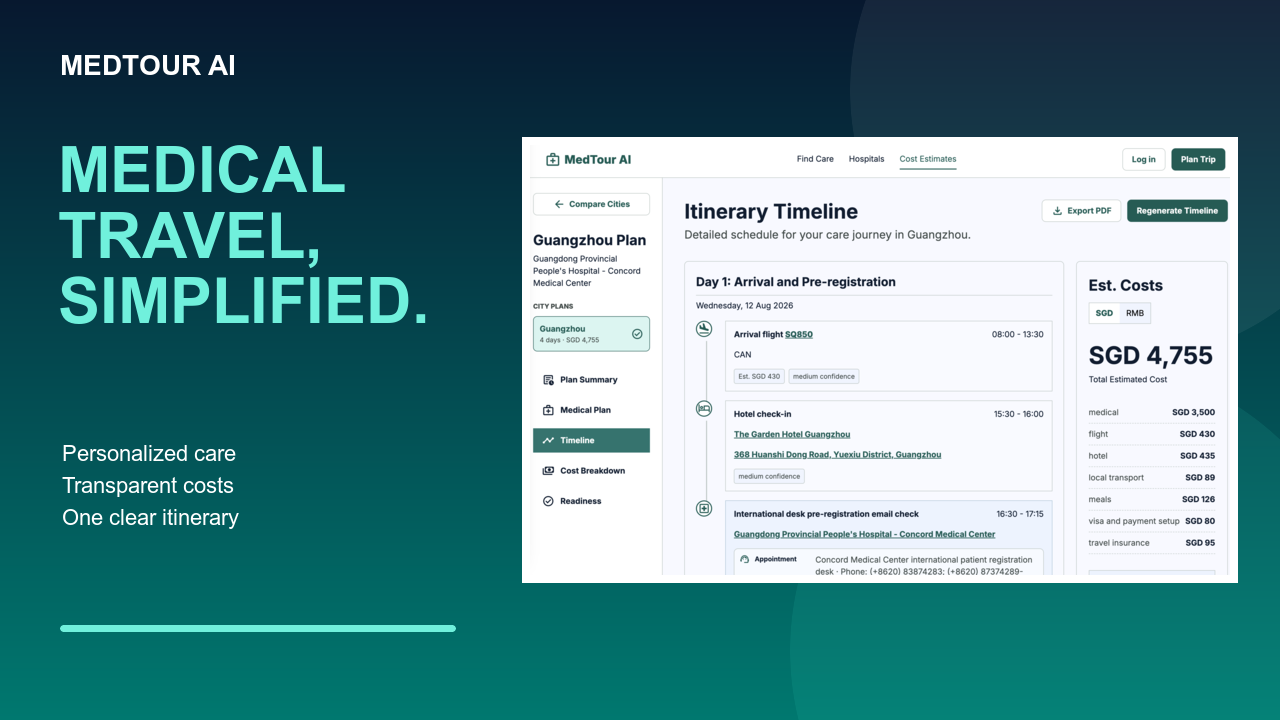
MedTour AI helps international patients plan an end-to-end medical journey to China.
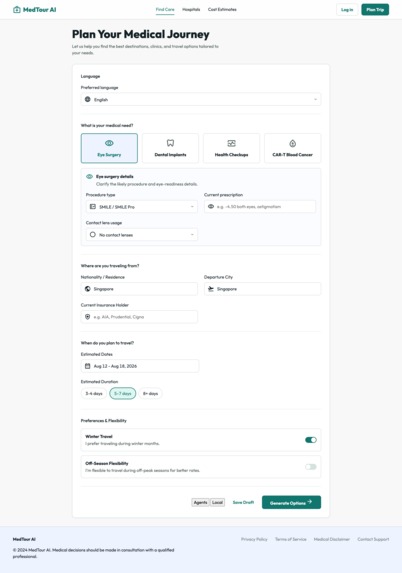
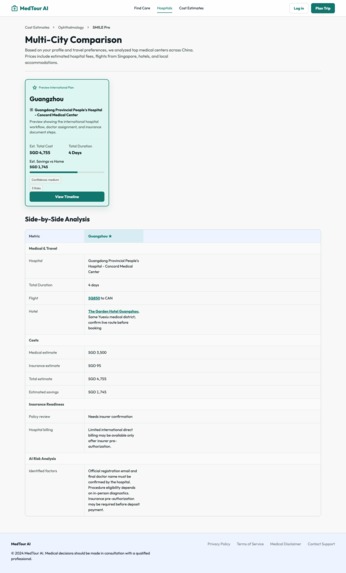
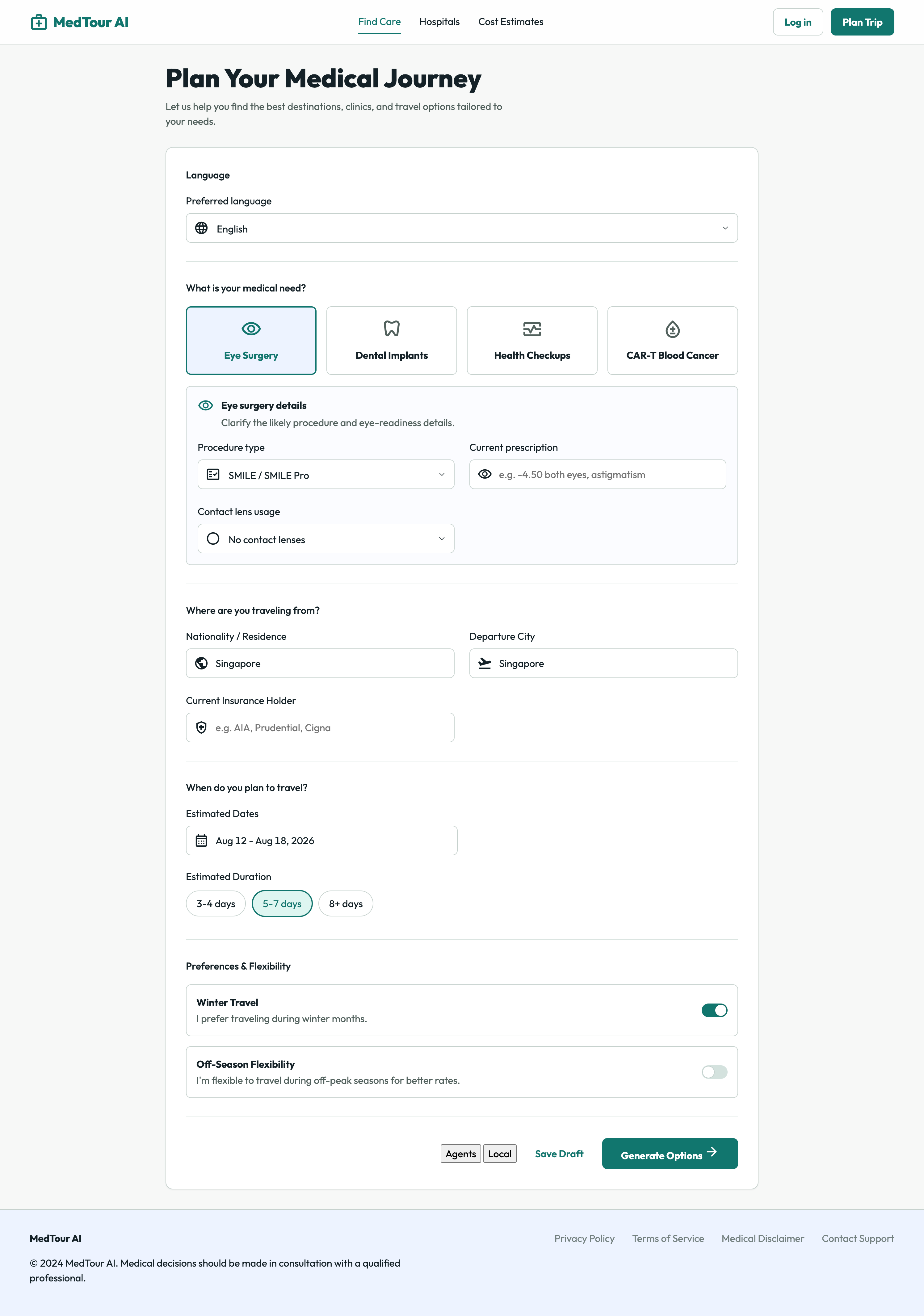
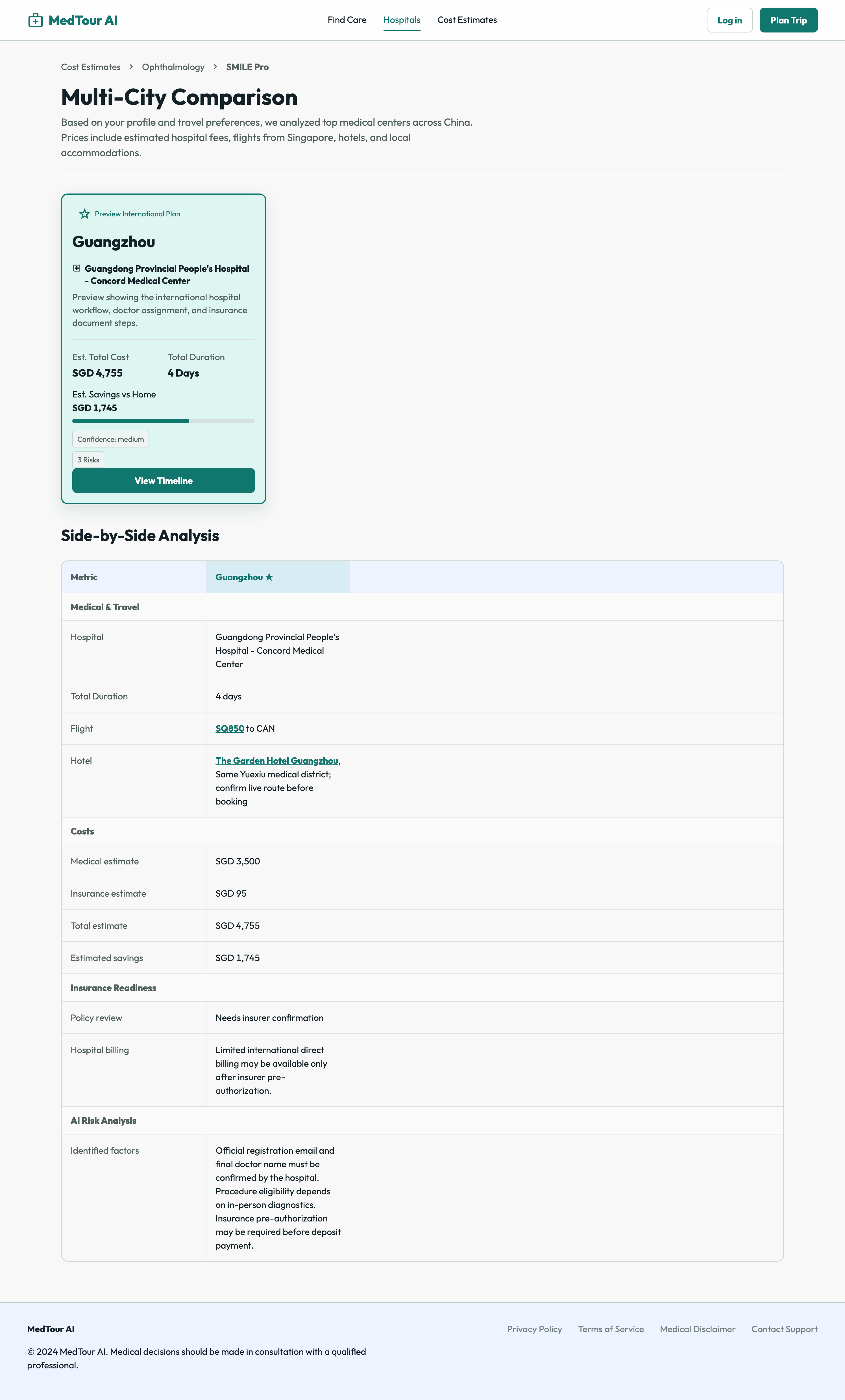
Users enter information such as their medical needs, preferred procedure, nationality, departure city, travel dates, budget, and insurance status. The platform then generates and compares medical-tour plans across major Chinese cities.
Each plan can include:
- Recommended hospitals and international departments
- Estimated treatment and travel costs
- Potential savings compared with other destinations
- Suggested flights and accommodation
- Hospital contact and registration guidance
- Insurance and billing considerations
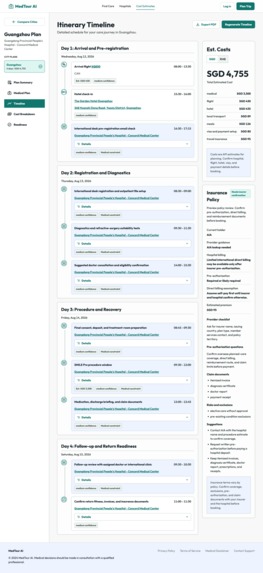
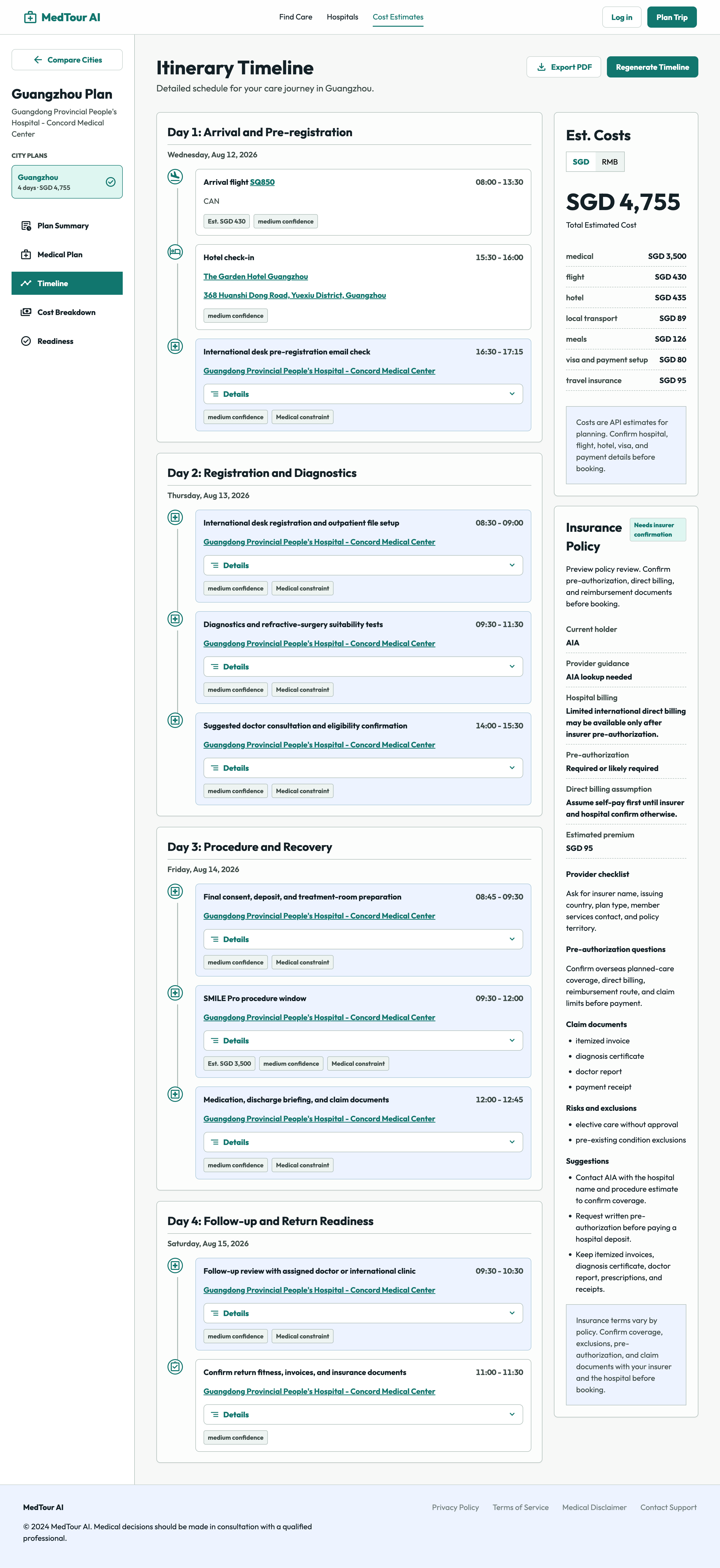
- A step-by-step treatment and travel timeline
- Visa, payment, appointment, and document checklists
- A downloadable PDF report
Rather than simply listing hospitals, MedTour AI gives patients an actionable plan that connects healthcare decisions with the practical details of international travel.
How we built it
We built MedTour AI as a web application with a lightweight frontend and a FastAPI backend.
The platform supports two planning engines. A deterministic local planner provides reliable demonstrations and fallback results, while an AI-powered multi-agent workflow uses Google ADK, LiteLLM, and OpenAI models to produce more personalized plans.
The multi-agent workflow divides the planning process into specialized tasks, including:
- Understanding and normalizing the patient’s requirements
- Identifying medical and travel constraints
- Comparing suitable Chinese cities
- Researching hospital contact pathways
- Estimating travel and treatment costs
- Reviewing insurance and billing considerations
- Constructing a practical journey timeline
- Auditing sources, costs, risks, and confidence levels
- Synthesizing everything into one structured report
We used Pydantic schemas to validate and normalize AI-generated results before displaying them. The frontend then presents the output through comparison views, detailed plans, readiness checklists, registration email drafts, and PDF export.
Challenges we ran into
One of our biggest challenges was producing AI-generated plans that were detailed while remaining consistent enough for the application to display reliably. Language models may omit fields, return unexpected formats, or provide estimates without sufficient context.
We addressed this by introducing strict schemas, normalization rules, validation, fallback values, confidence indicators, and clear disclaimers. When the AI workflow is unavailable, the system can also fall back to the deterministic planner.
Another challenge was combining medical planning with travel planning. A useful recommendation must consider more than the hospital. It also needs to account for flights, accommodation, recovery time, insurance, billing documents, visa preparation, and communication with the hospital.
Deploying on a stateless serverless platform created an additional constraint. To keep generated plans available across pages without relying on permanent server memory, we implemented browser-side plan snapshots.
Accomplishments that we're proud of
We are proud that MedTour AI is more than a hospital directory or a basic chatbot. It transforms a complex, high-stakes decision into a structured plan that patients can understand, compare, and act on.
We successfully built a working multi-agent planning workflow in which specialized agents contribute to a single validated report. We also created a schema-first architecture that makes AI output more dependable and easier to integrate into a real product.
Most importantly, the prototype connects healthcare, budgeting, insurance, and international travel in one experience. It gives patients a clearer picture of the complete journey, including the work that must happen before and after treatment.
What we learned
We learned that useful AI applications require more than a strong prompt. Reliability comes from combining AI with structured schemas, validation, normalization, fallbacks, source awareness, and transparent confidence levels.
We also learned that medical tourism is not simply a price-comparison problem. Patients need to understand hospital suitability, specialist access, treatment timelines, travel requirements, insurance coverage, billing documentation, and recovery logistics.
Finally, we learned that the best multi-agent systems assign each agent a focused responsibility and then audit and combine their outputs through a clearly defined data structure.
What's next
Our next step is to connect MedTour AI with verified, frequently updated data from hospitals, international patient departments, airlines, hotels, exchange-rate providers, insurers, and official visa sources.
We also plan to add:
- Retrieval-backed hospital and treatment knowledge
- Live flight, accommodation, and currency information
- Direct appointment requests and advisor handoffs
- Secure user accounts and saved medical-tour plans
- Multilingual support for international patients
- Better cost comparisons and insurance eligibility checks
- CRM tools for hospitals and medical-tour coordinators
- Stronger privacy, security, and regulatory safeguards
Our long-term vision is for MedTour AI to become a trusted planning and coordination layer between international patients and healthcare providers in China.
Built With
- adk
- chatgpt
- codex
- javascript
- node.js


Log in or sign up for Devpost to join the conversation.