Inspiration
Our inspiration is three-fold. Stella, one of our teammembers, is the daughter of a Korean-American mother. Her mother, while having lived in the United States for 20 years, has overcome the stigma of seeking mental health services, but is still afraid of the language barrier that she will face because of poor interpretation services that come with California state medical insurance. She doesn't feel she has the right words in English and that an interpreter will likely not either.
The problem extends to the current global refugee crisis. So many people are currently displaced from their homes, and when they need to seek treatment, the language barrier is intimidating--especially if they never needed to speak the language of the healthcare provider.
Current applications exist to translate yes-no and other close-ended questions to different languages. However, the best method for collecting data is often open-ended questions, where healthcare providers can learn more about the symptoms of the patient. sisu addresses this problem by being able to translate both for patient and healthcare provider seamlessly.
What it does
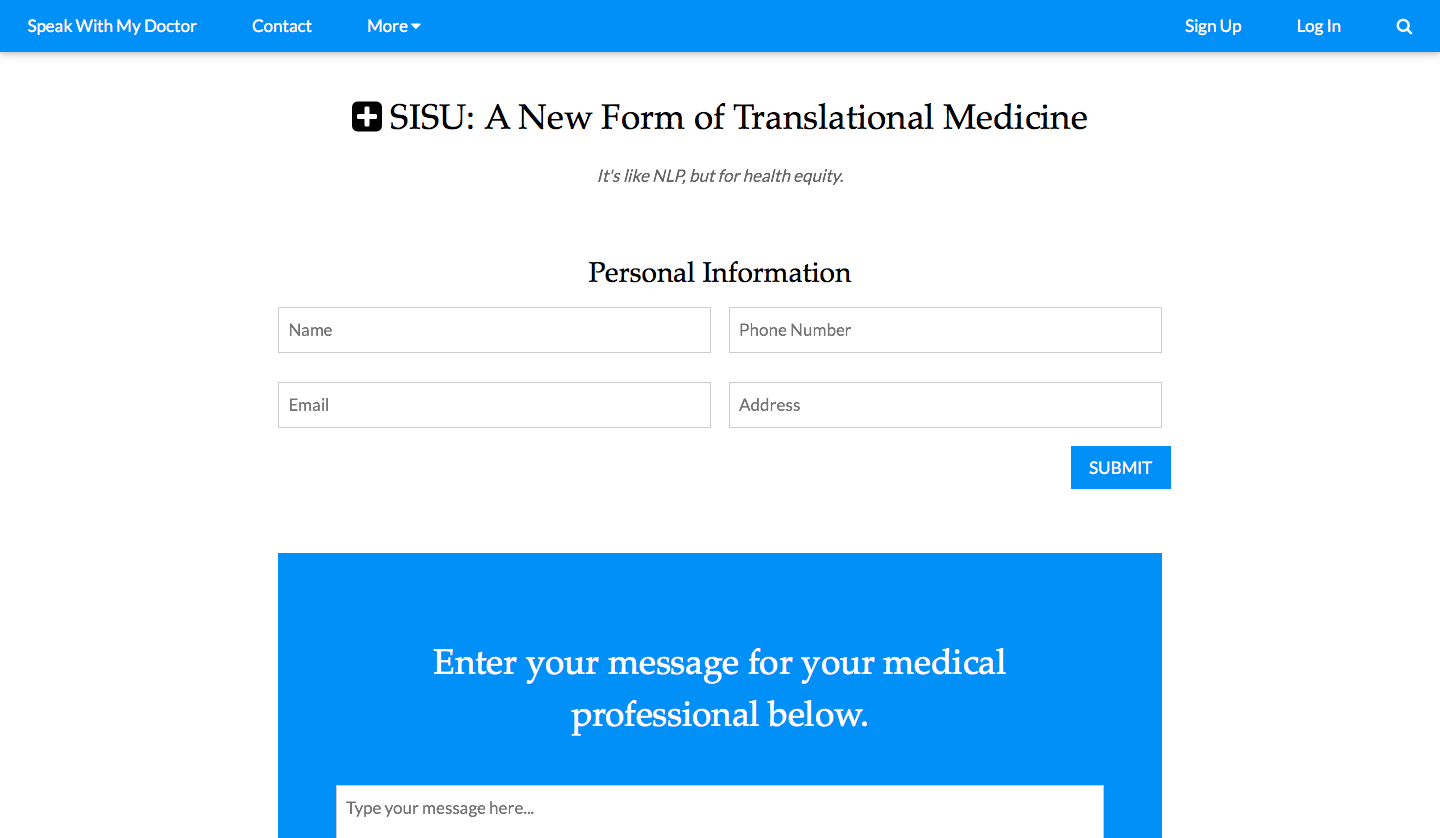
sisu is an online platform for telemedicine geared towards ESL speakers. Each individual is connected to a healthcare provider and are able to type their messages in their preferred language. sisu will translate the message to the healthcare provider's preferred language. Likewise, the healthcare provider's messages will be translated to the patient's preferred language. This is meant to facilitate open-ended questions and communication between the patient and healthcare provider to maximize efficiency and accuracy when diagnosing and treating.
Each chat log is anonymized and stored in a database--both the original, native version and the translated version. As we build up a larger and larger database of clinical text and diagnoses, we can build a neural net to perform natural language processing, linking key words with certain pathologies. The idea is that different populations, cultures and languages have different words, attitudes, and disease predispositions. Some of these cultural nuances are often lost in translation, so building a neural net from the original words can be a more powerful diagnostic tool. This is another level of cultural competence, addressing nuance in language.
How I built it
Our current deliverables are not yet integrated. We have a chat app was created in Python. The translation was implemented using Java and Microsoft Azure's Cognitive Services. The Cognitive Services handles language detection, translation, and outputs a JSON file to be sent to the core database. The website itself is built from HTML, CSS, and JaveScript. All subprojects were inspired and supported by existing open-source projects.
Challenges I ran into
Our team is composed entirely of first-time hackers. It was a challenge to narrow down our ideas, but even moreso to create a deliverable. There was a learning curve for all of us, whether we were learning PHP, HTML, CSS, SQL, or JavaScript or even just brushing up on Python or Java. The Microsoft Azure Cognitive Services API was the first API that any of our teammembers had ever used, and navigating it and implementing its tools was also confusing, challenging, but rewarding.
Accomplishments that I'm proud of
We're proud to have a deliverable (even if it's in pieces) and future plans for it (the neural net to build word associations). We've learned a whole lot of different languages along the way, and we've learned so much as developers. We used our first API and learned HTML/CSS/PHP/JavaScript.
What I learned
Jess, a Public Health major, learned tecnical expertise (eg: Git), and the rest of us, as bio(medical)engineers, learned so much about social determinants of health and web development. In the last 36 hours, we've learned a considerable amount about our ability to learn and adapt, our skillset, and the current health environment.
What's next for sisu
We've got to integrate all our moving parts together and get the database up and going. Furthermore, once we've collected sufficient data, we'd like to start training our neural net to start linking key words and diagnostics.


Log in or sign up for Devpost to join the conversation.