-
-
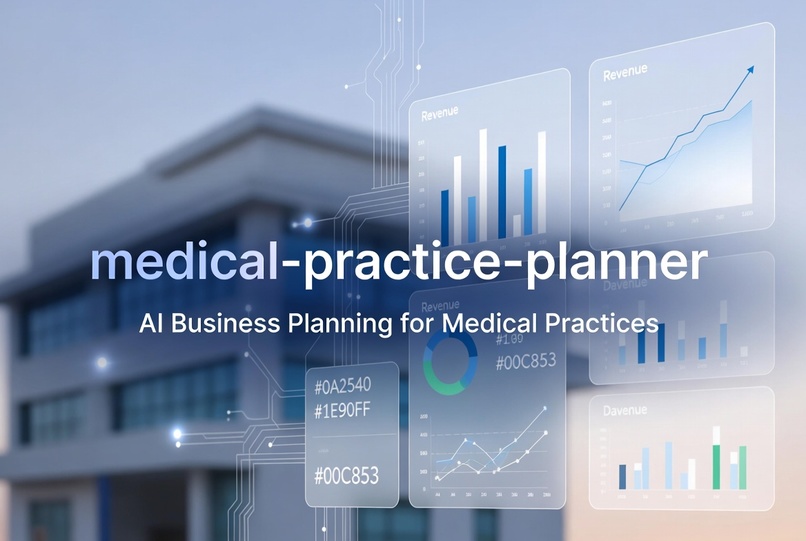
AI-powered economic planning for medical practices
-
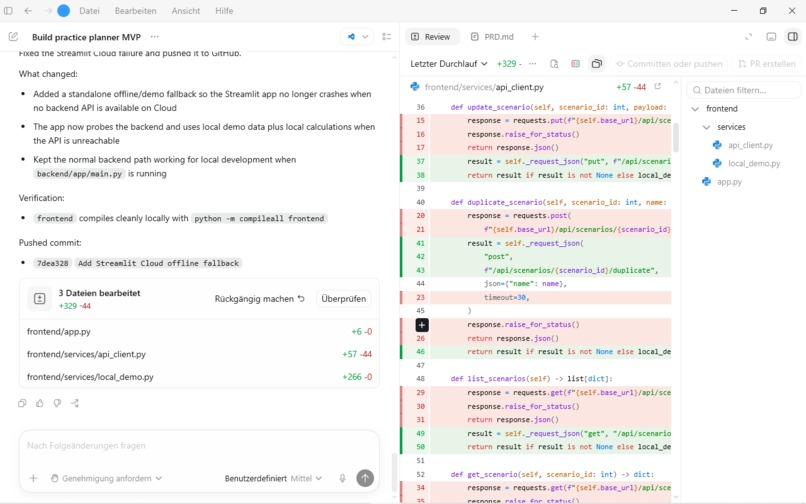
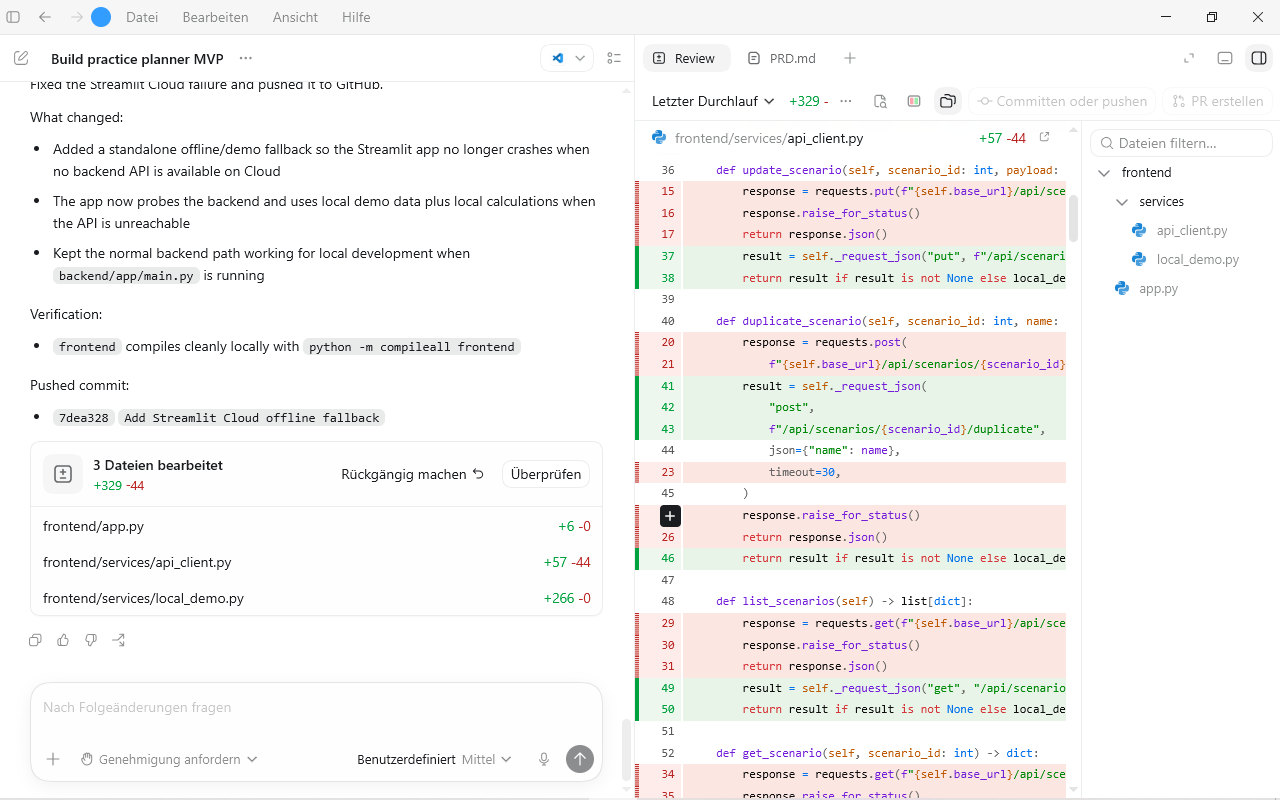
Codex window showing a GitHub pull request. Syntax-highlighted code diffs, changed files, reviewer comments, and project status.
-
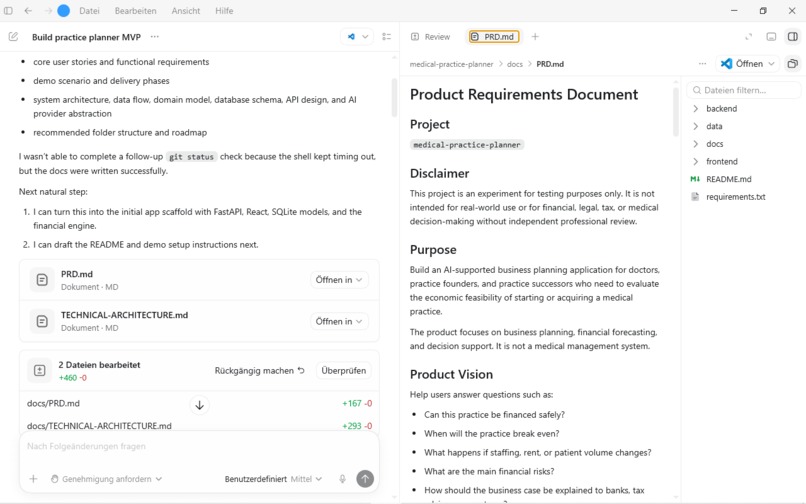
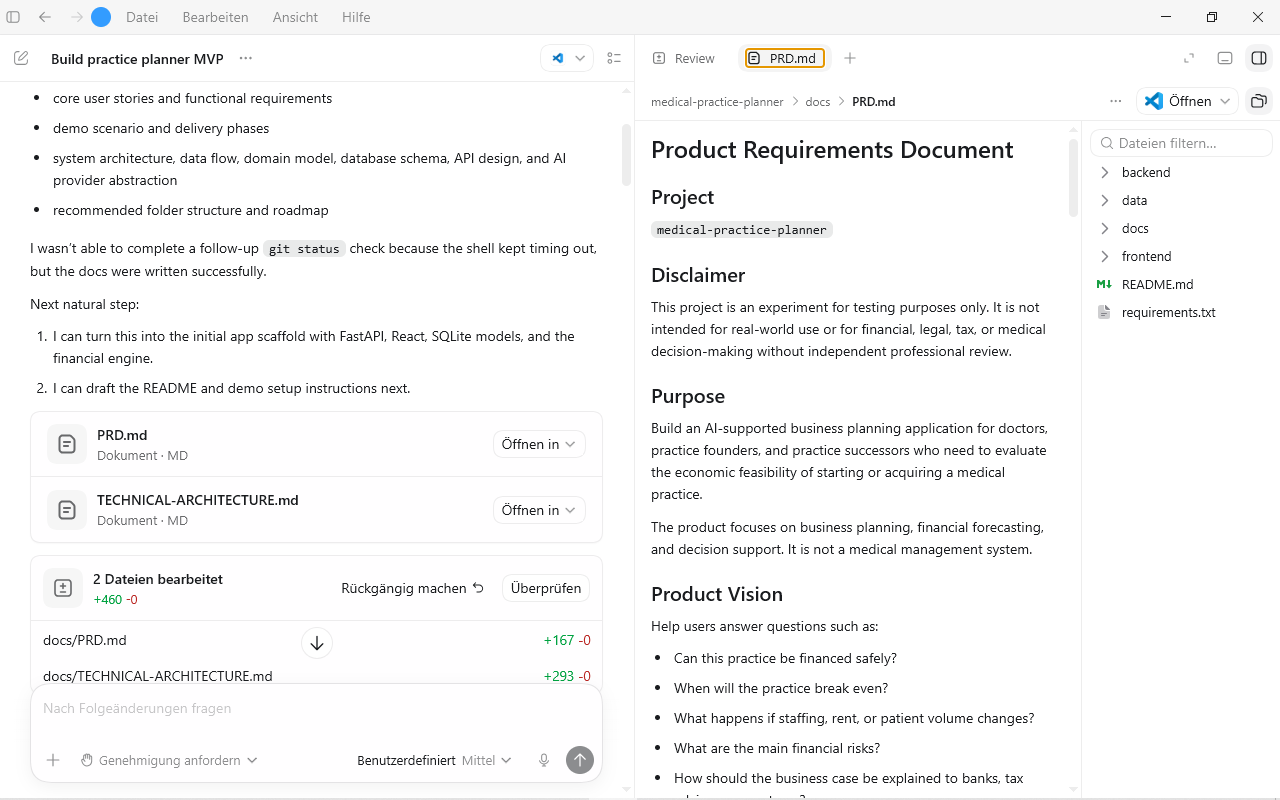
Product Requirements Document for project development. Shows detailed sections on objectives, features, and structured requirements.
-
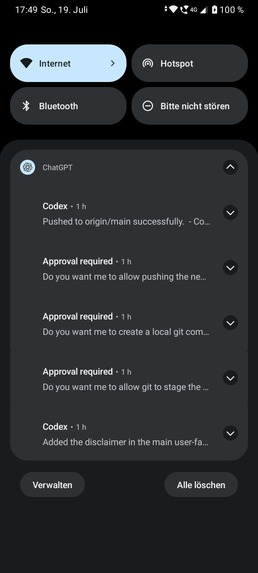
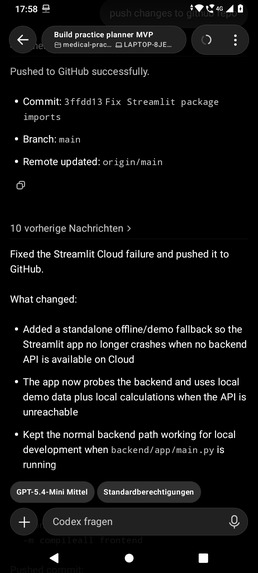
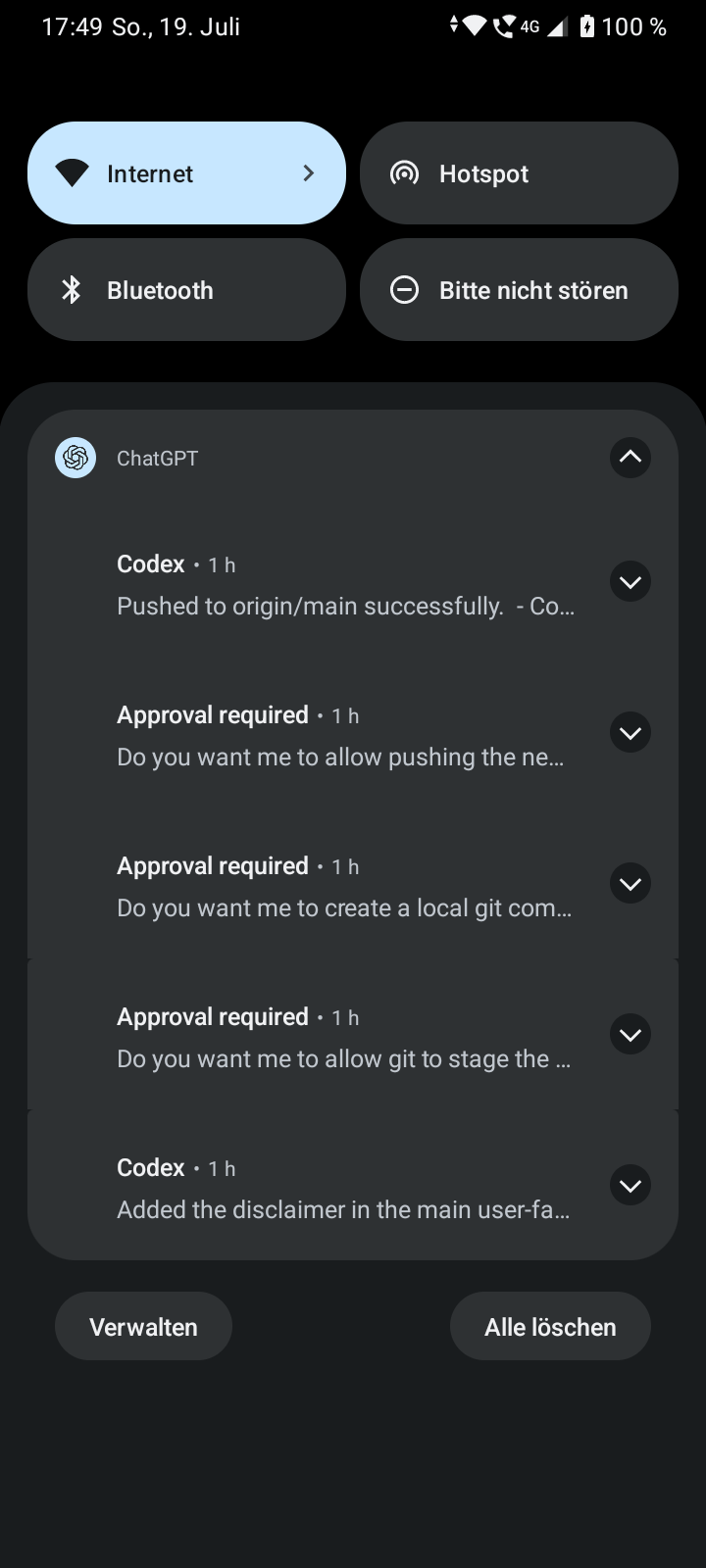
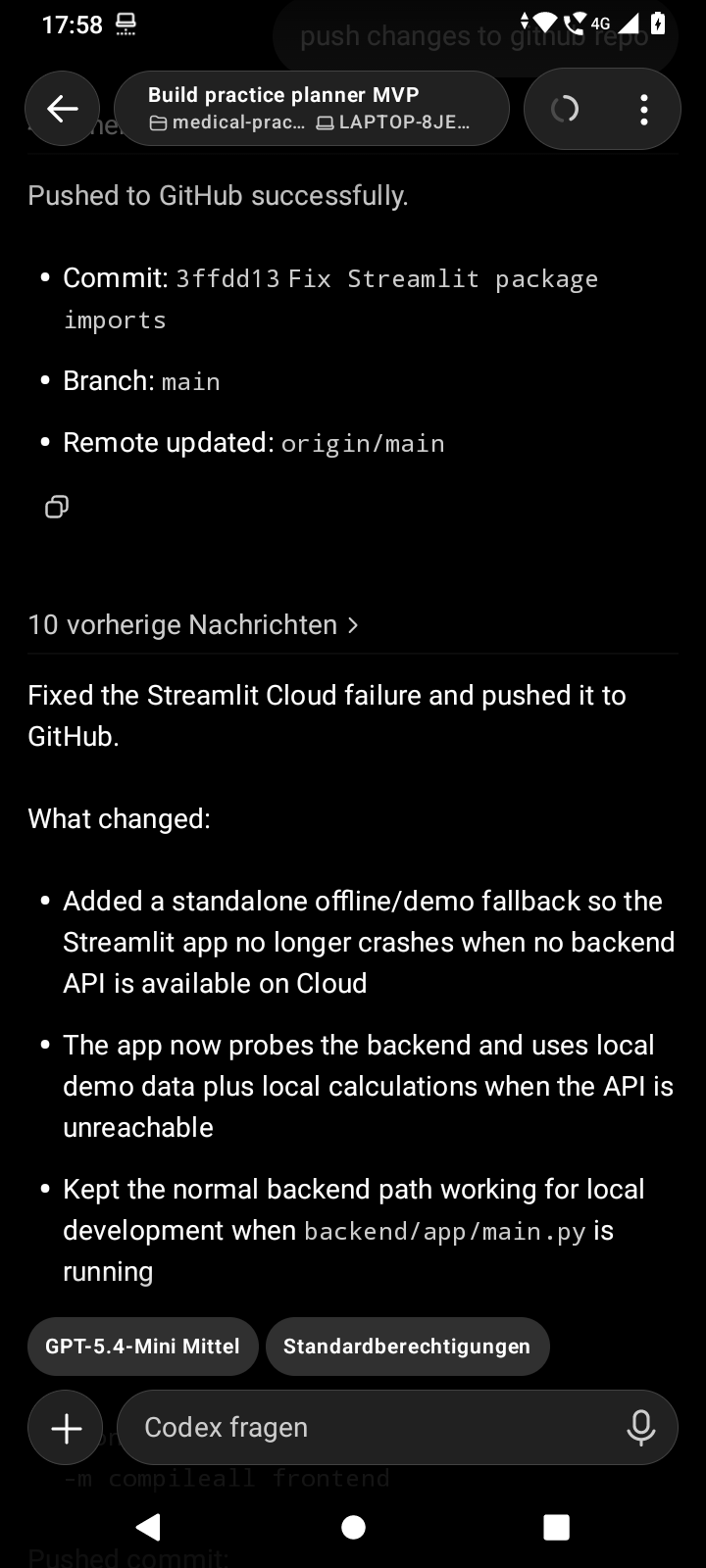
Codex mobile in dark mode showing recent activity: successful push to origin/main and multiple "Approval required" prompts.
-
medical-practice-planner – AI-powered economic planning for medical practices
Inspiration
While doctors receive extensive medical training, many have limited support when it comes to business planning, investment decisions, financing requirements, and long-term profitability analysis. A successful medical practice is not only a healthcare organization — it is also a complex business with many interacting factors:
- Investment costs
- Staff expenses
- Rent and operating costs
- Patient volume
- Revenue assumptions
- Financing obligations
- Long-term liquidity
The idea behind medical-practice-planner was to build an intelligent assistant that combines financial modeling with AI-powered explanations, making business planning more accessible for medical professionals.
What we built
medical-practice-planner is an AI-supported business planning assistant for doctors who want to start or acquire a medical practice.
The application helps users:
- Create structured business plans
- Estimate financial feasibility
- Analyze revenue and expenses
- Calculate profitability scenarios
- Understand liquidity development
- Evaluate financing requirements
- Explore "what-if" scenarios
- Receive AI-generated recommendations and explanations
Instead of simply generating a document, the application acts as a decision-support assistant.
For example:
"What happens if I hire two additional medical assistants?"
The system analyzes the impact on:
- Monthly operating costs
- Profitability
- Cash flow
- Break-even timeline
and explains the consequences in understandable language.
How we built it
The project was developed using OpenAI Codex and GPT-5 as part of OpenAI Build Week.
Codex was used throughout the development process to:
- Design the application architecture
- Generate and refine code
- Create backend APIs
- Implement frontend components
- Improve code quality through refactoring
- Develop testing workflows
- Assist with debugging and documentation
GPT-5 was used as an development partner for:
- Architectural decisions
- Problem solving
- Reviewing implementation approaches
- Designing AI interaction patterns
- Improving the user experience
The application architecture separates business logic from AI integration through an LLM provider abstraction layer. This allows different AI providers to be connected without changing the core application.
The current architecture supports integration with OpenRouter as an AI gateway, enabling flexible model selection and future scalability.
Technical Approach
The application consists of several layers:
User Interface
A web interface allows users to enter practice assumptions and explore financial scenarios.
Financial Engine
The application calculates key business indicators:
- Revenue forecasts
- Expense projections
- Profitability
- Liquidity development
- Break-even point
- Financing requirements
These calculations are deterministic and independent from AI responses.
AI Assistant
The AI layer provides:
- Business plan generation
- Executive summaries
- Risk analysis
- Financial explanations
- Strategic recommendations
The AI does not replace financial calculations. Instead, it transforms complex results into understandable insights.
Built for OpenAI Build Week
This project demonstrates how AI can be used not just to generate content, but to create practical tools that solve real-world problems.
By combining software engineering, financial modeling, and AI assistance, medical-practice-planner aims to make healthcare entrepreneurship more transparent, predictable, and accessible.
Built With
- codex
- fastapi
- gpt-5
- healthcare
- healthtech
- openai
- openrouter
- pydantic
- python
- sqlalchemy
- sqlite

Log in or sign up for Devpost to join the conversation.