-
-
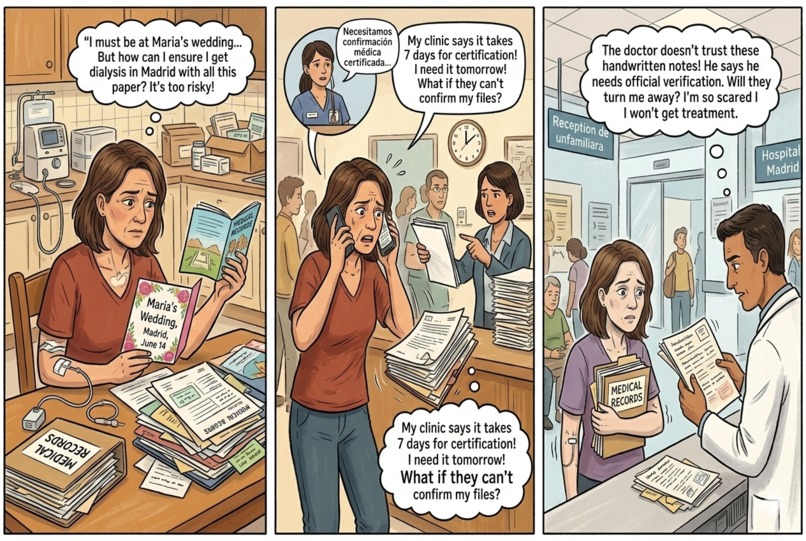
Story of Alice, and the need for Medical Passport

Inspiration
Our inspiration came from a teammate’s experience in a nephrology clinic, seeing how difficult travel is for people on chronic dialysis. Even short trips demanded weeks of coordination, paperwork, and anxiety. We realised that a large part of this burden came from how medical information is shared: fragmented, slow, and heavily dependent on busy clinicians. That insight motivated us to explore a patient-centred way to make essential dialysis information secure, portable, and trusted across borders.
What it does
Medical Passport is a digital “travel passport” for dialysis patients. It stores a concise, hospital-verified summary of a patient’s essential dialysis information and recent labs, and makes it easy to share this securely with other clinics. Patients carry a digital card and QR code that overseas centres can scan to view verified records, helping them book safe dialysis sessions when they travel. The goal is to reduce paperwork, delays, and uncertainty for both patients and clinicians.
How we built it
We started by mapping the dialysis patient journey, from planning a trip to receiving treatment abroad. Using our teammate’s clinical insight, we identified which data points are truly critical for safe dialysis handover. We then translated this into a simple information architecture for a medical passport: patient profile, dialysis settings, lab results, and verification status. From there, we created low-fidelity user flows and screens, then refined them into a click-through prototype that shows how patients, home clinics, and destination centres would interact with the system.
Challenges we ran into
A key challenge was balancing clinical realism with hackathon constraints. Dialysis care is complex and highly regulated, so we had to be careful not to oversimplify medical requirements while still keeping the concept implementable. We also grappled with cross-border issues such as different documentation standards, privacy rules, and consent models. Another challenge was deciding how much control patients should have over editing or sharing data while keeping records trusted by clinicians.
Accomplishments that we're proud of
We are proud that we turned a vague pain point into a clear, structured solution within a short time. Our team managed to capture real clinical workflows and represent them in a patient-friendly way. We also succeeded in keeping empathy at the centre of the design: the passport is built around what patients actually need when they travel, not just what is easy for systems to implement. The final prototype tells a coherent story that clinicians, patients, and judges can all understand.
What we learned
We learned how many invisible barriers dialysis patients face when they try to live normal lives and travel. It became clear that “data logistics” can be as stressful as the medical condition itself. We also learned how important it is to co-design with clinicians and to think about regulation, security, and interoperability from day one. Finally, we saw how powerful a simple, well-scoped idea can be when it is grounded in real user needs rather than technology for its own sake.
What's next for Medical Passport
Next, we would like to validate the concept with nephrologists, dialysis nurses, and patients to refine the data set and workflows. With more time and resources, we would explore technical implementation options for secure storage, verification, and integration with existing hospital systems. We would also prototype multilingual support and emergency-access features for first responders. In the longer term, the same framework could extend beyond dialysis to other chronic conditions that require frequent, coordinated care across multiple providers.
Built With
- fhir
- figma
- hl7
- hmac-sha256
- python
- react
- supabase
- typescript


Log in or sign up for Devpost to join the conversation.