-
-
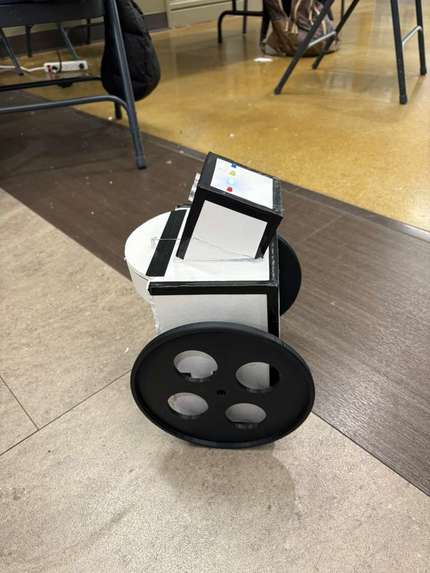
MediPal Right View
-
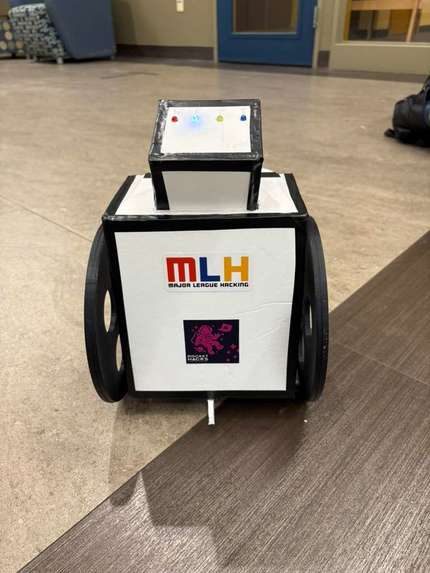
MediPal Back View
-
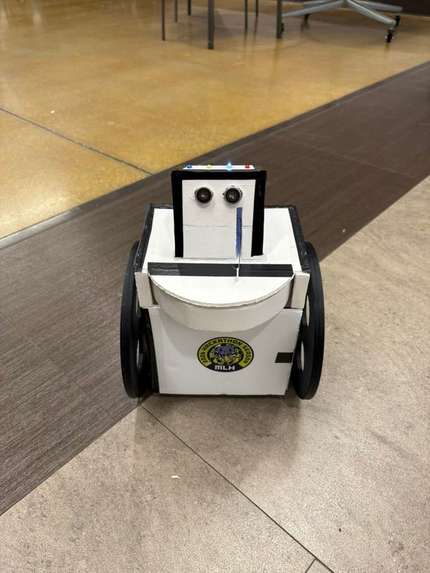
Medipal Front View
-
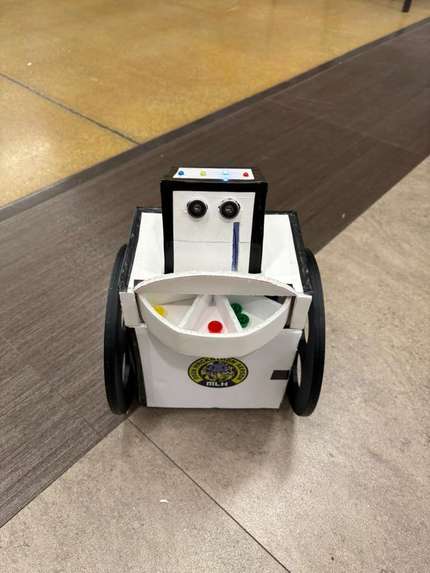
MediPal Front View (Open Compartment)


Hospitals often struggle with nurse shortages, which increases the workload on the available staff. Nurses frequently walk through hallways delivering medications to patients, which takes time away from other important medical tasks. Our inspiration was to reduce the amount of hallway traffic nurses must handle.
We wanted to design a robot that could assist nurses by delivering medication to patients at scheduled times. This allows nurses to prepare the medication beforehand while the robot handles the delivery process. By automating this routine task, nurses can focus more on patient care and critical responsibilities.
The Medical Logistics Robot is designed to deliver medication to hospital patients. Nurses can place the prepared pills into compartments, and the robot transports them to the correct patient room.
The robot can move through hallways and alert nearby people with a beeping sound so they are aware of its presence. This system helps reduce nurse traffic in hallways and improves efficiency in medication distribution.
Our robot was built using a combination of simple materials and electronic components. The structure of the robot was made from foam board, which allowed us to quickly prototype and modify the design.
Key components include:
-Arduino microcontroller for controlling the system -Servo motors to open and control compartments -Ultrasonic sensors for distance measurement and obstacle awareness -RC controller for manual navigation -3D printed components for custom mechanical parts
For this prototype, the robot is semi-automated, meaning it can be controlled remotely while still using sensors and programmed behaviors to assist with operation.
-During development, we faced several technical and logistical challenges: -Wi-Fi connection issues prevented us from successfully connecting the Arduino to a wireless network. -Ultrasonic sensor reliability was inconsistent, sometimes giving incorrect distance readings. -Self-balancing and stability problems made it difficult to keep the robot steady while moving. -Foam board shortages limited our ability to perform a second prototype iteration. -These challenges required us to adapt our design and troubleshoot problems under time constraints.
Despite the challenges, we are proud that we successfully built a working prototype that demonstrates our concept. Our team worked closely together, dividing tasks and supporting each other throughout the process. Having a strong teammate and a clear plan helped us turn our idea into a functional robot. Seeing our concept come to life and perform the tasks we imagined was a major accomplishment for our team.
Through this project, we learned many valuable skills:
-Hardware integration between sensors, motors, and microcontrollers -Rapid prototyping using foam board and 3D printing -Troubleshooting arduino, electronics, and sensor reliability issues -The importance of teamwork and communication in engineering projects -We also gained experience designing technology that addresses real-world healthcare challenges.
In the future, we plan to improve the robot by adding more advanced automation and intelligence. Future improvements include:
-Artificial intelligence for full automation -Face recognition to identify the correct patient -Autonomous navigation and obstacle avoidance -Additional compartments to serve more patients per trip -A taller robot design so elderly patients can easily access their medication
Our long-term vision is to create a smarter and more reliable hospital delivery robot that helps healthcare workers save time and improve patient care.
Built With
- 3dprinting
- arduino
- foamboard
- sensors
- servo


Log in or sign up for Devpost to join the conversation.