-
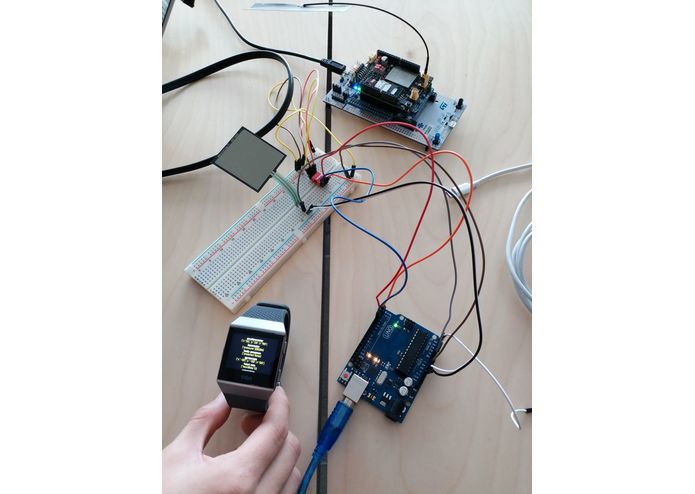
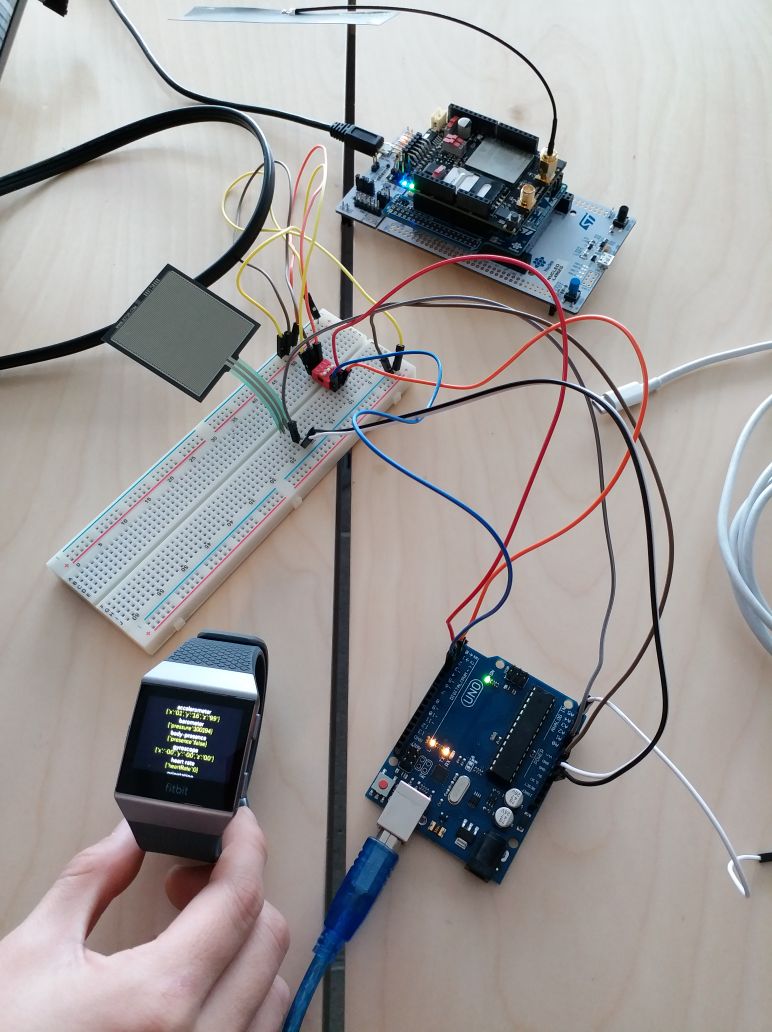
Fitbit, keypad,Telus IoT
Inspiration
The inspiration came from a scene in a TV show where the hospital had a sensor on people which they tracked and if the sensor detected an emergency, the person would be called and after confirming that there was indeed an emergency, 911 would be called.
What it does
Our idea is to build a medical information ‘sharing’ system. First the Fitbit or an alike wearable sensor would collect the health data [including heart rate, etc.] and send it to the cloud. Inside the cloud, other medical information such as prescription and family medical history would also be stored. Next, we would retrieve the information from the cloud using the IoT starter kit from Telus (This would be done on the doctor’s end). Before allowing data retrieval, we would need the patient’s fingerprint and the information linked to that fingerprint would be visible to the doctor through a computer application.
How I built it
We started by dividing tasks. One of us worked on the fingerprint sensor and trying to get it to sense the correct fingerprint. Another person worked on setting up the Fitbit, and retrieving and sending data to the cloud. Two of us worked on setting up the Telus IoT starter board to receive data (pressure and temperature). We ran into many challenges with the Fitbit and fingerprint sensor [Please see Challenges I ran into Section]. After finding away around those challenges, one of us worked on the keypad to retrieve the data, one of us worked on the python code to retrieve the data from the cloud, and two of us continued to work on trying to connect the Arduino to the Telus IoT board.
Challenges I ran into
While building this idea, we ran into a couple of problems and have moved on to plan B or C. The fitbit, in order to send data information, we would have to connect to wifi. We, as well as many other people on the internet, are unable to connect to the wifi, and thus unable to access the data. As plan B, we requested to get our personal data directly from fitbit and requested access, however, the automated response was that we would not get our data for another 3 days. As plan C, we created simulated data from a fitbit to validate the design, since data retrieval from the fitbit is a product design, and thus requires no change from us (we are only accessing this as an input). Solving that side of the problem, we encountered another problem which was that the fingerprint sensor was not working. Initially, we thought it was because our code was not working properly or a poor connection, however, upon further testing (ie. taking of the electrical tape to check the connections, etc.), we found that the D- wire was broken and there was no way of soldering it back on. After borrowing and replacing it with a Qwiic wire, we tested the code again, however, with more testing we were still unable to recognize the sensor, so we reached the conclusion that the sensor itself is broken. Thus as plan B, we have decided to use a keypad (made from buttons) instead.
Now, our final product contains a list of data, which we store into the cloud. Then using the IoT starter kit, we retrieve that data according to the number inputted on the keypad.
Accomplishments that I'm proud of
Some of our major accomplishments was setting up the starter kit as it was something that we initially had no idea how to do and now have it set up and able to retrieve data.
What I learned
We have learned to use the IoT starter kit in connecting to the cloud and retrieving its data. We have also learned to find ways around hardware problems including the Fitbit and the fingerprint sensor.
What's next for Medical Info Cloud
We think the Medical info cloud is a great idea and if implemented can make transferring information at the doctors office more efficient and they would have more access to every day data of the patient. We would like next time to use a camera with facial recognition instead next time as a verification for retrieving the data and try to find a way around using a fitbit as the medical sensor. Potential alternative can include sensors in our phone and then transferring those data to the cloud.
Built With
- arduino
- c++
- fingerprint-sensor
- fitbit
- javascript
- python
- switches
- telus-iot-stater-kit

Log in or sign up for Devpost to join the conversation.