-
-
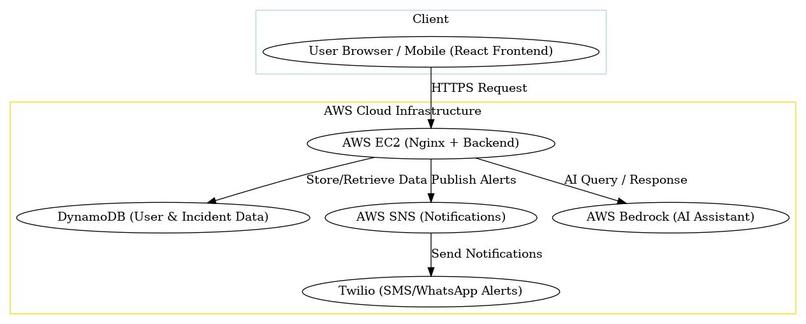
architecture daigram
-
Links and test email
Inspiration
Every year, thousands of people lose their lives — not because help isn’t available, but because help doesn’t reach them in time. In medical, accident, or assault situations, the delay of even a few seconds can be the difference between life and death.
At the same time, many women today don’t feel safe — especially when traveling alone or walking at night — because they fear that if something goes wrong, no one will know or reach them quickly enough.
These real-life fears and tragic incidents inspired me to build Rakshak AI, an intelligent emergency assistant that acts in those critical “golden moments” when human help is still possible. It automatically sends alerts to trusted contacts, shares live location, and uses AI assistance (powered by AWS Bedrock) to guide the user through what to do next — whether it’s a health emergency or a safety threat.
The goal is simple but powerful: Save lives by reducing response time. Empower people — especially women — to feel safe, connected, and protected.
What it does
Emergency Alerts: Instantly sends SOS notifications via AWS SNS to family, friends, or responders. Smart Messaging: Uses Twilio to deliver emergency alerts through SMS and WhatsApp. AI Assistance: Integrates AWS Bedrock to provide a conversational assistant that helps victims communicate calmly and clearly. Real-Time Location Sharing: Shares GPS coordinates with contacts in emergencies. Cloud-Backed Reliability: All user and incident data is securely stored in AWS DynamoDB. Multi-Platform Access: Accessible from any device via secure web (HTTPS).
How we built it
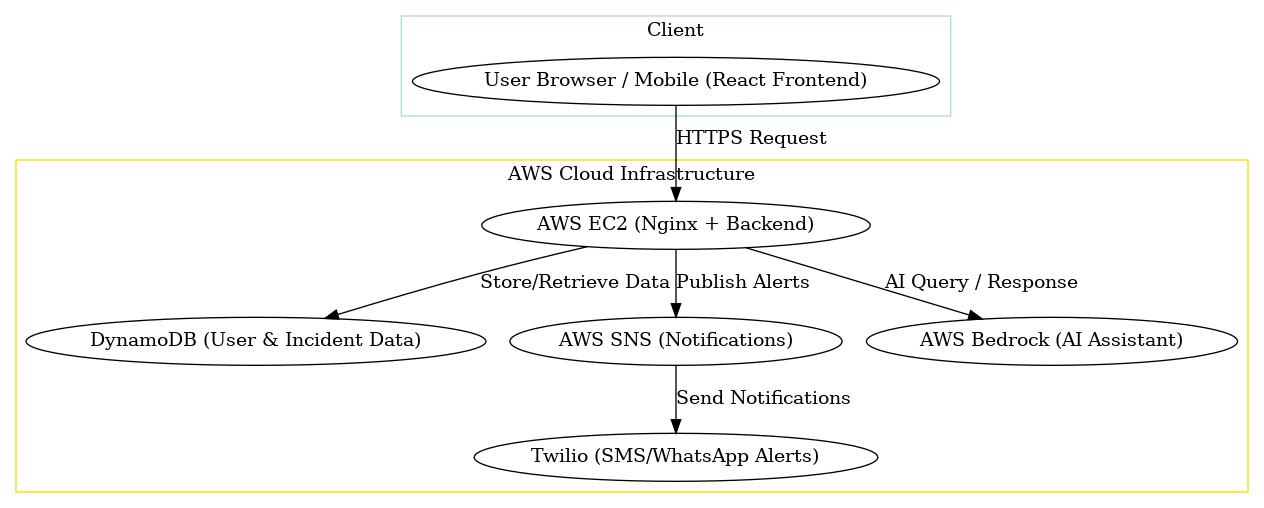
Frontend: React + Vite + Tailwind CSS for responsive design and fast builds. Backend: Node.js + Express REST APIs for authentication, user management, and alert flow. AI Layer: AWS Bedrock for natural language understanding and assistance. Messaging: AWS SNS for broadcasting alerts; Twilio for WhatsApp & SMS delivery. Database: AWS DynamoDB for user, incident, and contact data. Infrastructure: Deployed on AWS EC2 with Nginx reverse proxy and Let’s Encrypt (Certbot) SSL. Version Control: GitHub with secret scanning and environment protection.
Challenges we ran into
Safely managing secrets during development & deployment (moved secrets to .env and used push-protection rules). Getting CORS and the Vite VITE_API_BASE_URL right for dev vs production. Certbot validation when nginx was serving redirect/landing pages (fixed by simplifying server block and pointing /.well-known to a static directory). Twilio trial account limits and indian sim block messages (some messages fail to unverified numbers).
Accomplishments that we're proud of
Full end-to-end working demo: user registration → SOS → AWS SNS + Twilio messages delivered. Integration of AWS Bedrock to provide conversational assistance during an incident. Production-ready deployment on an EC2 instance with nginx + Certbot SSL for both UI and API subdomain.
What we learned
Aws Services and there implementation Proper secret hygiene (never commit API keys) and how GitHub push-protection blocks pushes with detected secrets. How to configure nginx as a reverse proxy for Node + static frontend and generate/renew Let’s Encrypt certs on EC2. Practical AWS SNS + DynamoDB usage patterns for emergency messaging.
What's next for Medical emergency bot
Add push notifications on mobile (web push / PWA). Add role-based access & audit logs for sensitive actions. Improve AI assistant prompts and add multi-language support. Add monitoring & alerting for production with SNS topics for internal ops. Speech Recogination and many more .
Built With
- amazon-web-services
- bedrock
- certbot)
- docker-(local/prod-builds)
- dynamodb
- encrypt
- express.js
- github-for-source-control
- let?s
- lex
- nginx-(frontend)
- node.js
- postman
- react
- sns
- tailwind
- twilio
- ubuntu-ec2-(prod)
- vite


Log in or sign up for Devpost to join the conversation.