Inspiration
The inspiration for Medical Assistant came from the global challenge of providing timely and accurate medical information. With the rise of telemedicine and the increasing demand for remote healthcare services, we saw an opportunity to harness AI technology to bridge the gap between patients and healthcare providers. Our goal was to create a reliable, user-friendly platform that could support individuals in managing their health more effectively.
What it does
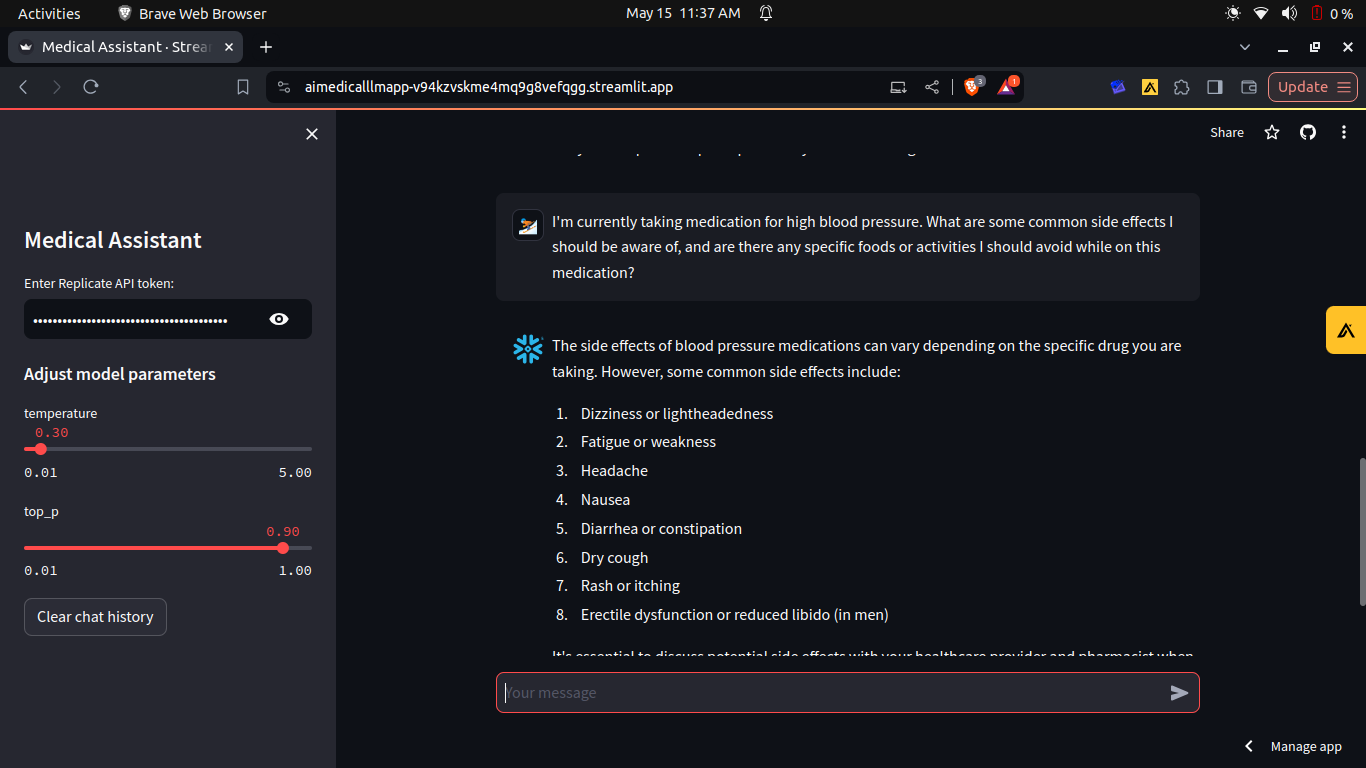
Medical Assistant is an AI-powered chatbot designed to provide real-time medical consultation. Users can ask medical-related questions, and the assistant generates accurate, context-aware responses to help them understand their health concerns better. It offers a user-friendly interface and customizable model parameters to tailor the responses to individual needs.
How we built it
The development process involved several key steps:
- Framework and Libraries: We chose Streamlit for the user interface due to its simplicity and interactivity. The backend leverages the Replicate API for model inference and the Hugging Face Transformers library for tokenization.
- Model Selection: We selected the "snowflake/snowflake-arctic-instruct" model for its ability to generate detailed and contextually appropriate responses.
- Tokenization: To manage input lengths and ensure efficient processing, we integrated the AutoTokenizer from Hugging Face.
- UI Design: The chat interface was designed to be intuitive, with features like a custom avatar and a sidebar for adjusting model parameters and managing chat history.
Challenges we ran into
- Medical NLP: Understanding the nuances of medical language and ensuring the model could handle sensitive health-related queries accurately.
- User Experience: Designing an intuitive and supportive chatbot interface to make users feel comfortable and understood.
- Data Privacy: Ensuring the security and confidentiality of user data, given the sensitive nature of medical information.
- Model Optimization: Balancing response accuracy and computational efficiency through fine-tuning model parameters.
Accomplishments that we're proud of
- Successfully integrating a state-of-the-art language model to provide accurate and context-aware medical advice.
- Designing a user-friendly interface that allows users to interact seamlessly with the AI assistant.
- Implementing robust data privacy measures to ensure the security of sensitive user information.
- Overcoming challenges related to medical NLP and achieving a reliable performance in understanding and generating medical responses.
What we learned
Throughout this project, we gained valuable insights into the complexities of building a healthcare-related AI application. Some key learnings include:
- Medical NLP: Gaining a deeper understanding of the medical language and training models to handle diverse health-related queries.
- User Experience Design: Learning how to create an intuitive and engaging chatbot interface.
- Data Privacy: Implementing effective measures to protect user data privacy.
- Model Optimization: Fine-tuning model parameters to achieve a balance between response accuracy and computational efficiency.
What's next for Medical Assistant
- Enhanced Model Capabilities: Continuously improving the model to handle a wider range of medical queries and provide even more accurate responses.
- Integration with Medical Databases: Connecting with real-time medical databases to offer the latest information and guidelines.
- Multi-language Support: Expanding the assistant's capabilities to support multiple languages, making it accessible to a broader audience.
- Mobile Application: Developing a mobile app version to make the Medical Assistant more accessible on-the-go.
- Partnerships with Healthcare Providers: Collaborating with healthcare providers to offer a more comprehensive and integrated health management solution.
Built With
- generativeai
- llms
- python
- streamlit

Log in or sign up for Devpost to join the conversation.