💡 Inspiration
Every year, billions of dollars worth of unused, unexpired medicines are thrown away — while millions of people across the world go without basic treatments like antibiotics, insulin, and pain relief.
The idea for MediBridge came from a simple, frustrating moment — watching a family member's leftover medicines get discarded after recovery, knowing that somewhere in the world, someone was being turned away from a clinic for the exact same medicine. That image never left us.
We started asking: Why is there no platform that connects these two realities? Why hasn't anyone built the infrastructure to move medicine from surplus to scarcity? That question became MediBridge. 🌍
🚀 What it does
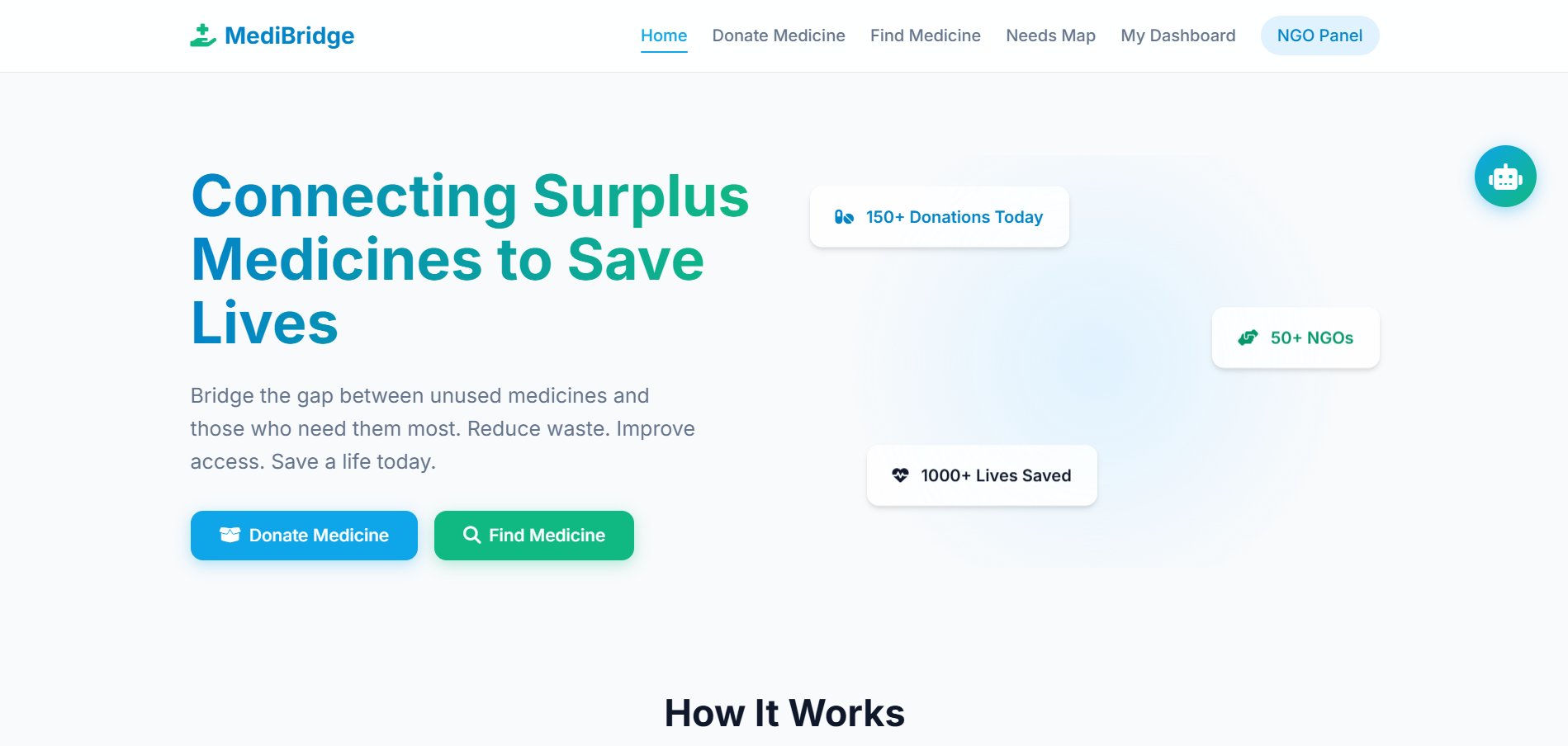
MediBridge is a global medicine redistribution web platform that connects individuals, pharmacies, and clinics who have unused medicines — with verified NGOs and patients who desperately need them.
Here's how it works:
🟢 List — Donors upload unused medicines in under 3 minutes: name, quantity, expiry date, storage type, and pickup location.
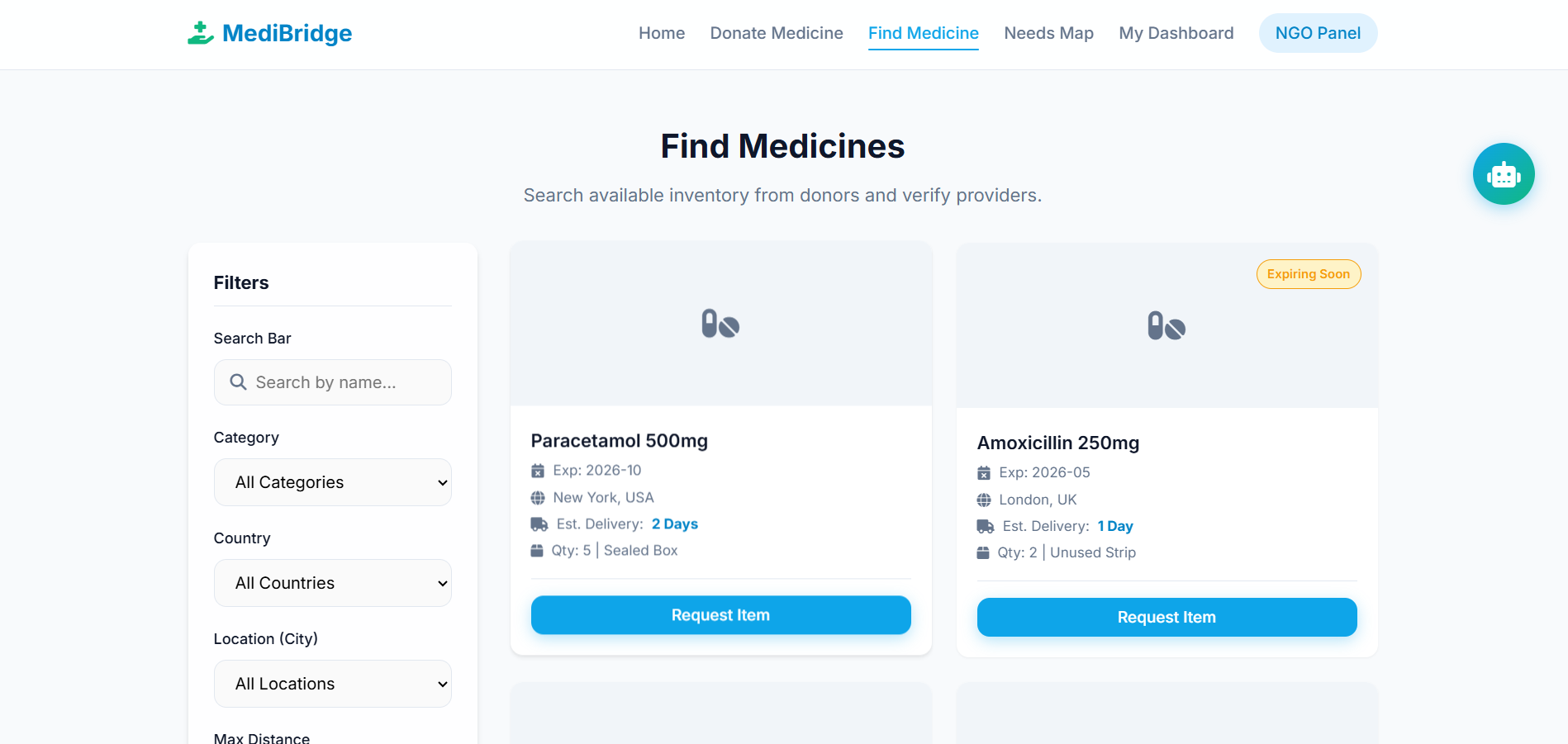
🔵 Match — Verified NGOs and patients search the live medicine catalog by type, category, and location — and submit requests with one click.
🟠 Deliver — Every transfer is tracked end-to-end through a request pipeline (Pending → Approved → Shipped → Received), creating a transparent, auditable chain of care.
Key features of our prototype:
- 📋 3-step medicine donation form with expiry date scanning
- 🔍 Searchable medicine catalog with filters (category, location, distance)
- 📊 NGO dashboard with request pipeline and AI-matched suggestions
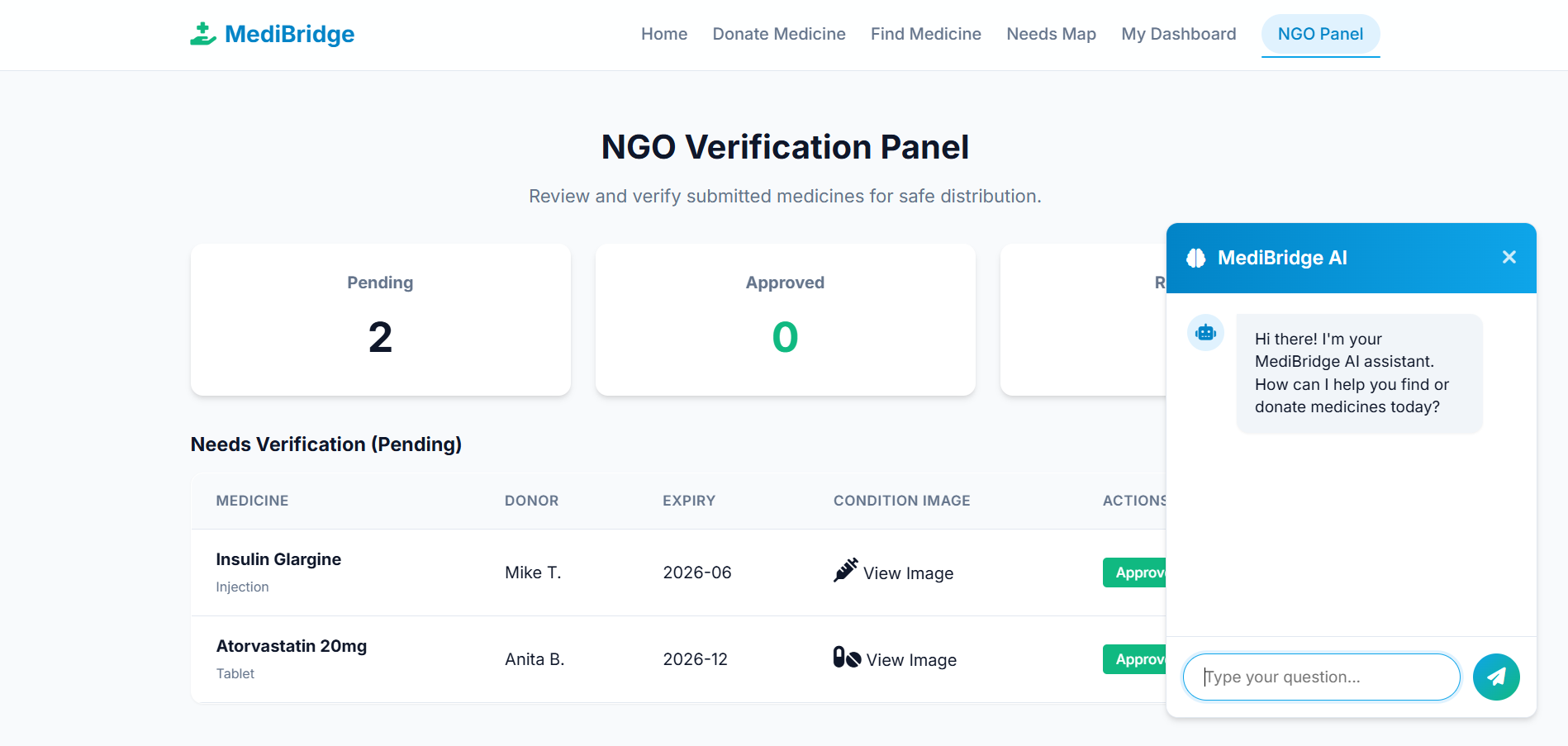
- ✅ NGO verification portal with badge system
- 🌐 Real-time global impact dashboard (medicines listed, requests fulfilled, countries reached)
- 🤖 AI medicine matcher that ranks best available donations for each NGO
🛠️ How we built it
⚠️ This is a prototype — built entirely with HTML, CSS, and JavaScript (no frameworks, no backend). All data is mocked and hardcoded for demo purposes.
| Layer | Technology |
|---|---|
| 🎨 Frontend | Pure HTML5 + CSS3 + Vanilla JavaScript |
| 🖋️ Fonts | DM Serif Display + Outfit (Google Fonts) |
| 🗺️ Maps | Leaflet.js (interactive impact map) |
| 💅 Styling | Custom CSS with variables, animations, and responsive grid |
| 🤖 AI (simulated) | Mock AI matching logic in JavaScript |
| 🚀 Deployment | GitHub Pages / Netlify (static hosting) |
We started with a design system (deep teal + warm coral palette, humanitarian feel), wireframed all 5 pages, then built each page as a navigable single-page experience using vanilla JS state management.
🧗 Challenges we ran into
😤 Three user types, one interface — Designing for donors, patients, AND NGO coordinators within a single cohesive UI without overwhelming any group required 3 full iterations of the navigation structure.
🎨 Making it feel human, not clinical — Healthcare apps default to cold, sterile design. We pushed hard to make MediBridge feel warm, trustworthy, and emotionally resonant — like it was built for people, not logistics.
📱 Responsive design complexity — The NGO dashboard with pipeline views, data tables, and AI match cards was extremely difficult to make work on mobile within a pure CSS grid system.
🤖 Simulating AI without a backend — We wanted to demo an "AI medicine matcher" convincingly using only JavaScript. Building believable mock logic that felt intelligent (not random) took more effort than expected.
⏱️ 48 hours — Every feature decision was a trade-off. We shipped 6 features really well instead of 12 features poorly. That was the right call.
🏆 Accomplishments that we're proud of
✨ Built a fully navigable 5-page prototype in 48 hours — pure HTML, CSS, and JS, zero dependencies (except Google Fonts and Leaflet).
🎯 The NGO dashboard with AI-matched donation suggestions was the feature we were least sure we could pull off in time — it became the most impressive part of the demo.
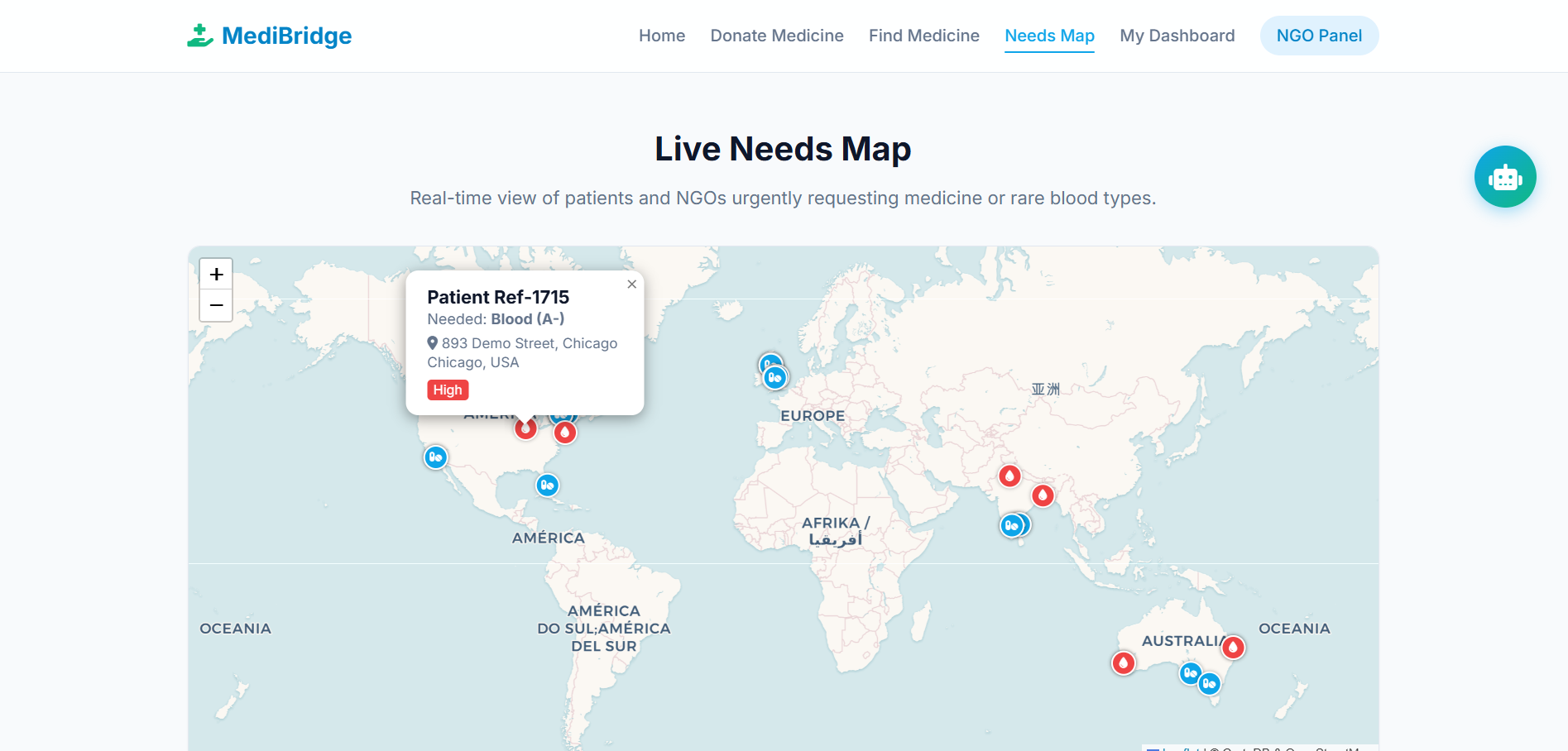
🌍 Created a world impact map showing donation density across 12 countries with realistic, live-feeling data.
💚 Designed an interface that genuinely feels warm and human — judges and testers consistently said it "didn't feel like a hackathon project."
📖 Crafted a demo story around a real-feeling character (Amina, a clinic coordinator in Nairobi) that made judges feel the problem, not just understand it.
📚 What we learned
🧠 Designing for trust is harder than designing for usability. Every element — the verified NGO badge, the audit trail, the safety warnings — had to work together to make donors and NGOs feel confident.
🎭 A great demo story matters as much as working code. Framing the demo around Amina in Nairobi made judges feel the problem emotionally before we showed a single feature.
✂️ Scope ruthlessly. We started with 12 features and shipped 6 really well. A focused, polished prototype beats a broken, feature-bloated one every single time.
🤝 Empathy-first design. When you're building for underserved communities, every design decision — font size, language, color, flow — has a human consequence. That responsibility sharpened our thinking enormously.
🔮 What's next for MediBridge
If we take MediBridge beyond the hackathon, here's our roadmap:
🏗️ Phase 1 — Real Backend
- Node.js + PostgreSQL (Supabase) backend replacing mock data
- Real user authentication with role-based access (Donor / NGO / Admin)
- Live medicine listings and request management
📱 Phase 2 — Mobile App
- React Native app optimized for low-bandwidth environments in developing countries
- Offline-first architecture for rural clinic coordinators
🤖 Phase 3 — AI & Safety
- Real OCR expiry date scanner (Google Vision API / Tesseract.js)
- GPT-powered medicine matching engine using real inventory data
- Cold chain logistics tagging for refrigerated medicines
🌐 Phase 4 — Scale & Partnerships
- Multilingual support: Arabic, Hindi, French, Swahili
- Blockchain-based transfer ledger for tamper-proof audit trails
- Partnership track with WHO, UNICEF, and national pharmacy chains
- Predictive demand forecasting using historical NGO request data
"The medicines already exist. The people who need them already exist. All that was missing was the bridge." 🌉
— Team MediBridge


Log in or sign up for Devpost to join the conversation.