Inspiration
Most consumer health apps suffer from the exact same flaw: they treat health as an episodic event. You log a symptom, it gives you a one-time chatbot response, and then it immediately forgets you.
When you go to a doctor, they don’t just look at how you feel right this second—they look at your history, your longitudinal patterns, and your changing vitals over time. In the chaotic rush of everyday life, patients forget their own timelines, critical symptoms slip through the cracks, and medical history becomes fragmented across different portals. We were inspired to build MedGuardian AI to bridge this gap, shifting the AI healthcare paradigm from transactional chat interactions to a true, lifelong health memory companion.
What it does
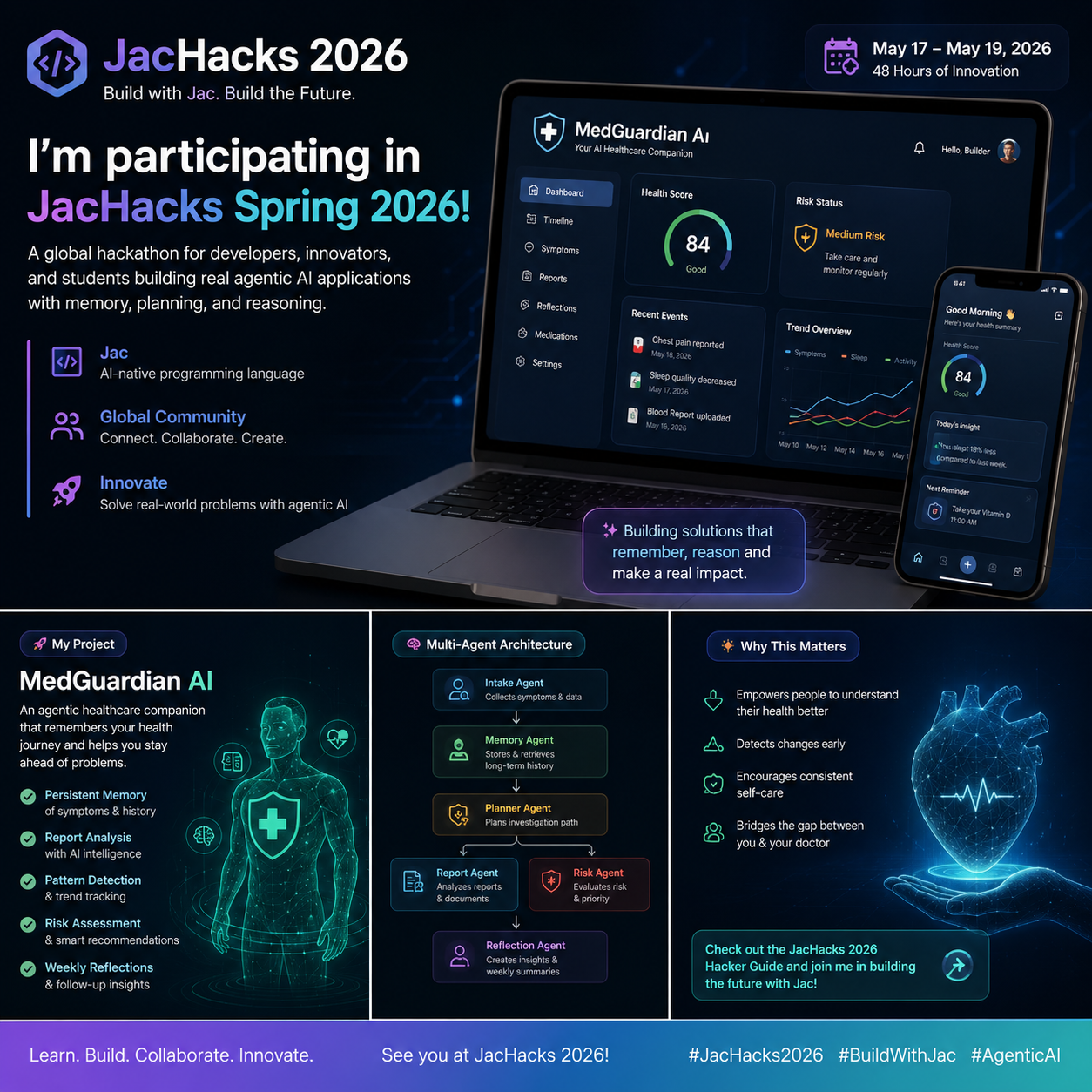
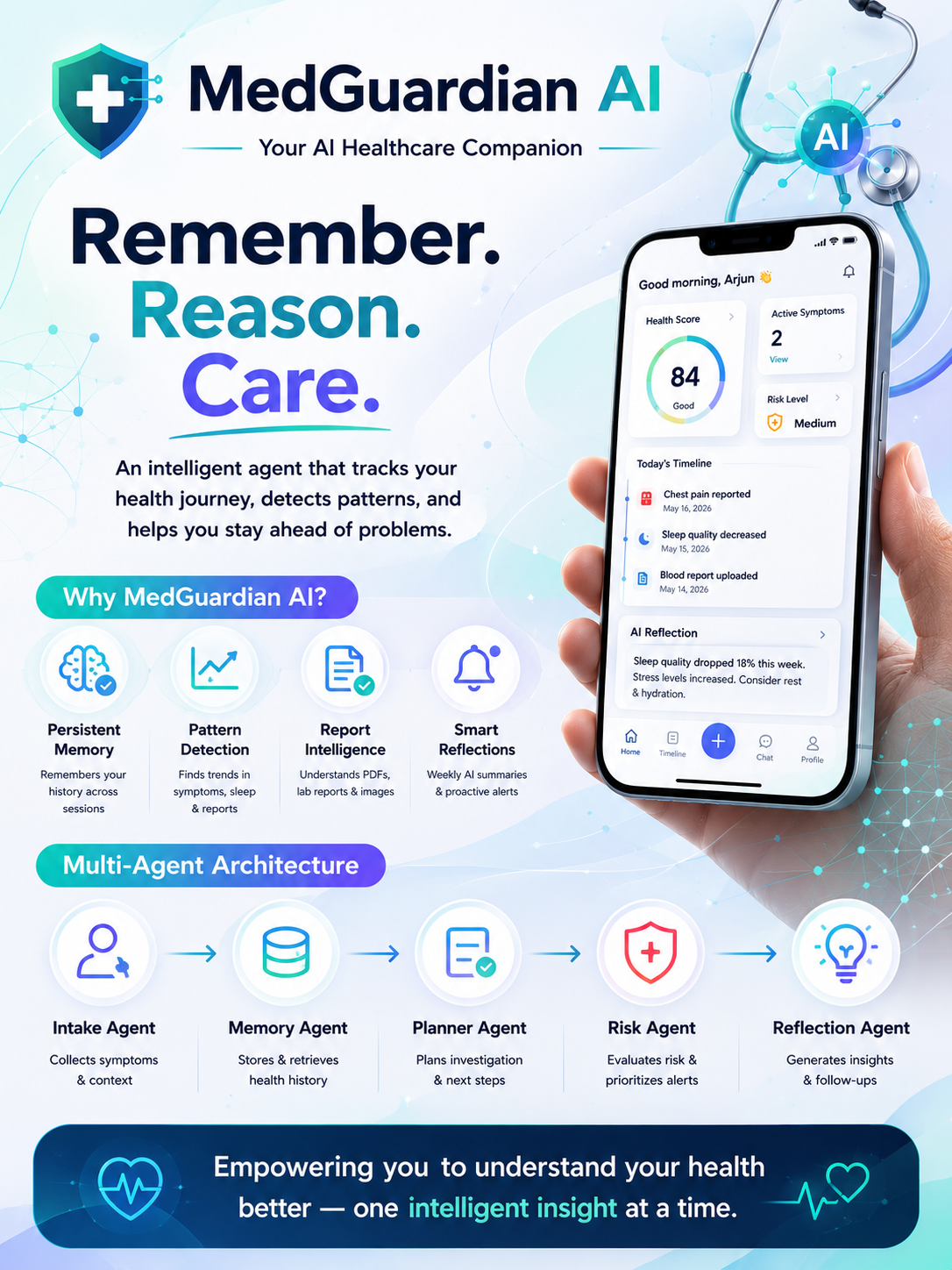
MedGuardian AI is an agentic consumer healthcare platform that remembers your history, tracks long-term wellness changes, and actively reasons over your health timeline.
Intelligent Symptom Intake: Users can input symptoms in plain natural language (e.g., "Chest pain and fatigue for 3 days").
Longitudinal Memory Matching: Instead of evaluating the symptom in a vacuum, the system automatically pulls relevant medical history and cross-references it to look for recurring patterns.
Multimodal Report Analysis: Users can drop in lab reports or PDFs. The platform extracts the text, runs medical reasoning on it, and links those data points back to existing symptom timelines.
Proactive Weekly Reflections: With a single click, a specialized reflection agent scans the entire week's worth of log data, symptom trends, and lab reports to surface an aggregated risk score and flag subtle health shifts that a user might otherwise ignore.
How we built it
Challenges we ran into
Integrating an advanced graph-based agent architecture like Jac into a standard web stack within a hackathon timeframe was a steep mountain to climb. We initially struggled with cross-session memory persistence, which occasionally caused latency bottlenecks when cold-starting the local vector database.
Additionally, building deterministic parsing pipelines for unpredictable medical PDF text layout variations (via PyMuPDF OCR) meant we had to heavily refine our LLM chunking strategies. We overcame these hurdles by establishing clear fallback structures, using strict JSON formatting schema prompts, and caching heavy operational data to protect against API rate limits.
Accomplishments that we're proud of Architecting a "Living" Memory: We successfully moved away from a basic chatbot. Watching the agent successfully flag a symptom as a "Medium Risk Recurrence" because it accurately recalled an event from two weeks prior was an absolute breakthrough.
Rock-Solid Agent Responses: We managed to get our Jac walkers and Gemini prompts to perfectly output clean, predictable JSON schema cards without breaking the UI.
A Beautiful Dashboard: We are proud of building an interface that feels like a polished, trustworthy consumer health tool, rather than a cluttered hackathon demo.
Accomplishments that we're proud of
What we learned
We learned that when it comes to Agentic AI, fewer, high-quality agents outshine complex multi-agent mazes every time. Focusing deeply on perfecting a 2-agent memory workflow yielded a substantially better user experience than trying to coordinate 5 or 6 unpolished agents. We also learned how uniquely powerful a graph-based representation of user data can be when trying to map complex, interrelated variables like timeline events, lab results, and somatic symptoms.
What's next for Untitled
The prototype we built is just the foundational layer. Moving forward, we plan to focus on:
Cross-Session Vector Scaling: Migrating from local ChromaDB instances to production-ready enterprise vector infrastructure for global user scaling.
Wearable Integrations: Hooking directly into continuous Apple Health, Fitbit, and Oura Ring API streams so our agents can actively cross-reference subjective symptom logs with objective biometrics (like heart rate variability and sleep disruption).
Proactive SMS Follow-ups: Shifting the app from a passive dashboard to an active guardian by implementing automated text-message check-ins (e.g., "Hey Alex, you logged chest pain 3 days ago. How is it feeling this morning?").

Log in or sign up for Devpost to join the conversation.