MedGuard AI — Our Story
💡 What Inspired Us
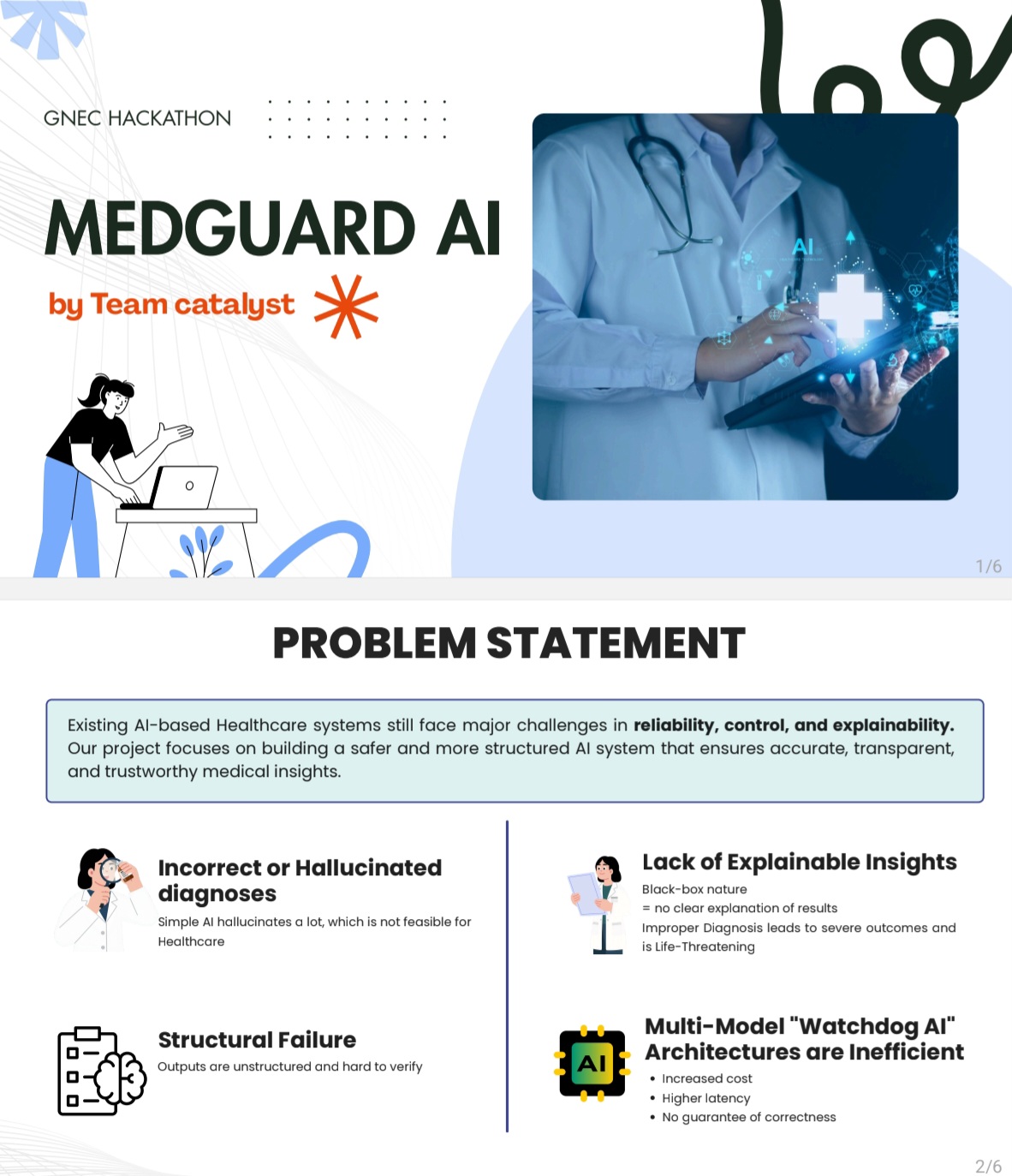
Healthcare is one of the most critical domains in the world — and yet, when we looked at existing AI-based medical tools, we saw a frightening gap. AI models were confidently giving wrong diagnoses. No explanations. No evidence. Just a black box spitting out answers that could cost someone their life.
We asked ourselves: what if AI in healthcare had a guardian? That's where MedGuard AI was born.
🔨 How We Built It
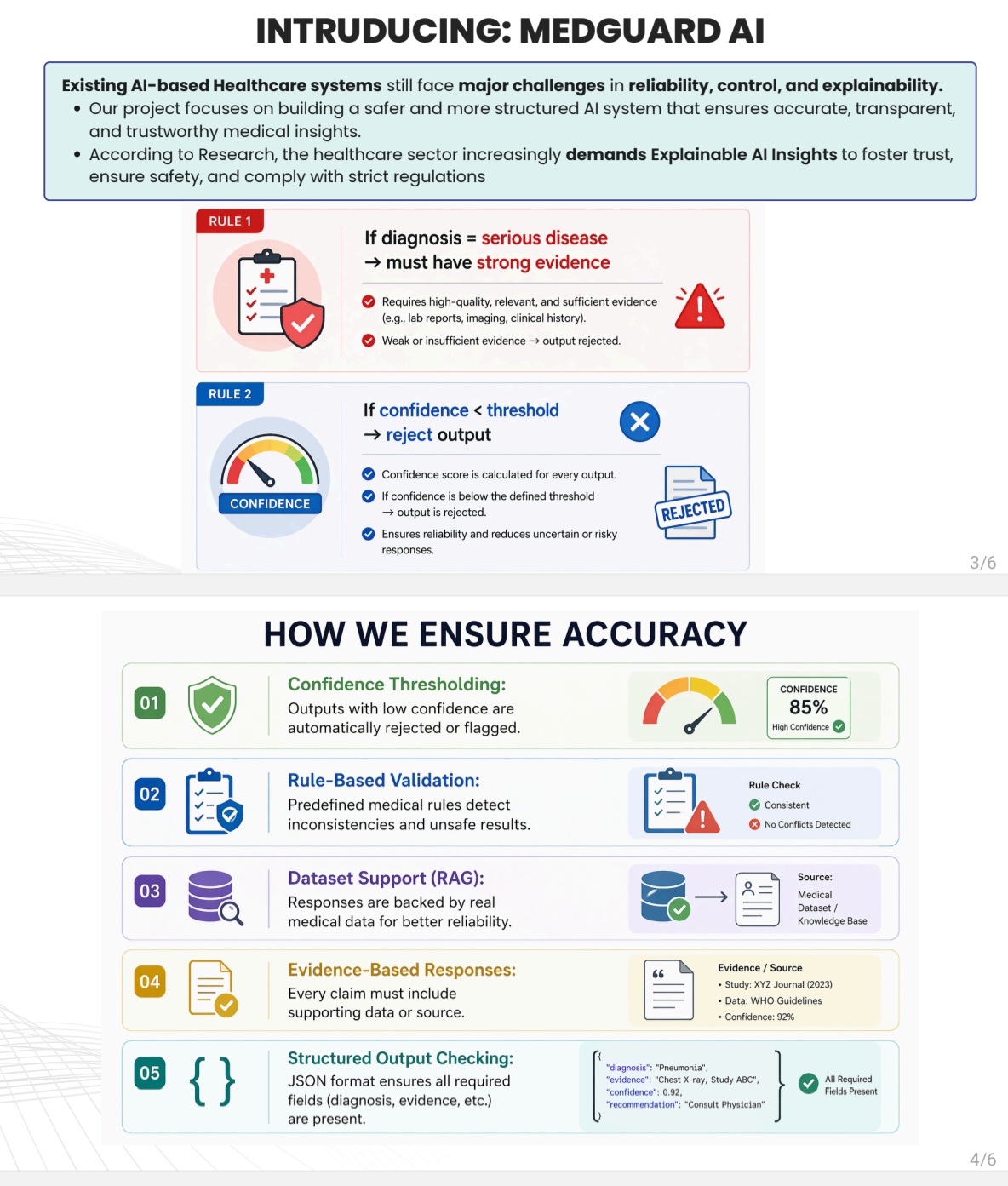
We designed a multi-layered validation pipeline:
- AI Core — processes user symptoms and medical queries
- Structured JSON Output — every response is formatted with required fields:
diagnosis,evidence,confidence,recommendation - Python Watchdog — deterministically validates the output against predefined medical rules
- Confidence Thresholding — any response below a confidence score $C < \theta$ is automatically rejected:
$$ \text{Output} = \begin{cases} \text{Valid} & \text{if } C \geq \theta \ \text{Rejected} & \text{if } C < \theta \end{cases} $$
- RAG Support — responses are grounded in real medical datasets and knowledge bases
📚 What We Learned
- Explainable AI (XAI) isn't optional in healthcare — it's essential
- A deterministic watchdog is far more reliable and cost-efficient than a second AI validator
- Structured outputs dramatically reduce hallucination risk
- Building for safety means designing for failure first
⚡ Challenges We Faced
- Defining the right confidence threshold $\theta$ without making the system too restrictive or too lenient
- Balancing latency vs. reliability — every validation layer adds processing time
- Ensuring the rule-based system covered enough medical edge cases
- Coordinating across the team under hackathon time pressure — including aligning our frontend demo name (Diagnostic AI) with our core branding (MedGuard AI)
Built with passion at the GNEC Hackathon by Team Catalyst.

Log in or sign up for Devpost to join the conversation.