-
-
MedGuard-AI

Inspiration
Healthcare scams are becoming more common, especially targeting patients and their families through fake insurance claims, lab reports, hospital appointments, and emergency donation requests. These scams often use fear and urgency, causing people to lose money and sensitive medical information. The inspiration for MedGuard-AI came from observing how difficult it is for non-technical users to identify these scams, especially when they appear to come from trusted medical sources. I wanted to build a simple tool that not only detects scams but also educates users so they can protect themselves in the future.
What it does
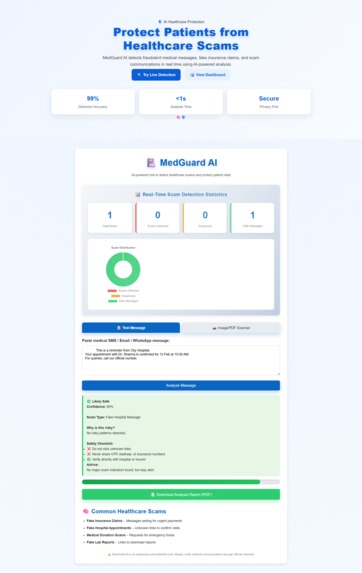
Detects medical scams in text messages and images. Explains why a message is risky. Educates users with awareness content. Helps prevent data theft and financial fraud.
How we built it
The project was built as a web-based prototype using: HTML & CSS for the user interface. JavaScript for logic and interaction. Keyword-based risk analysis to simulate AI detection. OCR (Optical Character Recognition) to extract text from images. Chart.js for real-time scam statistics. JSPDF to generate downloadable analysis reports. The scam detection logic assigns a risk score based on multiple indicators such as urgency, links, sensitive data requests, and known scam patterns: RISK SCORE=(sum of high risk keywords*2)+(sum of the medium risk keywords*1)
Challenges we ran into
Designing accurate scam detection without false positives. Handling image-based scams using OCR. Structuring the UI to clearly explain risks instead of just showing results. Making the project simple enough for everyday users while still being technically meaningful.
Accomplishments that we're proud of
Built a fully working prototype that detects healthcare scams in both text and image formats. Successfully integrated OCR scanning to analyze screenshot-based scam messages. Designed a user-friendly dashboard that clearly explains scam risks and confidence levels. Combined cybersecurity detection with user education through awareness content generation. Enabled PDF report exports for awareness, training, and documentation. Deployed the project as a live web application using GitHub Pages.
What we learned
How cybersecurity threats exploit human psychology. How OCR can be used to analyze image-based scams. The importance of combining security with education. How to design a user-friendly interface for non-technical users. How to present technical ideas clearly for real-world impact.
What's next for MedGuard-AI
Future plans for MedGuard AI include improving scam detection accuracy using machine learning models trained on real healthcare scam data. The project will expand to support multiple languages and mobile platforms to reach a wider audience.
Additional goals include integrating with hospitals and insurance providers for message verification, building a real-time scam database, and strengthening the education layer through awareness campaigns and training modules.
MedGuard AI aims to evolve into a trusted healthcare cybersecurity assistant that combines detection, prevention, and user education.
Built With
- chart.js
- css3
- githubpages
- html5
- javascript
- jspdf
- tesseract
- vercel

Log in or sign up for Devpost to join the conversation.