pdf link - https://drive.google.com/file/d/1WHMQhPxoGkdPUth0-uTY7kCsZc_M9nJe/view?usp=sharing
About the Project — AI-4-Alzheimer’s
Inspiration
Alzheimer’s disease is not only difficult to diagnose early, but also challenging to monitor longitudinally using medical imaging. While MRI scans contain rich structural information, extracting consistent, explainable, and clinically useful insights still requires significant expert effort.
This project was inspired by a simple question:
Can we combine medical imaging, modern deep learning, and domain-specific large language models to assist clinicians and researchers in understanding Alzheimer’s progression more efficiently?
AI-4-Alzheimer’s aims to bridge the gap between raw MRI data and actionable medical insight, without replacing clinical judgment.
🧠 What I Built
AI-4-Alzheimer’s is an end-to-end AI platform that transforms brain MRI scans into structured insights through:
- MRI classification & segmentation using deep learning
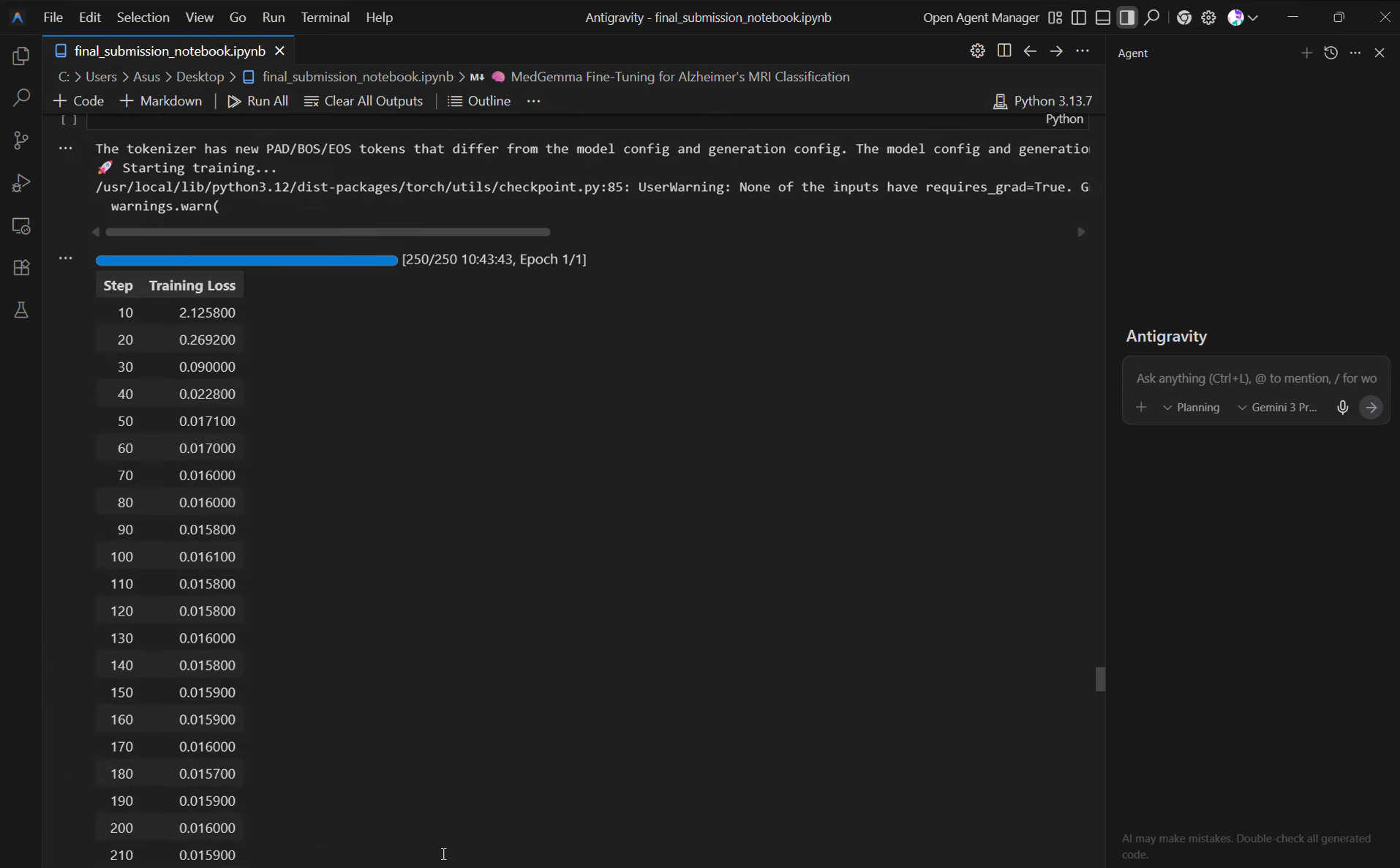
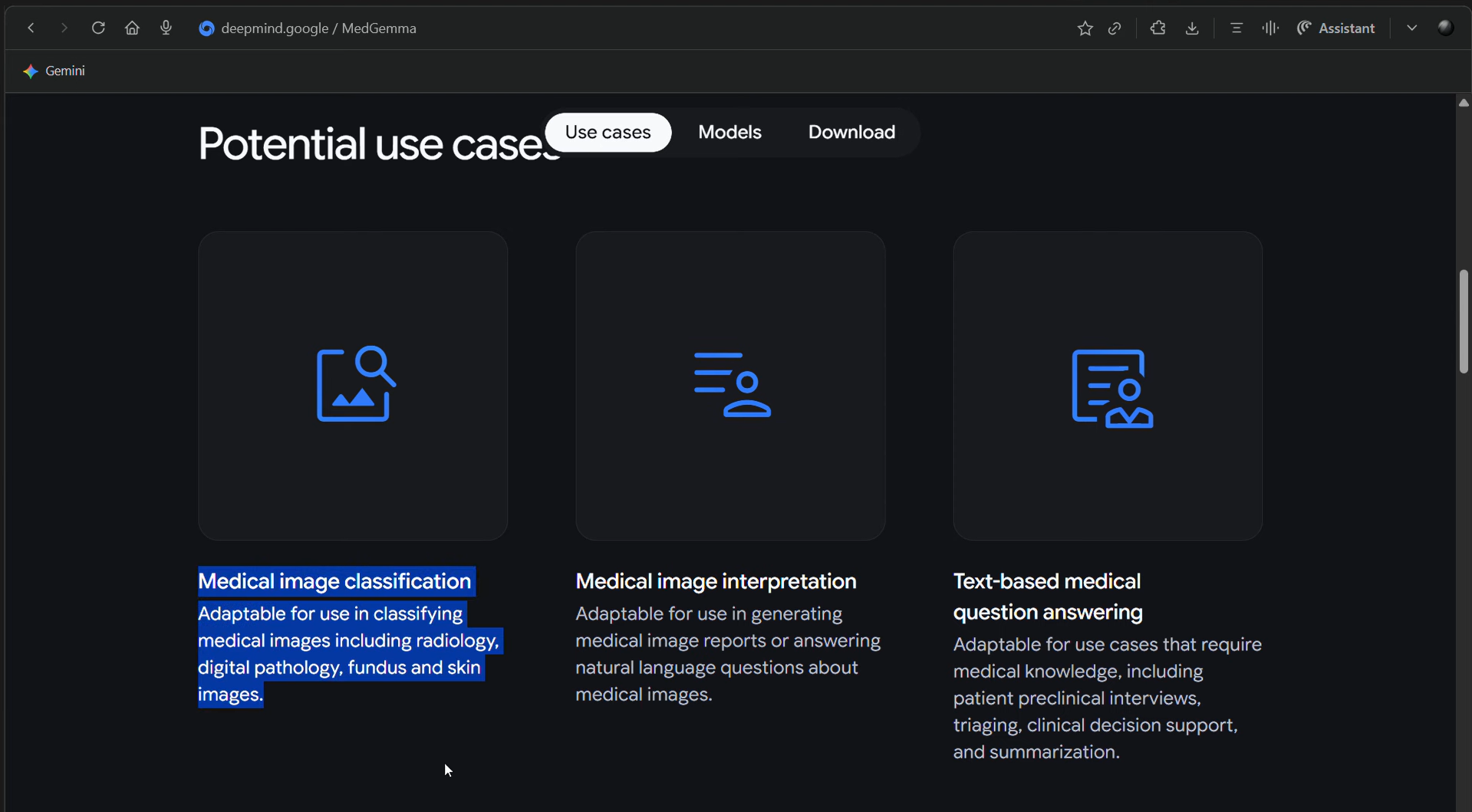
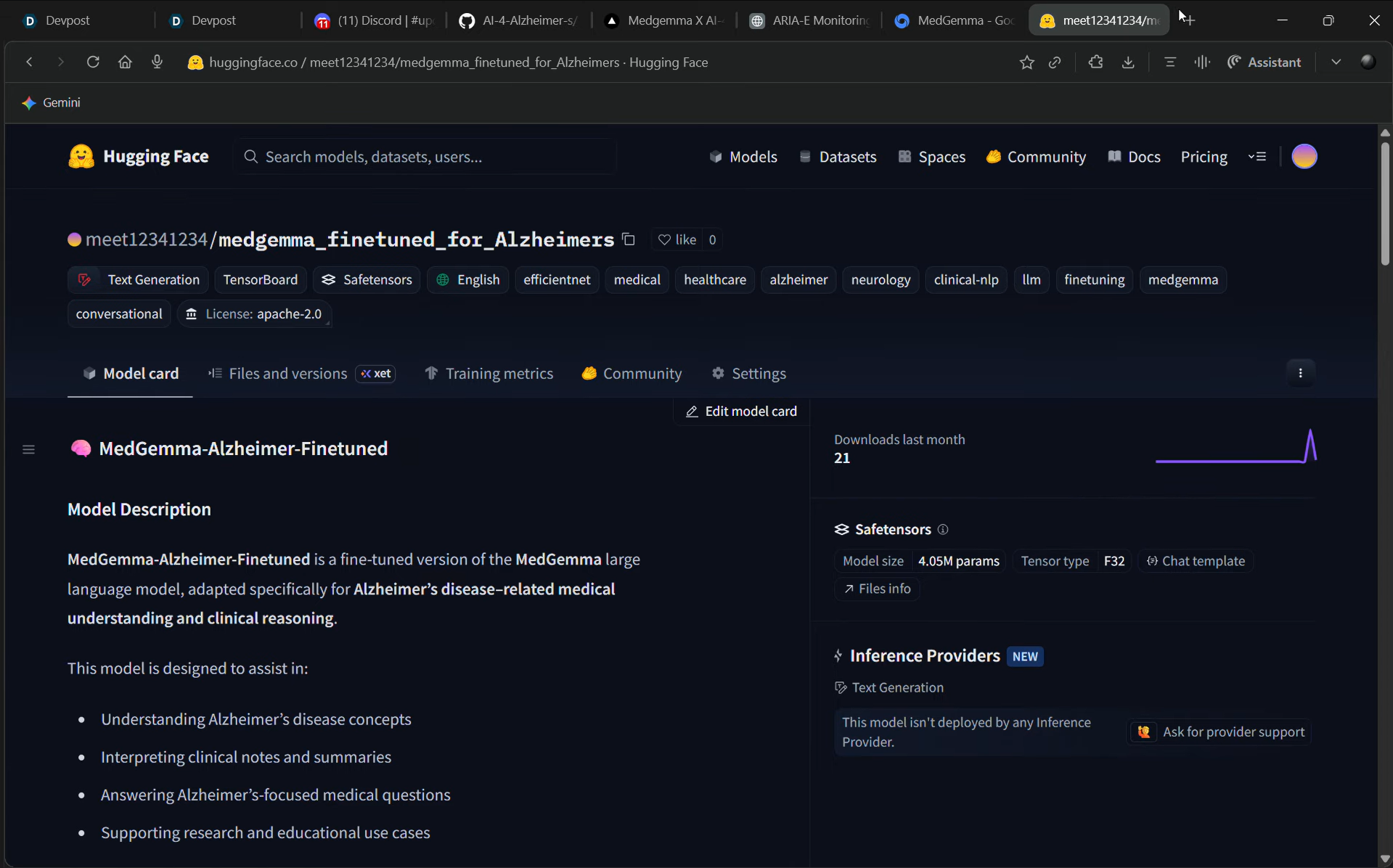
- Fine-tuned MedGemma for Alzheimer’s-specific clinical reasoning
- Retrieval-Augmented Generation (RAG) to ground responses in medical literature
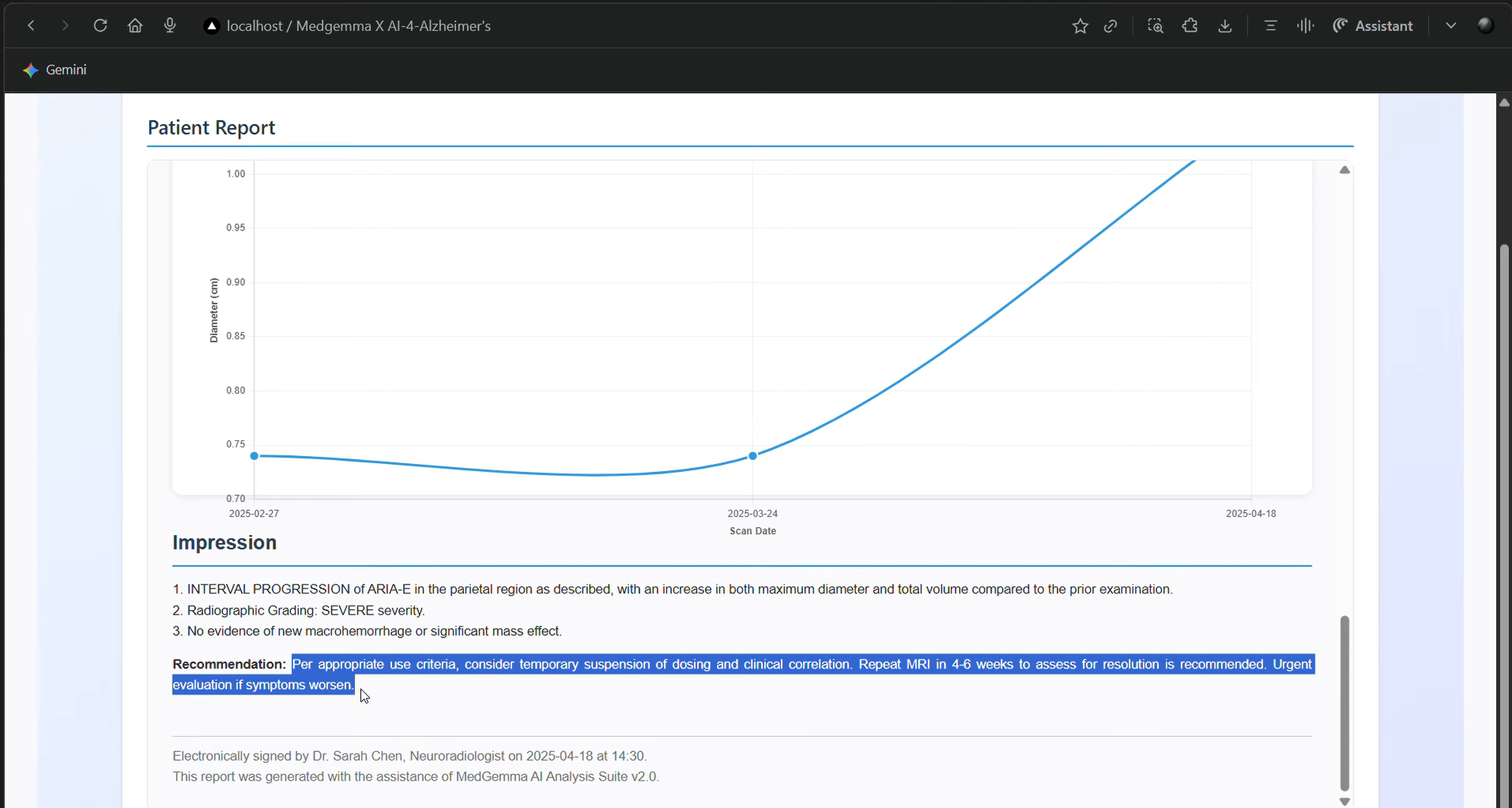
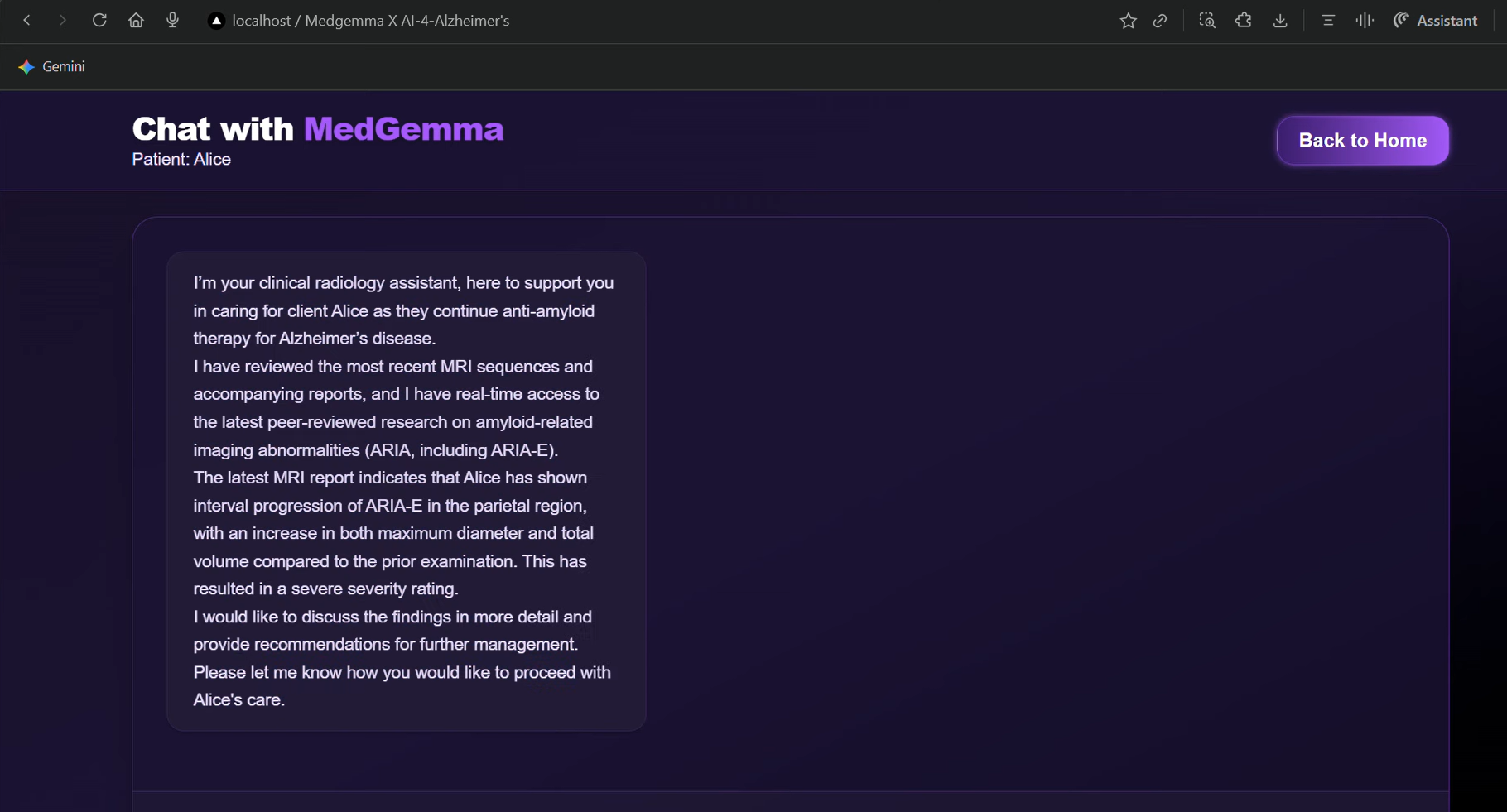
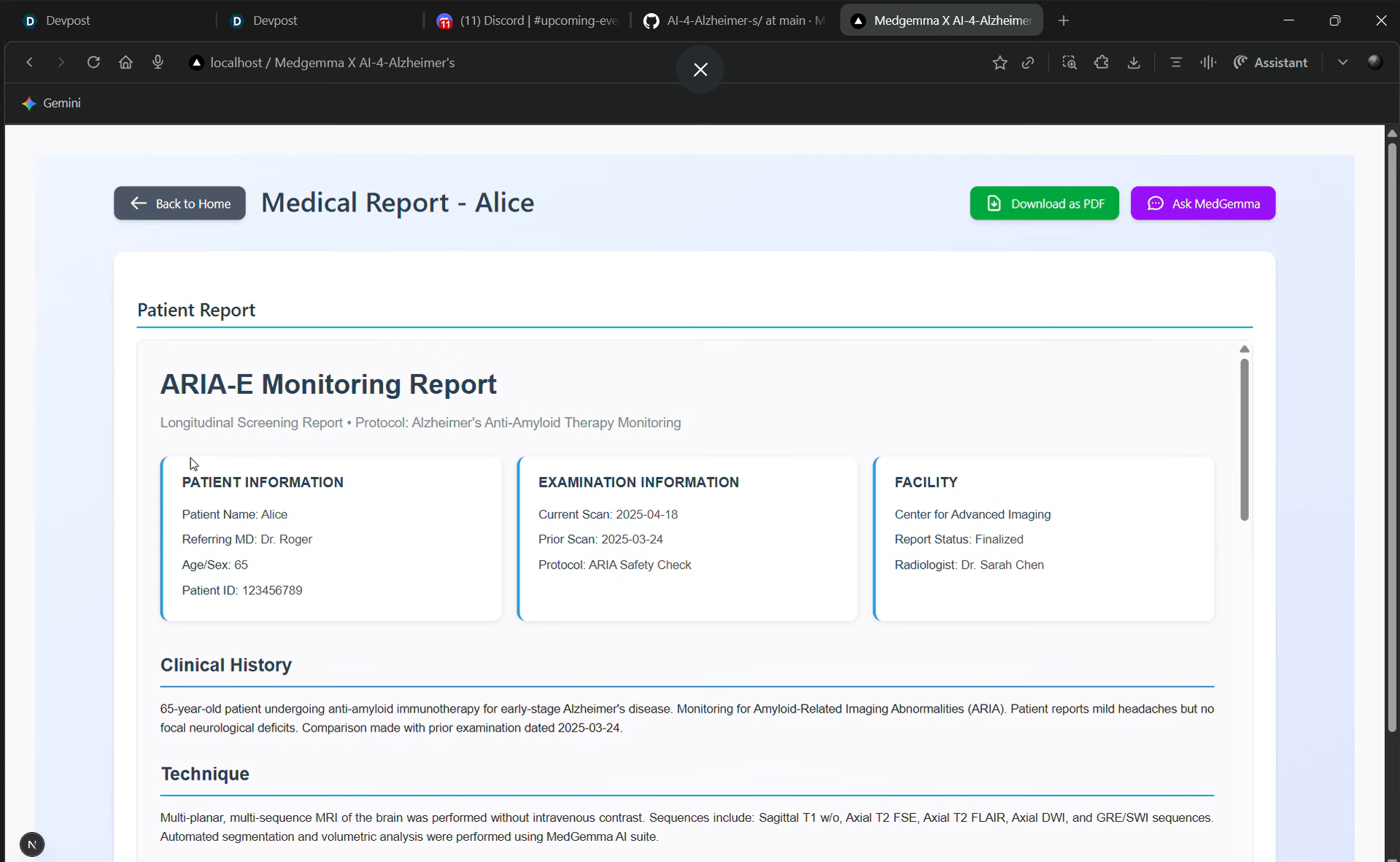
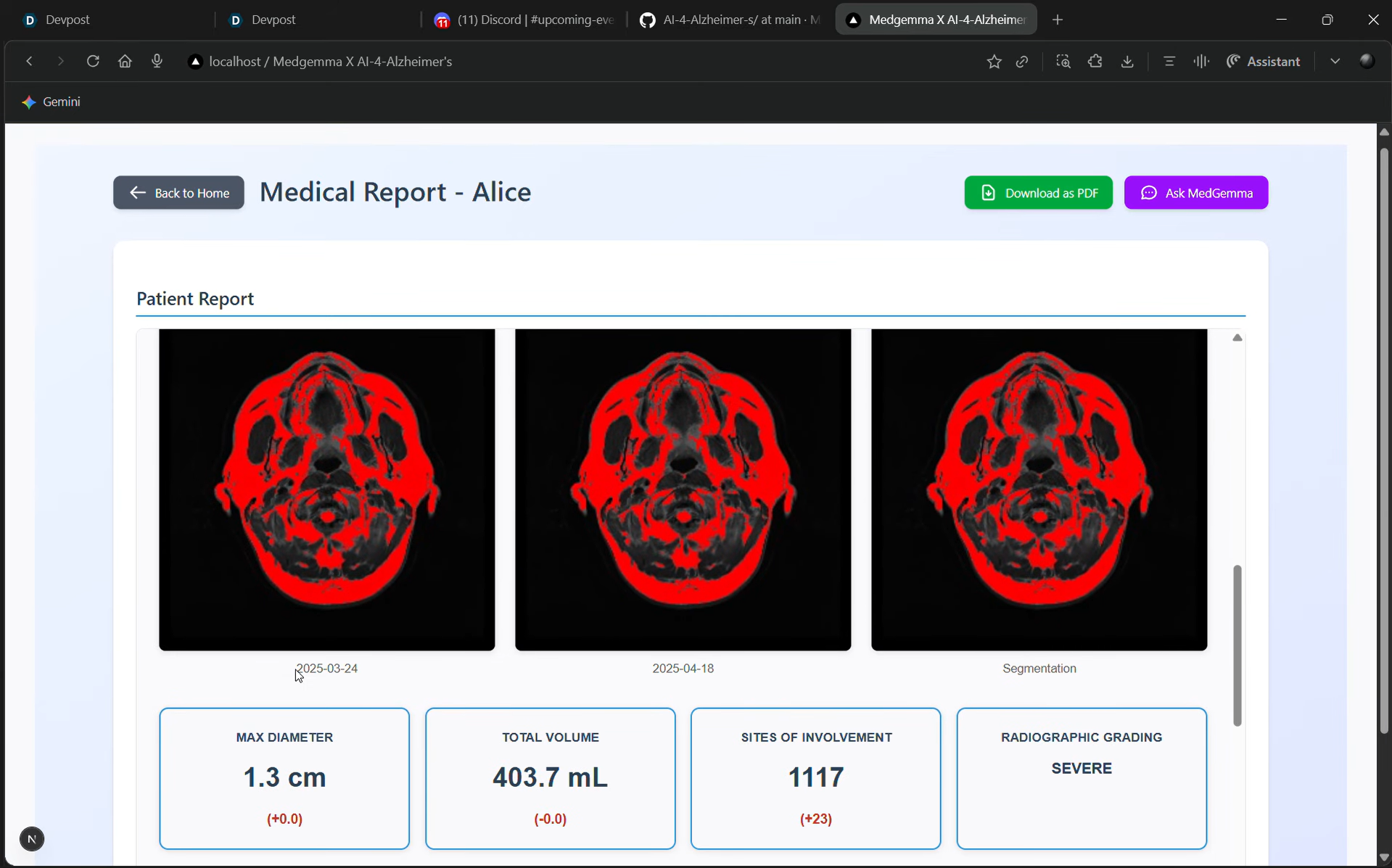
- Automated medical report generation with longitudinal comparisons
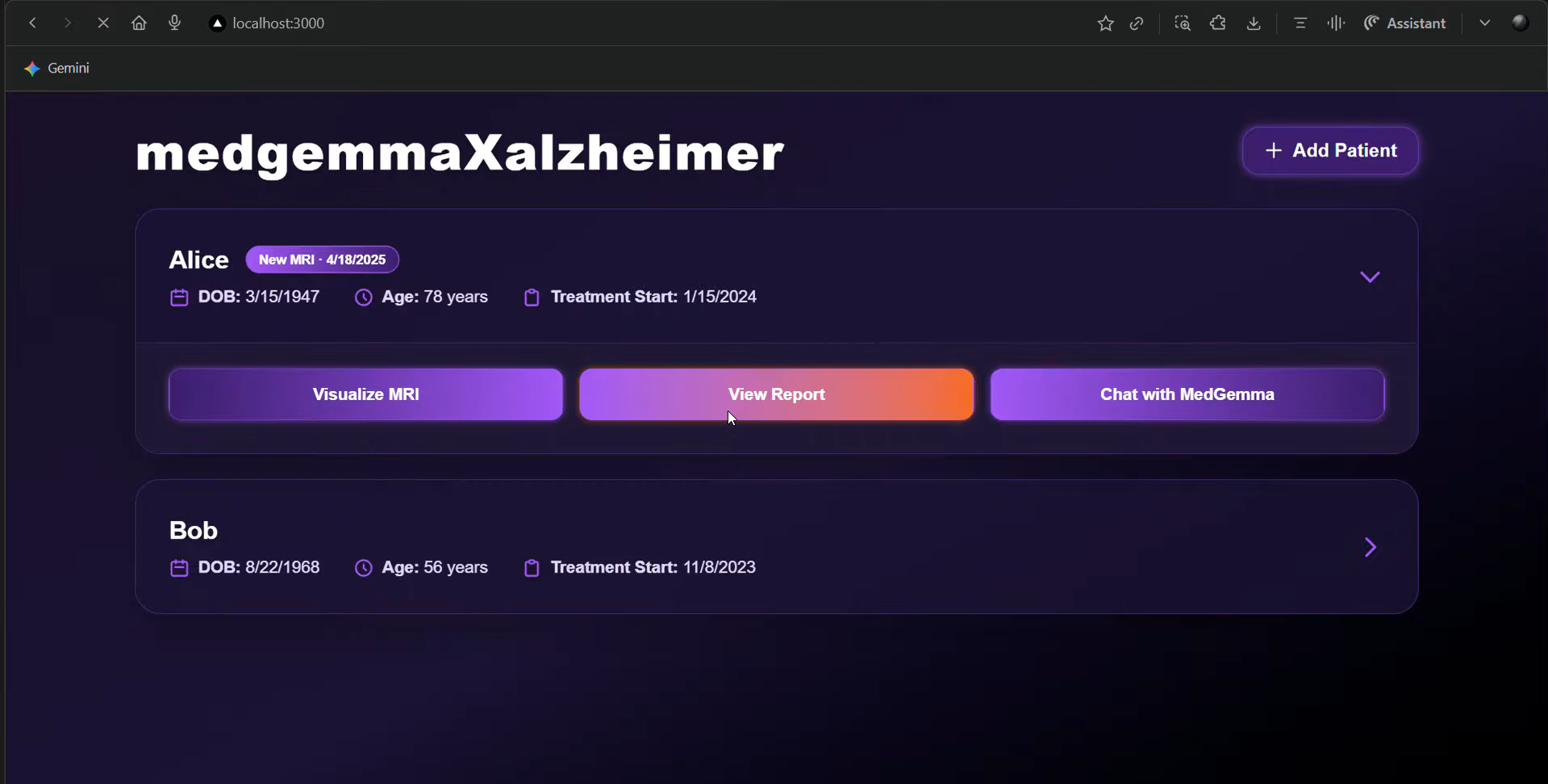
- A full-stack web interface for visualization, interaction, and analysis
The system supports Alzheimer’s severity classification, lesion segmentation, progression tracking, and natural-language clinical explanations.
🛠️ How I Built It
1. Data & Modeling
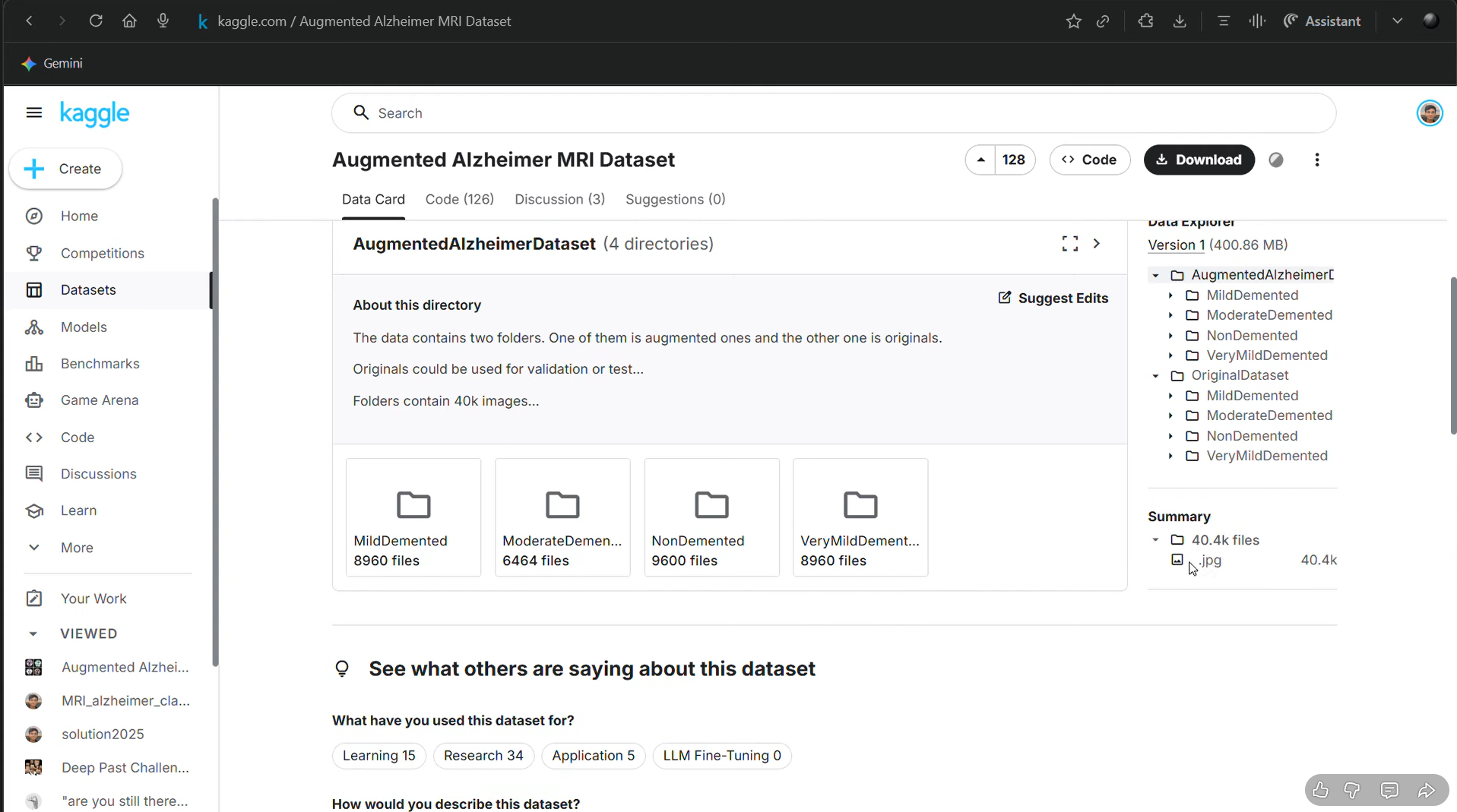
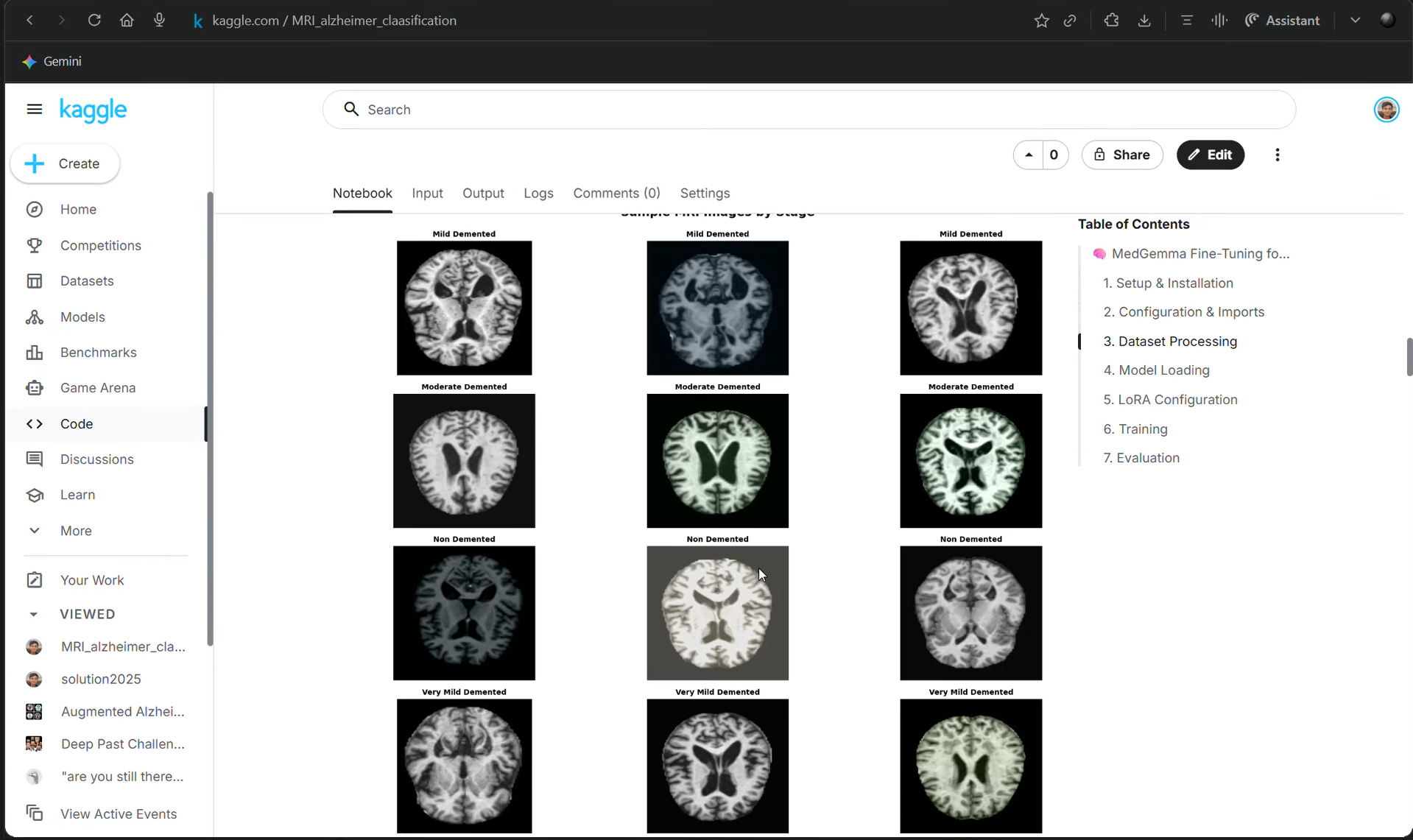
Used the Augmented Alzheimer MRI Dataset from Kaggle with four classes:
- Non-Demented
- Very Mild Demented
- Mild Demented
- Moderate Demented
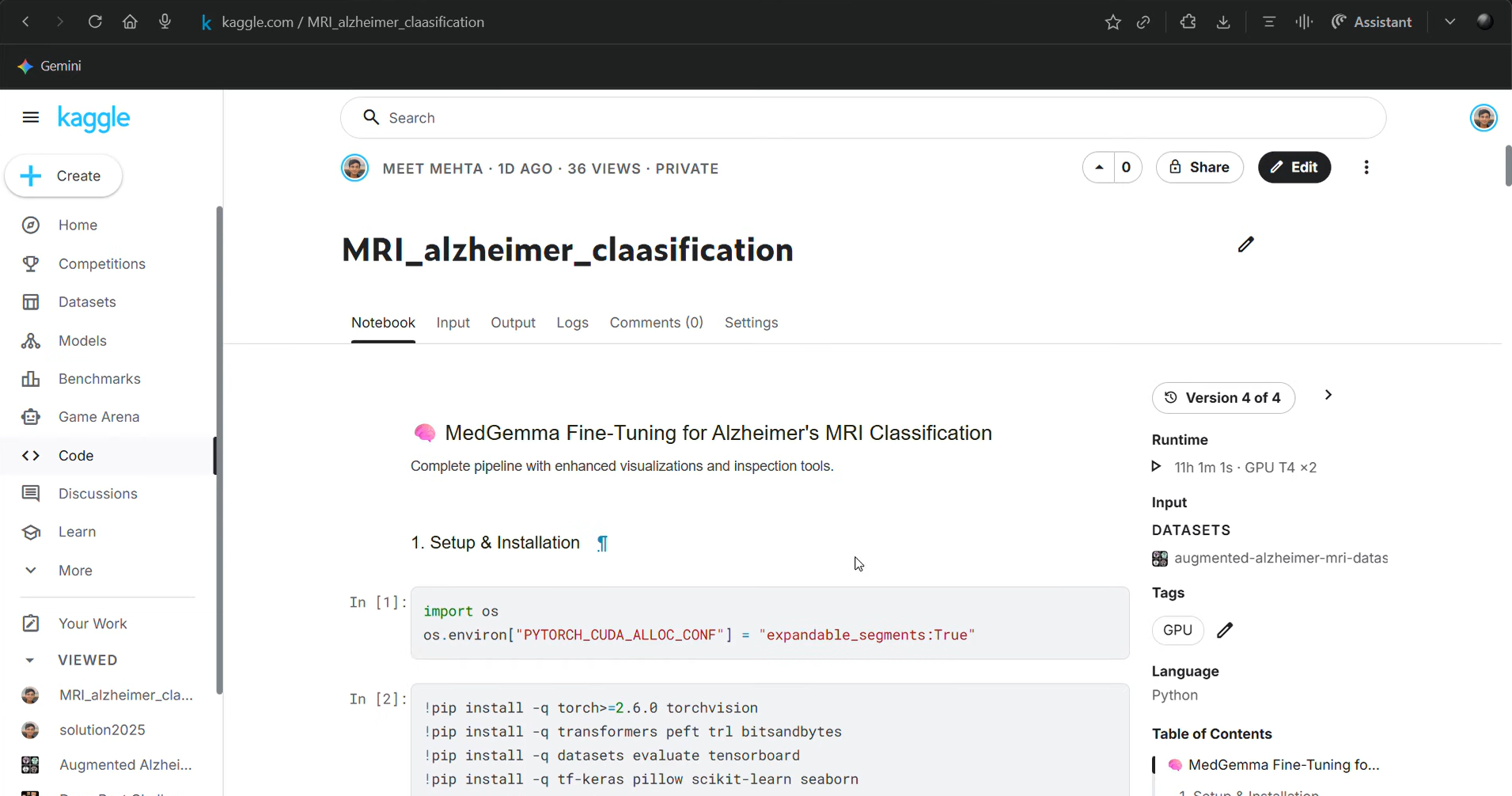
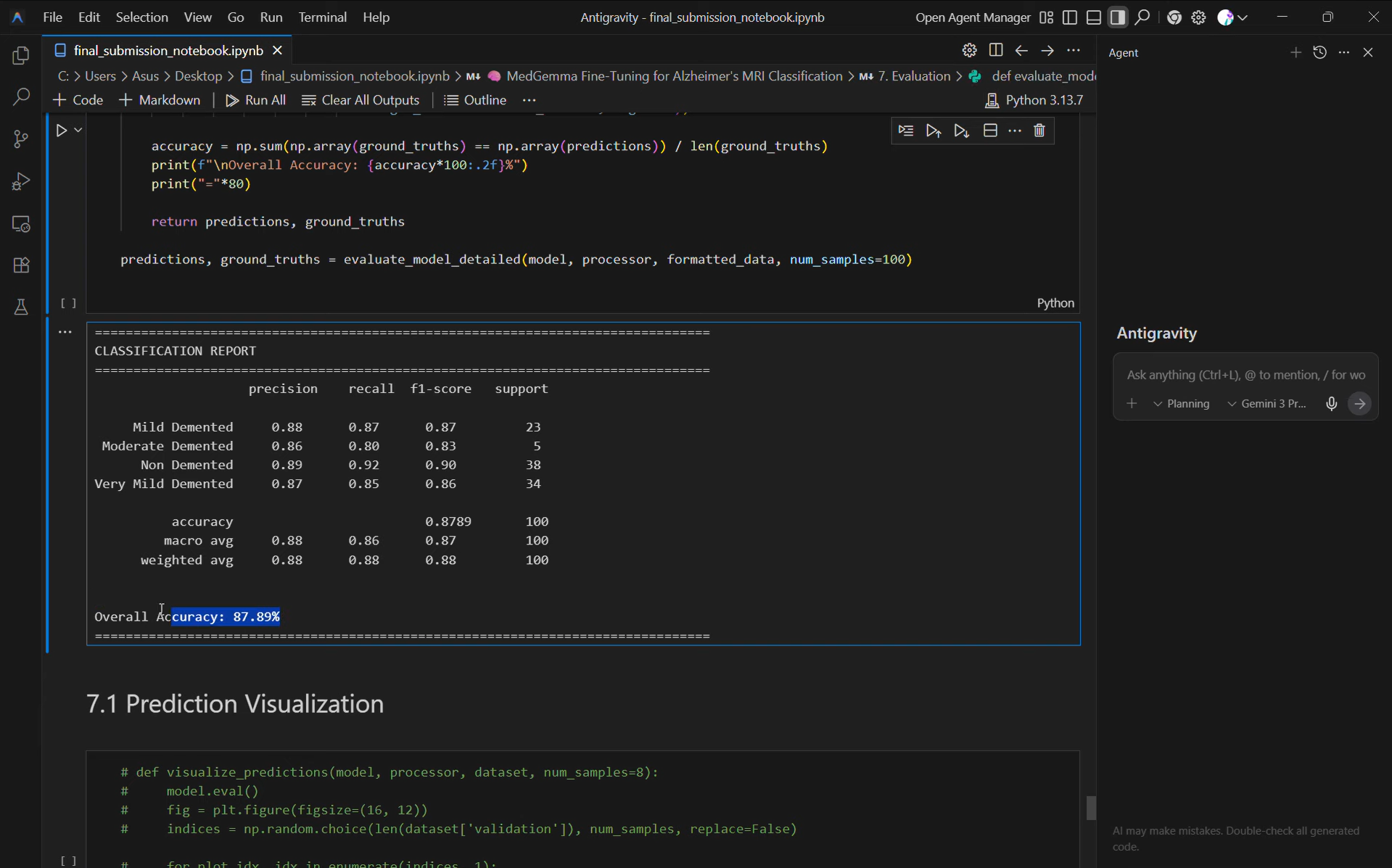
Implemented a complete training & evaluation pipeline in a Jupyter notebook
Achieved ~87.9% classification accuracy on validation samples
[ \text{Accuracy} = \frac{\sum \mathbb{1}(\hat{y}_i = y_i)}{N} ]
2. Medical Image Segmentation
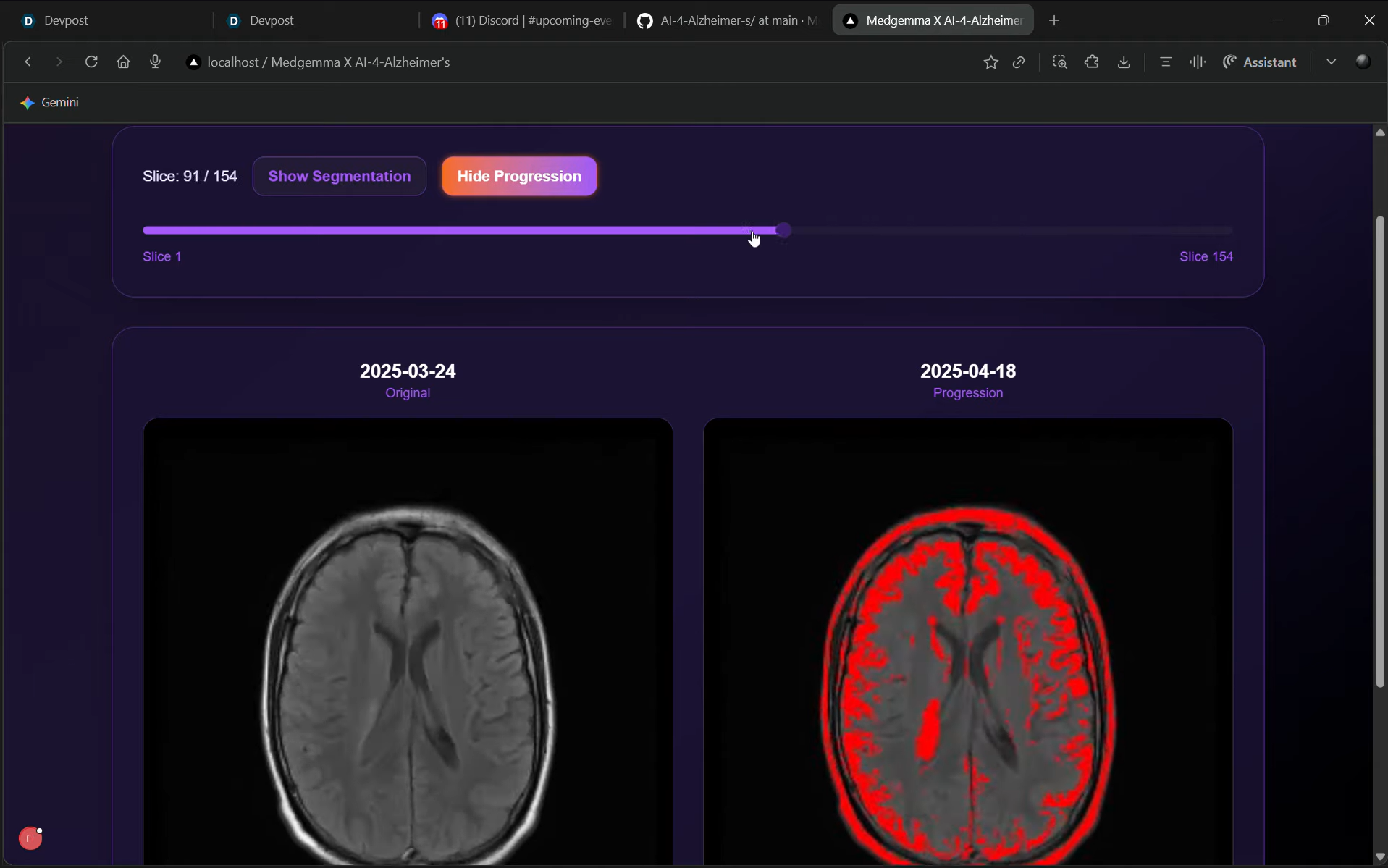
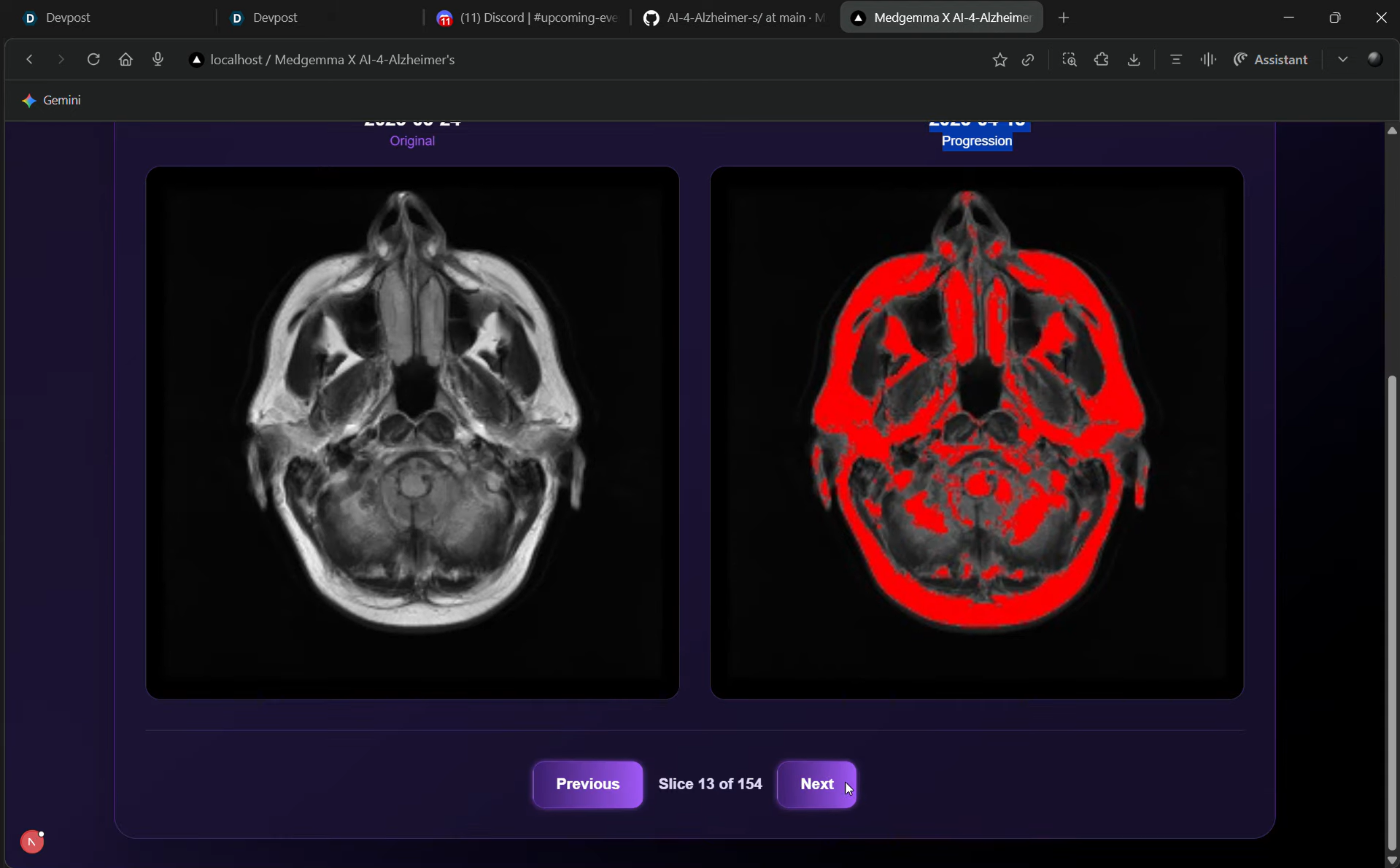
- Integrated nnU-Net for brain lesion segmentation
- Enabled slice-by-slice visualization and progression comparison
Quantified metrics such as:
- Maximum diameter
- Total lesion volume
- Sites of involvement
- Radiographic grading
3. MedGemma Fine-Tuning
- Fine-tuned MedGemma using LoRA for parameter-efficient learning
Adapted the model specifically for:
- Alzheimer’s terminology
- MRI interpretation
- Clinical reasoning
Published the model on Hugging Face for reproducibility
4. RAG-Powered Medical Knowledge
- Built a vector database of peer-reviewed medical literature
Enabled grounded responses for:
- ARIA-E interpretation
- Disease progression
- Treatment-related imaging findings
5. Full-Stack Application
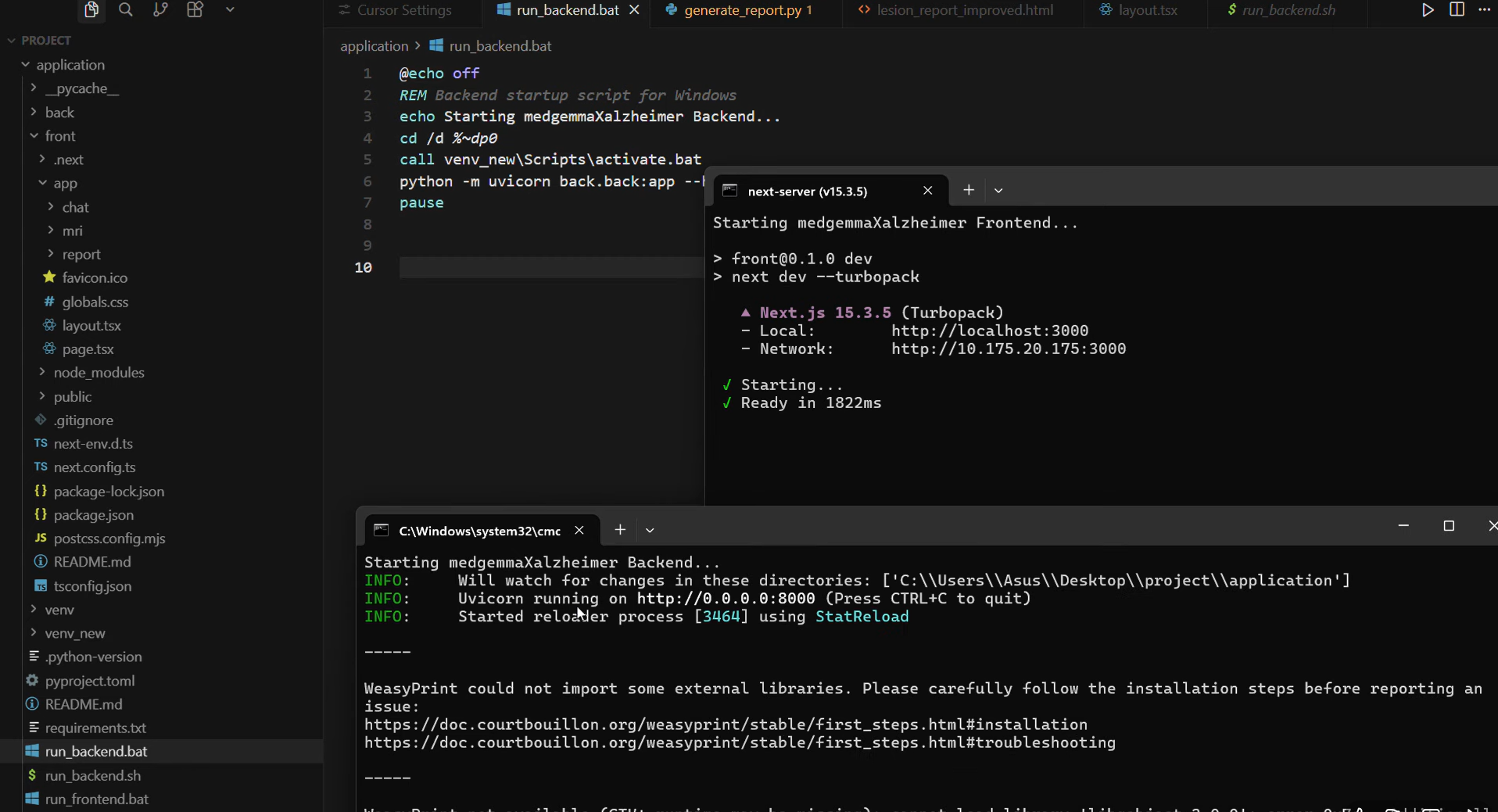
- Backend: FastAPI (MRI analysis, inference, report generation)
- Frontend: Next.js (MRI viewer, patient dashboard, reports)
Features include:
- Patient-wise MRI timelines
- Interactive segmentation overlays
- Downloadable PDF medical reports
- Conversational clinical assistant (“Chat with MedGemma”)
📚 What I Learned
This project taught me how to:
- Design production-ready ML pipelines beyond model training
- Work with medical imaging data and its domain constraints
- Fine-tune large language models using LoRA efficiently
- Combine computer vision + NLP + retrieval systems
- Build explainable, user-focused AI systems for healthcare
- Think critically about ethical AI, disclaimers, and clinical responsibility
🚧 Challenges I Faced
- Medical data complexity: MRI slices vary greatly in contrast, orientation, and noise
- Class imbalance: Required careful sampling and evaluation strategies
- Explainability: Ensuring outputs were interpretable, not just accurate
- System integration: Coordinating models, APIs, databases, and frontend views
- Clinical caution: Designing the system strictly as a decision-support tool, not a diagnostic replacement
Each challenge reinforced the importance of robust evaluation, transparency, and responsible AI design.
🌍 Impact & Vision
AI-4-Alzheimer’s demonstrates how AI can assist—not replace—medical professionals by:
- Reducing manual effort in MRI interpretation
- Improving consistency in longitudinal analysis
- Making advanced AI accessible through intuitive interfaces
- Supporting research, education, and clinical workflows
The long-term vision is to extend this platform to:
- Multi-modal imaging
- Other neurodegenerative diseases
- Federated and privacy-preserving learning setups
🔗 GitHub Repository: https://github.com/MeetInCode/AI-4-Alzheimer-s/tree/main
Built With
- fastapi
- gcp
- github
- huggingface
- jupyter
- kaggle
- lora
- medgemma
- nextjs
- nnu-net
- node.js
- ollama
- python
- pytorch
- rag
- scikit-learn
- seaborn
- transformers
- unsloth


Log in or sign up for Devpost to join the conversation.