-
MedFlow CostEco
MedFlow CostEco Making Medical Supply Waste Visible, Measurable, and Manageable
Inspiration
As a master's student in economics at the University of Toyama, Japan, my research focuses on hospital medical supply chains, environmental management accounting, and resource efficiency. During my research, I began to consider an important question: What if hospitals could identify and prevent avoidable medical supply waste before it creates financial losses and environmental burdens? Hospitals rely heavily on disposable medical supplies, including syringes, gloves, and infusion sets. These products are essential for healthcare delivery. However, inventory expiration, inefficient allocation, and unnecessary disposal can also generate avoidable waste. I came to realize that sustainability in healthcare should not begin only when waste reaches a treatment facility. It should also be integrated into everyday decisions concerning procurement, inventory management, and resource allocation. This idea inspired me to develop MedFlow CostEco, a non-code sustainability innovation framework that connects medical supply management with financial and environmental evaluation.
What it does
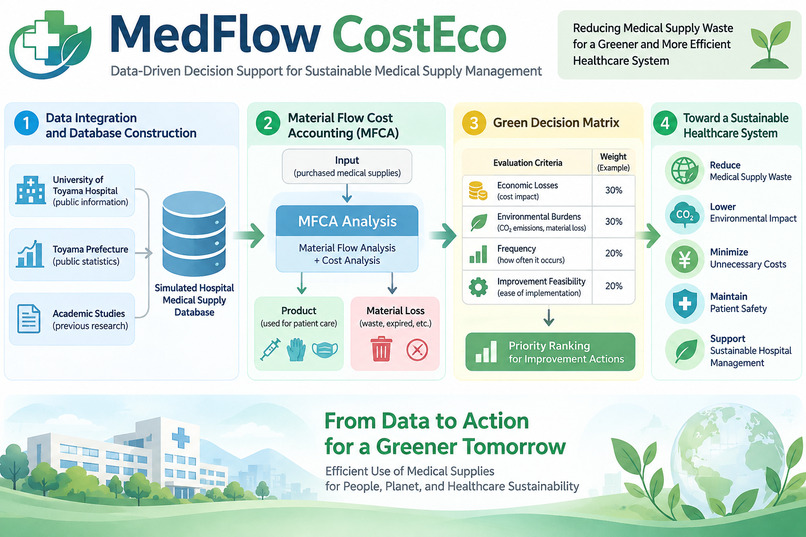
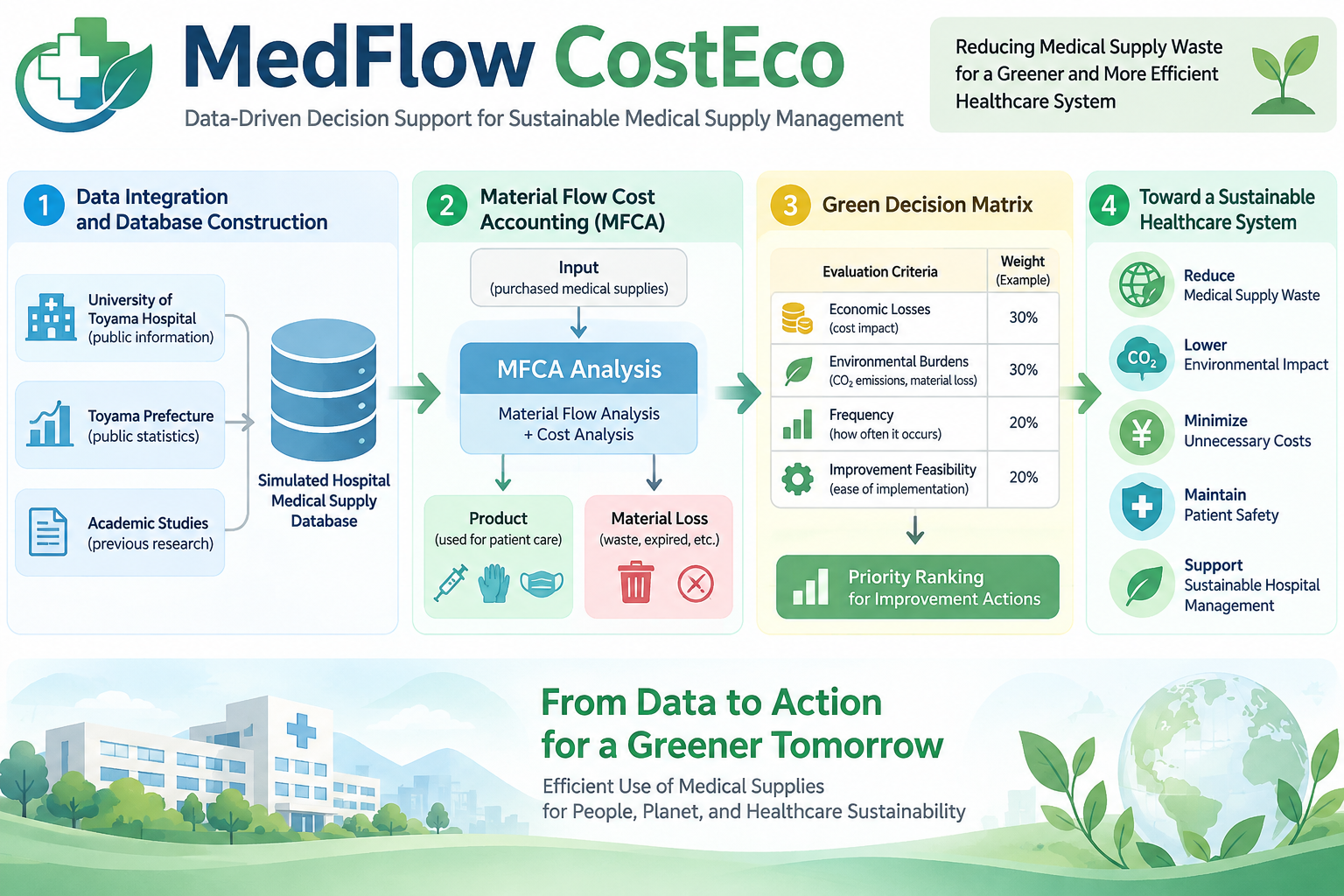
MedFlow CostEco aims to help hospitals identify, evaluate, and reduce avoidable medical supply waste. The framework consists of four interconnected stages. Step 1: Construct the Material Flow Identify how selected medical supplies move through procurement, storage, departmental distribution, clinical use, and final disposal. Step 2: Measure Material Losses and Associated Costs Evaluate avoidable material losses and their economic consequences. Unlike approaches that focus primarily on purchasing costs or waste disposal expenses, MedFlow CostEco incorporates Material Flow Cost Accounting (MFCA), a method of environmental management accounting. This approach considers not only the costs of wasted medical supplies but also associated costs, such as personnel time spent handling material losses, where these costs can be reliably identified and allocated. Where reliable data are available, the framework can also incorporate environmental indicators, including discarded material mass and waste treatment requirements, allowing comparisons between economic losses and environmental burdens. Step 3: Determine Improvement Priorities Apply the proposed Green Decision Matrix to evaluate waste-related problems using four dimensions: Economic Loss Environmental Burden Frequency of Occurrence Improvement Feasibility Step 4: Implement Improvements and Monitor Performance Develop practical interventions, including expiration monitoring, improved inventory rotation, better allocation of medical supplies across departments, and the integration of resource efficiency indicators into management performance evaluations. Regular assessments can then be conducted to evaluate improvements and update management priorities. The overall objective is to transform fragmented operational information into accessible, actionable sustainability information that supports hospital decision-making.
How we built it
I developed the conceptual framework of MedFlow CostEco by integrating principles from Material Flow Cost Accounting, material flow analysis, and hospital supply chain management. Rather than developing a complex software system, I focused on designing a low-cost, accessible, and practical management decision-support tool. Given the financial pressures faced by many healthcare institutions, a relatively simple and cost-efficient framework may be easier to adopt than an expensive and technically demanding software platform. The proposed framework can be presented and applied through process flowcharts, structured evaluation tables, and spreadsheet-based calculations. The central mechanism of MedFlow CostEco is the Green Priority Score , which supports the systematic prioritization of medical supply waste reduction opportunities. $$GPS = w_e E + w_b B + w_f F + w_i I$$ E: Economic Loss Score B: Environmental Burden Score F: Frequency of Occurrence Score I: Improvement Feasibility Score w: Weight assigned to each evaluation dimension Each dimension is evaluated on a five-point scale, and the sum of all weights equals 1. Under the default setting, all four dimensions receive equal weights of 25%. However, hospitals can adjust these weights according to their financial circumstances and environmental management objectives. For example, a hospital with relatively strong financial resources and environmental sustainability goals may assign greater weight to environmental burden and less weight to economic loss. Conversely, a hospital facing significant financial constraints may place greater emphasis on economic loss. This flexible weighting mechanism allows different hospitals to establish improvement priorities according to their specific circumstances while maintaining a consistent evaluation structure. At its current stage, MedFlow CostEco is a conceptual innovation proposal, rather than an operational hospital management system or a clinically validated intervention.
Challenges we ran into
One of the most significant challenges in developing this project was integrating environmental sustainability with the operational responsibilities of healthcare institutions. The primary responsibility of a hospital is to provide safe and effective medical care, rather than simply minimize environmental burdens. Therefore, reducing material consumption must never come at the expense of patient safety, infection prevention, or healthcare quality. For this reason, MedFlow CostEco focuses on avoidable material losses, rather than reducing the use of medically necessary supplies. Another major challenge was the limited availability of detailed hospital operational data. Information concerning material flows, procurement costs, and medical waste treatment processes is often difficult to obtain from publicly accessible sources. To address this challenge, I explored the use of publicly available information from the University of Toyama Hospital, health-related statistics published by Toyama Prefecture, and data reported in previous academic studies and research reports. These sources can support the construction of a hypothetical hospital scenario for demonstrating the proposed framework. Because such a scenario may integrate information from different hospitals, departments, and years, its results cannot be directly interpreted as the actual operational performance of a particular hospital. Nevertheless, it can be used to examine the calculation logic and potential applicability of the framework.
Accomplishments that we're proud of
One accomplishment I am proud of is developing the conceptual framework of MedFlow CostEco by integrating Material Flow Cost Accounting (MFCA), medical supply chain management, and environmental sustainability. I also designed the Green Decision Matrix, a flexible evaluation mechanism that considers economic losses, environmental burdens, frequency, and improvement feasibility. Most importantly, I transformed my academic research experience into a practical, non-code innovation concept that aims to help hospitals reduce avoidable medical supply waste without compromising patient safety.
What we learned
Developing MedFlow CostEco helped me better understand how environmental sustainability and management accounting can complement each other in the healthcare sector. I learned that sustainability innovation does not necessarily require sophisticated information technology.
What's next for MedFlow CostEco
The future development of MedFlow CostEco will focus on the following areas: Refining the evaluation criteria and weighting system to improve flexibility and practical relevance. Developing a spreadsheet-based demonstration model using clearly documented data sources and assumptions. Examining additional medical supply case studies to further evaluate the framework. Seeking feedback and validation opportunities from healthcare supply chain and environmental management professionals. Exploring the development of a visual management dashboard that integrates environmental and financial performance indicators. Any future real-world implementation must comply with patient safety requirements, infection control standards, and applicable medical waste management regulations. The long-term objective is to make medical supply waste more transparent and manageable, helping healthcare institutions improve resource efficiency while maintaining the quality and safety of patient care. MedFlow CostEco aims to transform hidden material losses into evidence-informed management decisions, reduce avoidable resource waste at its source, and contribute to more sustainable healthcare.
Built With
- ema
- mfa
- mfca

