-
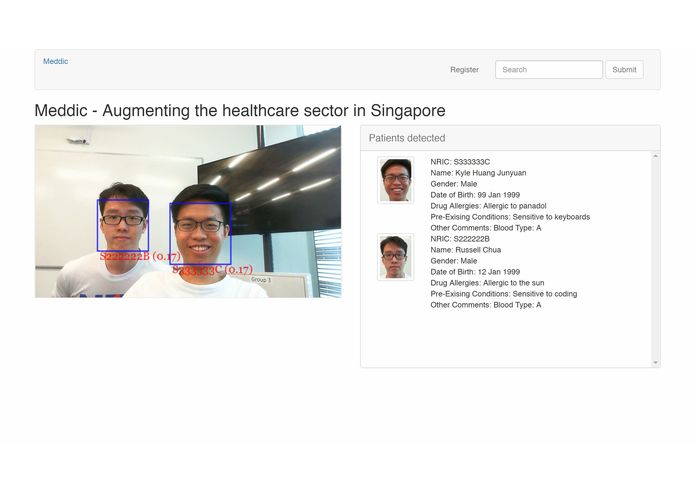
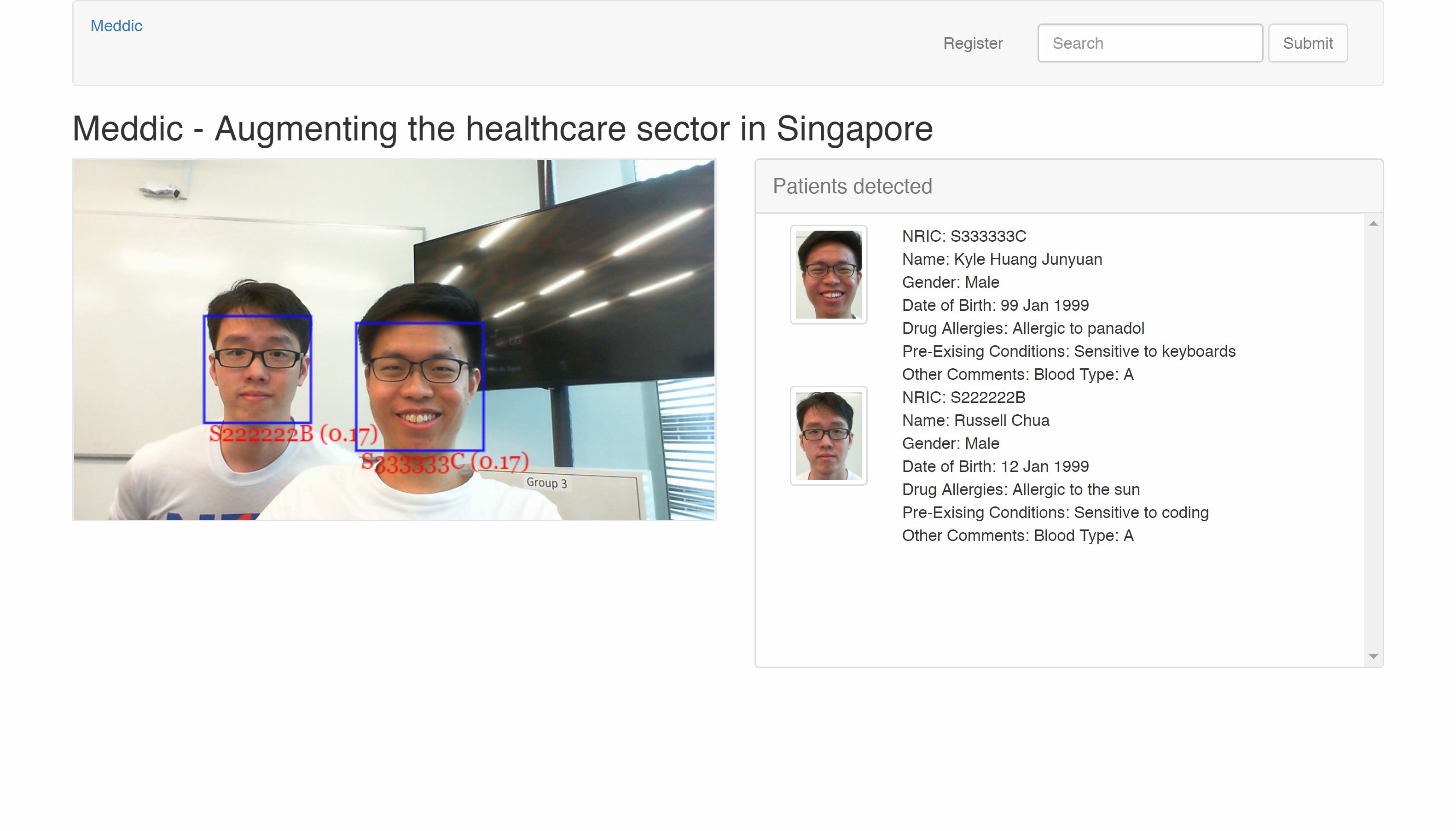
Prototype of patient recognition in Meddic
Inspiration
Our team was looking to make use of facial recognition technology to augment the healthcare sector in Singapore. Are we able to move away from identifying patients through a physical NRIC card? With the push of the smart nation initiative, we built Meddic to help clinics and hospitals to leverage image recognition technology, making it easy to identify patients and quickly obtain all their medical information.
What it does
Using a simple application, nurses in clinics and hospitals can easily register patients to see doctors without the need for patients to carry along their NRIC card. Once registered, all medical details (i.e. pre-existing medical conditions, drug allergies, blood type etc.) are fetched from the database and made available to the doctors immediately.
First responders that attend to victims will also be able to take advantage of Meddic. With a simple scan, all pre-existing medical conditions, drug allergies and blood type will be displayed on the application. This allows doctors/nurses to quickly attend to patients with the necessary precautions as quickly as possible rather than looking for physical identification that the patient may not be holding at the time.
We believe this will help push the Smart nation initiative by removing the reliance on physical forms and NRIC for registration purposes. This would be used to send patients through faster processing and access to healthcare as efficiently as possible.
How we built it
For this demonstration, we have decided on building a web application with simple HTML front end and nodeJS on the back-end, all of which running on an express framework. For fast deployment, we decided to use Firebase as our database and hosting source.
For our proof of concept, we decided to make use of a Face Recognition API (build on Tensorflow core module) to match users against their pre-captured faces. Due to the short development time span, we did not have the resources to capture training data. Hence we made use of 128 unique face descriptor values for matching, with surprisingly accurate results.
Challenges we ran into
The toughest and most tedious challenge we experienced was capturing the face descriptors of users, parsing necessary data from a huge chunk data of descriptor data from the Firebase Storage and comparing those descriptors to every video input frame of the presently captured faces.
Furthermore, due to the frame by frame descriptor comparison, we had to find efficient ways to organise our code to cater for reduced lag time and better face matching performance.
Accomplishments that we are proud of
Although many of us have never joined a hackathon, we are proud to be able to come out and present a working prototype within 24 hours. It was a really nerve wrecking process and we even had thoughts on abandoning the hackathon all together. However, we believed in each others capabilities and pushed on. To overcome our struggles and see our idea grow into a working prototype, it brought smiles to our faces and we could all agree that it was an accomplishment we were very proud of.
What we learned
Often we may doubt our teammates abilities, but what we learnt from this event is to trust each other. Without trust, it will be very hard for our team to go far. We also learnt that it is important to work together. There will be many disagreements between team members, but after all, we should put our difference aside and see the potential in each other, helping each other in various parts of the project.
Additionally, we also learnt how rapid prototyping is certainly possible within a days work. With many APIs out there, it was really easy to setup a running application fast. Furthermore, with good delegation, teamwork and leadership, miracles can happen.
What's next for Meddic
Future implementations for Meddic would be to integrate more advanced recognition models such as infra-red to improve matching performance and 3D detection models to prevent the use of an image bypass.
Our platform should not only be able to serve the needs of healthcare services but target various different sectors. One of which we have considered is the use of this system in the School’s attendance taking process in which our technology can potentially eliminate physical attendance taking procedures and attendance forgery incidences.
Moreover, we would like our platform to be versatile and adaptable to kinds of application and hopefully solve many problems to come, embracing our future as a smart nation
Built With
- face-api
- firebase
- html
- javascript

Log in or sign up for Devpost to join the conversation.