-
-
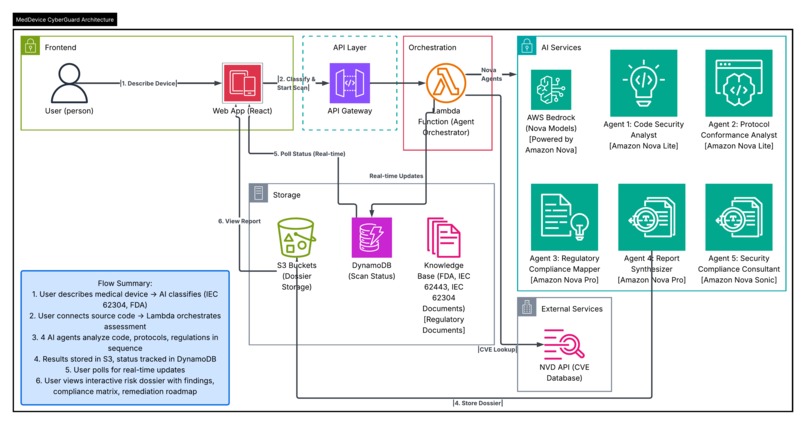
MedCyberGaurd Architecture Overview
Inspiration
In 2024, the FDA mandated cybersecurity documentation for all new medical device submissions under the Consolidated Appropriations Act. As a team with hands-on experience shipping medical device firmware under IEC 62304 in production, we have seen firsthand how manufacturers struggle with this requirement. Compliance teams spend 6 to 12 weeks manually preparing cybersecurity risk dossiers: mapping code vulnerabilities to FDA guidance, analyzing communication protocols, building threat models, and generating SBOMs.
Meanwhile, hospitals are deploying thousands of connected devices with unknown security postures. A compromised infusion pump or sterilizer is not just a data breach. It is a patient safety issue.
We saw an opportunity: what if AI agents could automate the entire cybersecurity assessment workflow and produce an FDA-ready dossier in minutes?
What it does
MedDevice CyberGuard is a multi-agent system powered by Amazon Nova that performs end-to-end cybersecurity assessment of connected medical devices.
Input: Device firmware (C/Python), IoT communication logs, network architecture diagrams, device specifications
Output: A structured cybersecurity risk dossier containing:
- SAST findings with medical device context (patient safety impact, IEC 62304 safety class)
- Protocol conformance analysis (IoT communication deviations from spec)
- Regulatory compliance mapping (FDA, IEC 62443, IEC 62304, Health Canada)
- STRIDE threat model
- Software Bill of Materials (SBOM)
- Architecture security analysis with IEC 62443 zone/conduit violations
- Risk score and prioritized remediation roadmap
How we built it
Multi-Agent Architecture (Strands Agents + Amazon Nova 2 Lite):
- Code Security Analyst: Runs real Semgrep static analysis and Syft SBOM generation, then uses Nova to contextualize each finding for medical device risk (patient safety impact, attack vectors, exploitability)
- Protocol Conformance Analyst: Parses IoT communication logs and validates against the device specification, identifying deviations such as unauthorized clients, schema violations, forbidden topics, and QoS mismatches
- Regulatory Compliance Mapper: Uses RAG over FDA/IEC regulatory documents (Bedrock Knowledge Bases + S3) to map every finding to specific regulatory requirements
- Report Synthesizer: Uses Nova Multimodal Understanding to analyze architecture diagrams for zone segmentation issues, then merges all agent outputs into a unified dossier
Key Design Decision: Agents use real security tools (Semgrep, Syft, JSON Schema validators). Nova reasons over tool outputs rather than attempting raw code analysis. This ensures findings are accurate and defensible.
Infrastructure:
- Amazon Bedrock (Nova 2 Lite for reasoning, Nova Multimodal for diagram analysis)
- Bedrock Knowledge Bases with S3 data source (regulatory documents)
- AWS Lambda (containerized agents with Semgrep/Syft)
- DynamoDB (scan state), S3 (artifacts/reports)
- React + Tailwind UI with real-time agent status
Cost optimization: Used S3 + Bedrock Knowledge Bases instead of OpenSearch Serverless, reducing RAG infrastructure cost from $700/month to ~$8 total for the hackathon.
Challenges we ran into
LLM reliability for security findings: We initially considered having Nova perform SAST directly, but this produces hallucinated vulnerabilities. Solution: agents invoke real tools and Nova only interprets results.
IoT protocol anomaly detection: LLMs cannot do statistical anomaly detection reliably. We reframed this as protocol conformance analysis: Nova compares logs against a specification document, which it excels at.
Regulatory document copyright: We cannot distribute full IEC standards. We created comprehensive regulatory summaries that capture requirement structure and citations for RAG without violating copyright.
Multimodal prompt engineering: Getting consistent structured output from Nova Multimodal for architecture diagrams required careful prompt design with explicit JSON schema and IEC 62443 zone/conduit terminology.
Agent orchestration complexity: Coordinating 4 agents with inter-agent data dependencies. Strands Agents SDK made this manageable with clean tool definitions and structured output schemas.
Accomplishments that we're proud of
- Real tools + AI reasoning: Not just "ChatGPT for security." Every finding is backed by actual static analysis, then enriched with medical device context.
- Regulatory accuracy: RAG over real FDA/IEC guidance produces defensible citations that would hold up in a submission review.
- End-to-end automation: From firmware upload to FDA-ready dossier in ~3 minutes. This genuinely solves a 6-week manual process.
- Credible medical device expertise: The system understands IEC 62304 safety classes, IEC 62443 zone models, and FDA premarket requirements, not generic security advice.
What we learned
- Multi-agent systems need real tools: LLMs are excellent at reasoning over structured data, poor at generating it from scratch. The best agent architectures combine classical tools with AI interpretation.
- RAG quality depends on document preparation: Regulatory summaries with clear section structure and metadata outperformed raw PDF ingestion.
- Bedrock Knowledge Bases are underrated: S3-backed RAG with zero ops overhead is ideal for early-stage products.
- Medical device cybersecurity is massively underserved: Every manufacturer we have spoken to about this problem immediately wants it. The market need is real.
What's next for MedDevice CyberGuard
- Open-source the core: Publish the agent orchestration and medical device Semgrep rules so small manufacturers can self-assess
- CI/CD integration: Run assessments automatically on every firmware commit
- Hospital procurement integration: Enable hospitals to request CyberGuard dossiers as part of vendor due diligence
- Expand protocol support: Beyond current IoT protocols to cover CoAP, BLE, Zigbee, and cellular for broader connected device coverage
- Continuous monitoring: Webhook-triggered re-assessment and drift detection as device software evolves post-market

Log in or sign up for Devpost to join the conversation.