Inspiration
1 in 3 medication errors happen because patients cannot understand their own labels. FDA drug labels are written for clinicians — dense, jargon-heavy, and inaccessible to the people who need them most. Elderly patients managing multiple prescriptions, caregivers, and first-generation immigrants navigating the healthcare system all face the same wall of incomprehensible text. We built MedClear to tear that wall down.
What it does
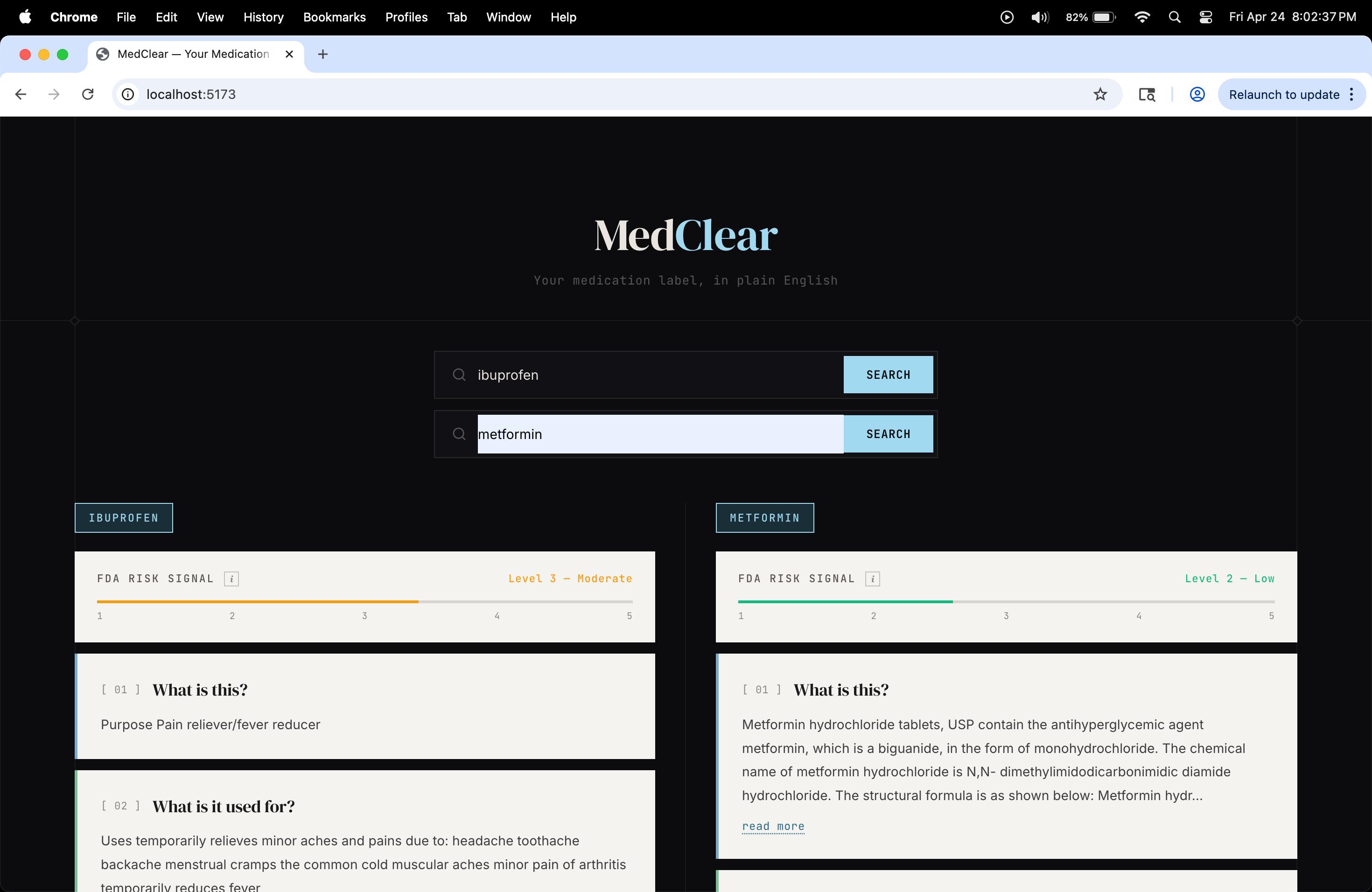
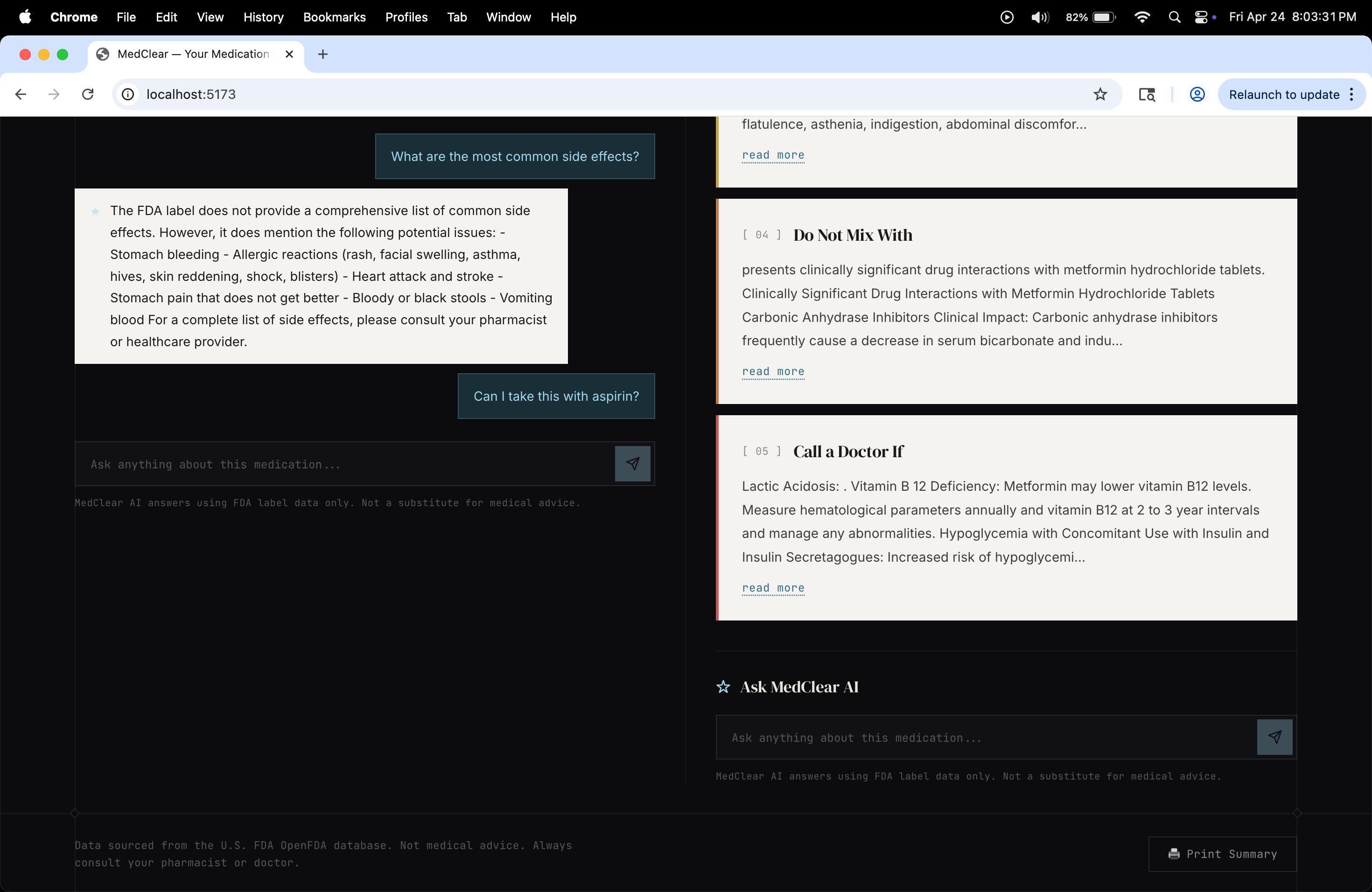
MedClear takes any medication name and instantly translates its FDA label into five plain-English sections anyone can act on:
- What is this drug?
- What is it used for?
- Common side effects
- Do not mix with
- Call a doctor immediately if...
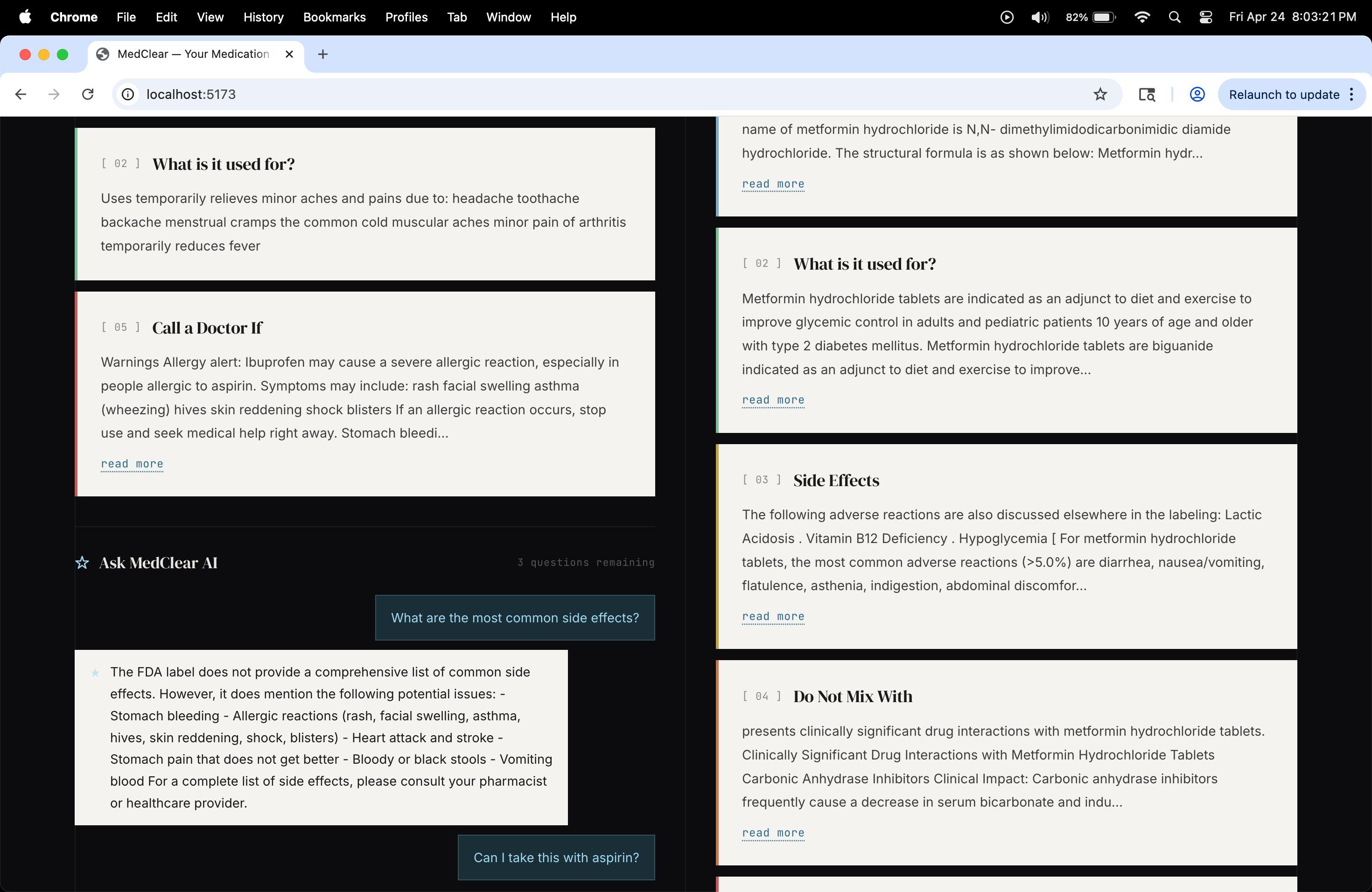
It also features an FDA Risk Signal gauge that scans warning text for high-risk keywords and maps them to a visual 1-5 indicator — making buried danger signals instantly visible. Users can compare two medications side by side, and ask natural language questions via Ask MedClear AI, which answers strictly from the FDA label data using Groq LLaMA 3.3 70B — no hallucinations, no invented information.
How we built it
- React + Vite for the frontend
- OpenFDA public API for real FDA drug label data — no auth required, no fabricated content
- Groq API (LLaMA 3.3 70B) for the natural language Q&A layer, grounded strictly on the fetched FDA label text
- Vercel for deployment
- Pure CSS for styling — no UI frameworks
- Built and deployed within a 90-minute hackathon window
Challenges we ran into
- The OpenFDA API returns inconsistent field structures across drugs — some fields are missing entirely for certain medications. We handled this with multi-field fallback logic and graceful error states.
- Preventing the AI from going beyond the FDA label data required careful system prompt design. We explicitly constrain the model to the label context and instruct it to redirect clinical questions to a pharmacist.
- Keeping the compare mode layout responsive across screen sizes while fetching two independent API calls in parallel.
Accomplishments that we're proud of
- A fully working, deployed product built in 90 minutes
- The FDA Risk Signal gauge — a simple but genuinely useful feature that surfaces risk information buried in dense regulatory text
- The AI Q&A layer that stays honest — it tells users when the answer is not in the label rather than guessing
- A UI that looks and feels like a real product, not a hackathon prototype
What we learned
- The OpenFDA API is a powerful, underutilized public resource — real authoritative medical data, completely free
- Grounding LLMs on retrieved data rather than letting them generate freely is the right pattern for high-stakes domains like healthcare
- Safety disclaimers are not an afterthought — they are a core feature when building health tools
What's next for MedClear
- Multi-drug interaction checker across a full medication list
- Voice input for elderly users
- Spanish and multilingual support for underserved communities
- Dosage reminder notifications
- Pharmacist referral connector for questions that go beyond the label
Built With
- css
- groq
- javascript
- llama-3.3-70b
- openfda-api
- react
- vercel
- vite

Log in or sign up for Devpost to join the conversation.