-
-
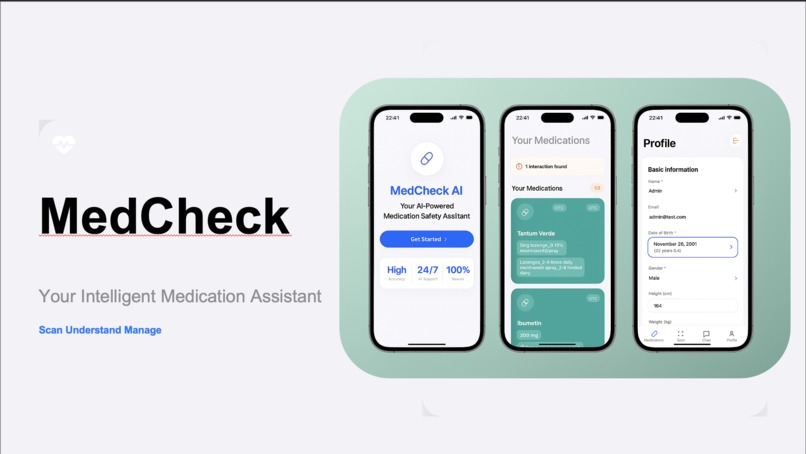
Pitch Deck
-
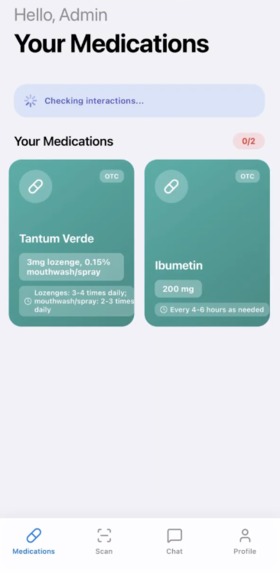
Dashboard
-
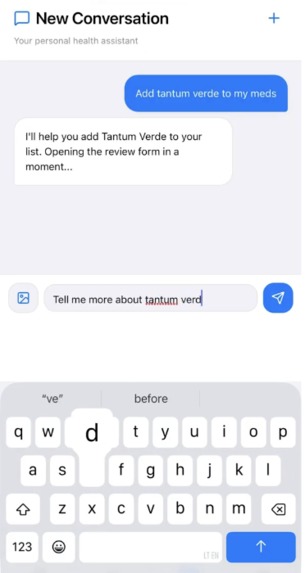
AI Assistant
-
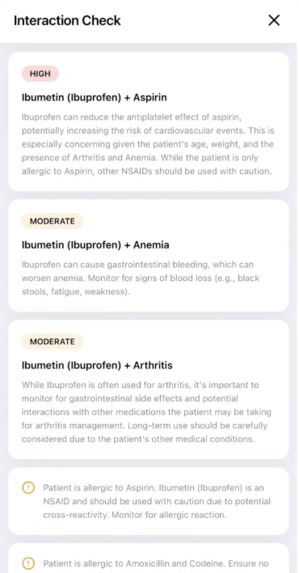
Meds/Supplement interaction warnings
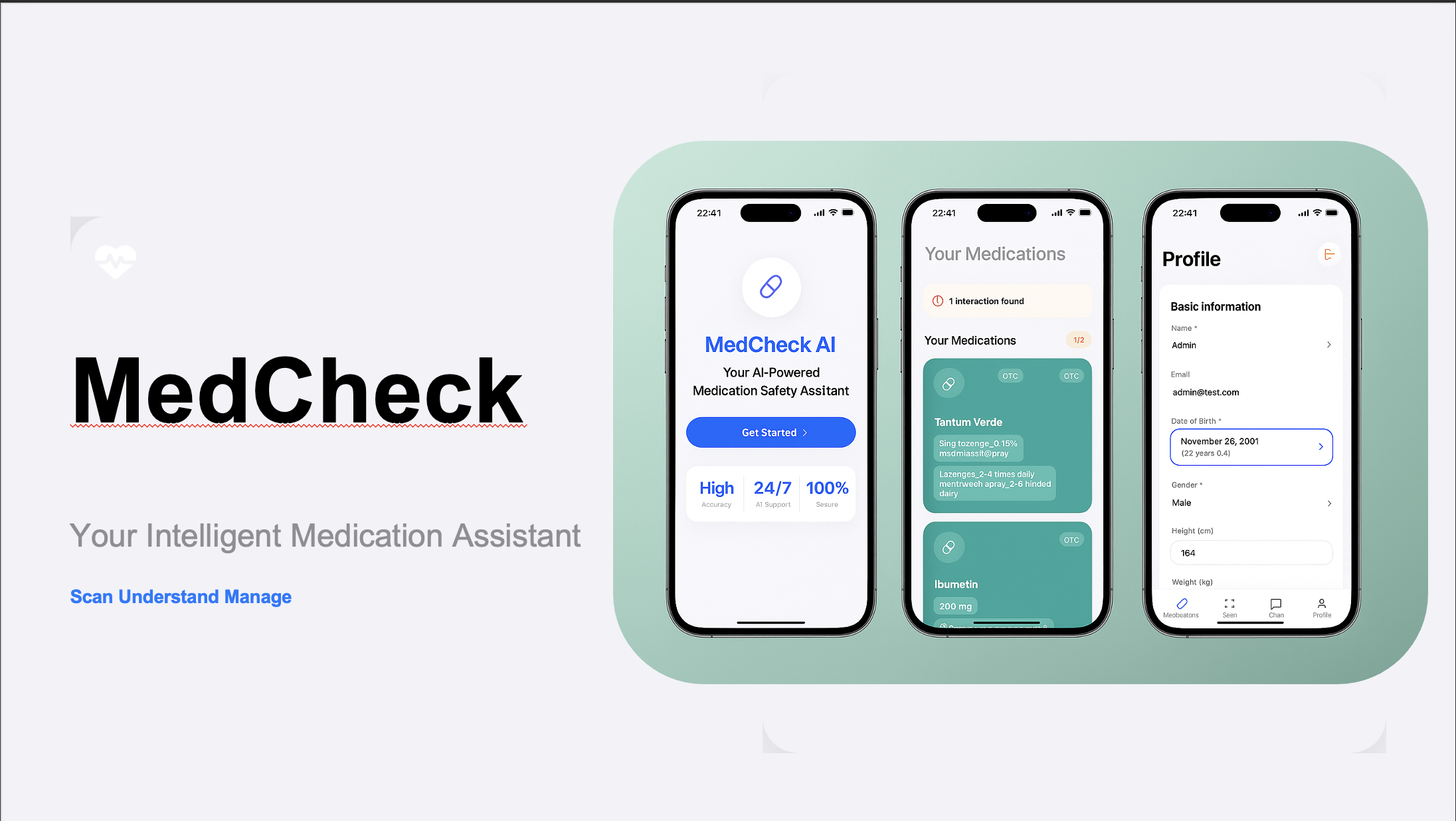
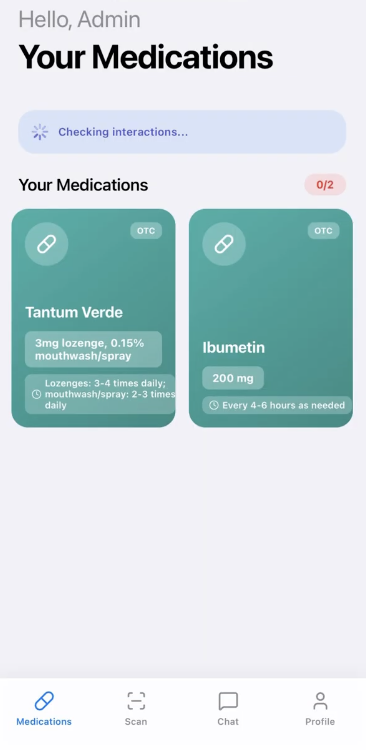
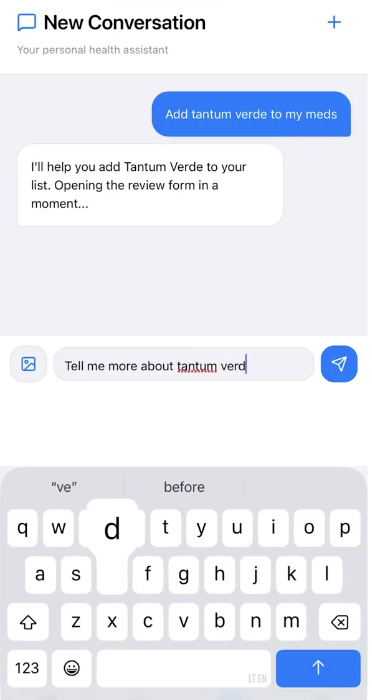
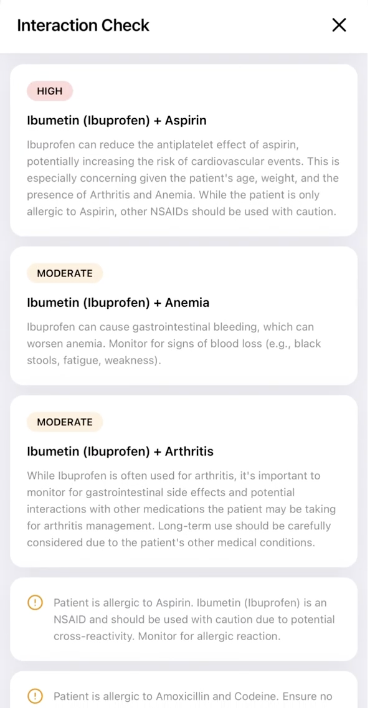
MedCheck: The Intelligent Medication Assistant
- Problem Statement: The Burden of Cognitive Load
The process of managing multiple prescriptions is fundamentally broken, leading to widespread confusion, poor adherence, and significant health risks. This problem is acute among the elderly, polypharmacy patients, and caregivers.
Cryptic Instructions: Medication labels are laden with medical jargon, complex dosing schedules, and fine print that is difficult for the average user to interpret correctly.
Manual Friction: Existing medication management apps rely on tedious manual input of drug names, dosages, and schedules. This high cognitive load leads to low adoption, user fatigue, and data entry errors.
Information Disconnect: Current tools track inventory but fail to provide essential, context-aware information, such as plain-language explanations of why a drug is taken, its common side effects, and potential interactions.
This friction point in the healthcare journey creates a significant gap between prescription and adherence, resulting in avoidable hospitalizations and reduced quality of life.
- Solution Overview: Clarity Through Computer Vision
MedCheck is an intelligent medication assistant that uses cutting-edge AI to automate data entry and provide synthesized, personalized drug information. Our core value proposition is frictionless data acquisition and instant, simplified understanding.
Instant Scan & Parse: Users simply take a photo of their medication label (bottle, box, or paper). MedCheck’s Vision AI instantly performs Optical Character Recognition (OCR) to extract the drug name, dosage, and instructions with high accuracy, eliminating manual typing.
Intelligent Synthesis: The extracted data is fed into a Large Language Model (LLM), which acts as an interpreter. It cross-references the drug against validated data sources (later-stage feature) and synthesizes the complex medical instructions into simple, actionable steps tailored for the user.
Example Output: "Take 1 pill every morning with food. This drug helps lower your blood pressure."
Safety Check (Proactive Alerts): The system maintains a comprehensive list of the user's active medications and instantly flags potential interactions between a newly scanned item and existing ones, using clear, traffic-light system alerts (Green, Yellow, Red).
MedCheck transforms medication management from a clerical chore into a seamless, informative health routine.
- Tools & Technologies Used
MedCheck is built on a modern, scalable, and secure technology stack, prioritizing rapid development and access to state-of-the-art generative models.
Component
Technology
Rationale
Frontend/App
React (with Tailwind CSS)
Provides a fast, responsive, and mobile-friendly application with the clean, accessible aesthetic of an iOS Health app.
Backend/Data
Google Cloud Firestore
Secure, real-time, and scalable database for storing user medication lists and profiles, adhering to the required Canvas environment standards (/artifacts/{appId}/users/{userId}/...).
AI Core (Vision)
Gemini API (gemini-2.5-flash-preview-09-2025 with image input)
Used for robust OCR and Computer Vision (CV) tasks, specifically for reading and extracting unstructured text (drug names, dosage, instructions) from images of labels.
AI Core (Synthesis)
Gemini API (gemini-2.5-flash-preview-09-2025 with text input)
Used to process the extracted text, cross-reference data, and generate natural language summaries and safety warnings.
Authentication
Firebase Auth
Utilizes secure token-based authentication (__initial_auth_token) for user identification and ensuring data access adheres to security rules.
- Why MedCheck Could Grow into a Valuable/Profitable Startup
MedCheck addresses a critical, massive, and highly motivated market with a defensible technology advantage, positioning it for strong growth and profitability.
Massive, Highly Motivated Market: The primary users are the 65+ demographic and caregivers, segments characterized by low tech-savviness but high necessity for medication adherence. The US market for medication management is projected to be over $5 billion, driven by the aging population and the rise of chronic conditions requiring polypharmacy.
Frictionless Adoption & User Retention: By solving the primary pain point of manual data entry, MedCheck achieves higher initial adoption and long-term retention than competitors. The LLM-powered synthesis provides unique, daily utility, transforming a passive tracker into an active health assistant.
Defensible Tech Moat: The core intellectual property lies in the prompt engineering and fine-tuning of the Gemini Vision model for pharmacy label interpretation—a highly specialized and noisy data problem. This specific expertise makes it difficult for generic trackers to replicate the core scan-and-understand accuracy.
Clear Monetization Pathways:
B2C Subscription (Premium): Offering features like caregiver collaboration, advanced health reports, and integration with wearables for a monthly fee.
B2B Partnership (Pharmacy/Payer): Long-term revenue generation through APIs provided to pharmacy chains or insurance payers, allowing them to track adherence for high-risk patients and reduce costs associated with medication non-adherence (est. $100–300 billion annually in the US).
Data Licensing (Anonymized): Licensing anonymized, aggregated adherence data to pharmaceutical companies for market research (subject to strict HIPAA/privacy compliance).
Regulatory Strategy (Phased Approach): By starting with AI synthesis based on public data, MedCheck can establish product-market fit quickly. The roadmap explicitly outlines the move toward official Verified Drug Database integration, which acts as a crucial regulatory milestone and strengthens the moat against future competitors.
Web App may not have full functionality, recommend running locally and checking out using expo go
Built With
- firebase
- gemine
- react-native
- supabase


Log in or sign up for Devpost to join the conversation.