-
-
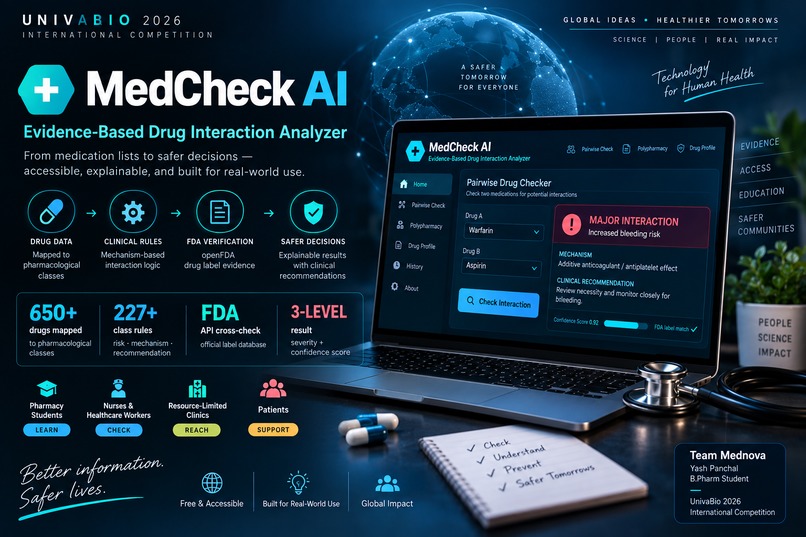
Overview of medcheck Ai
Inspiration
What it doe## Inspiration
As a B.Pharm student, I noticed how dangerous drug interactions often go unnoticed — especially for elderly patients on multiple medications (polypharmacy). Manual checking is time-consuming and error-prone, and many existing tools are either expensive or inaccessible in resource-limited healthcare settings. I wanted to build something free, fast, and reliable that any pharmacy student, nurse, or clinic could use.
What it does
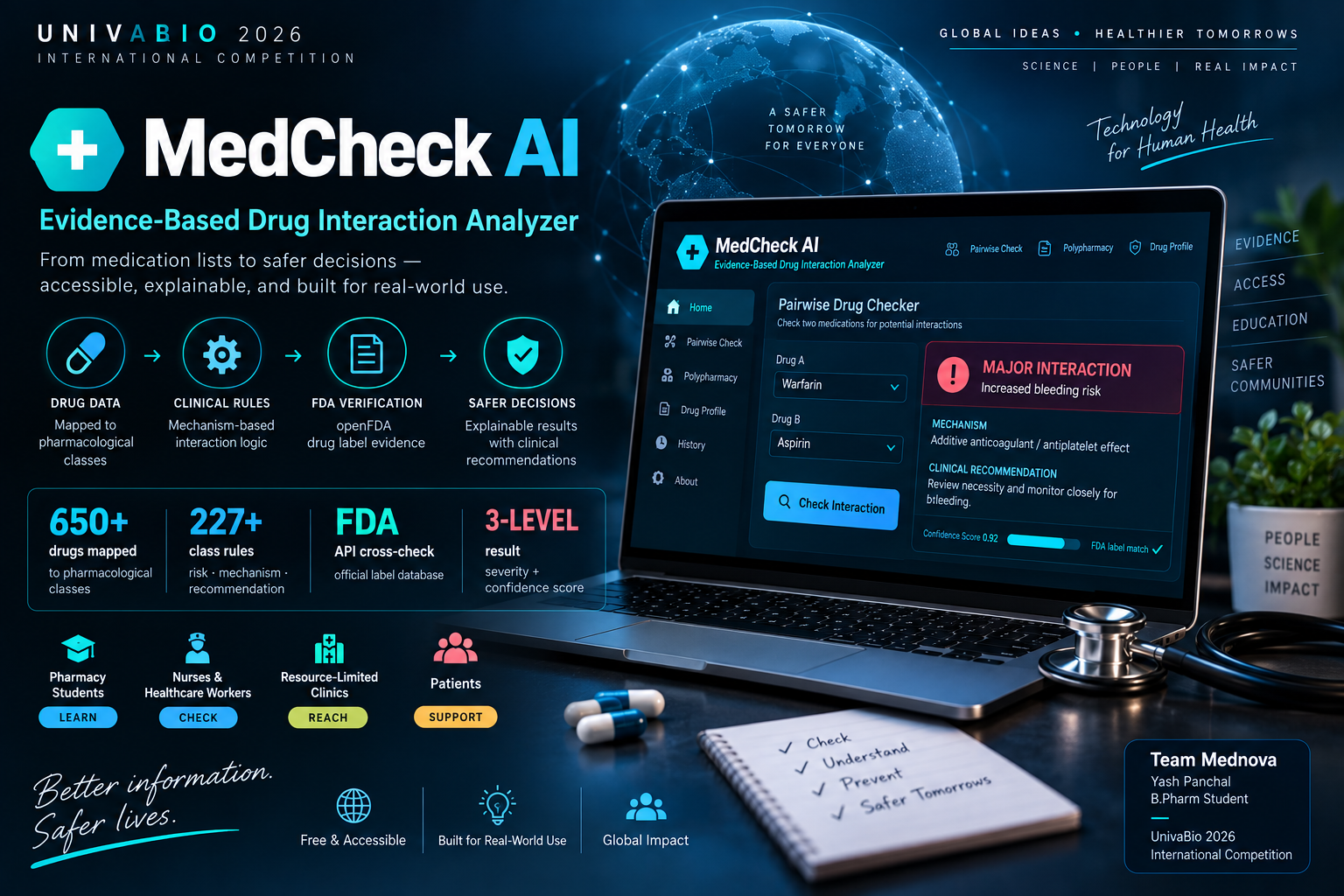
MedCheck AI is a web-based drug interaction checker with three core tools:
- Pairwise Checker — instantly checks interactions between any two medicines
- Polypharmacy Analyzer — analyzes a patient's full medication list and flags all risky combinations at once
- Drug Profile Lookup — provides detailed class and interaction information for individual drugs
Each result includes a severity level (Major/Moderate/Minor), the clinical mechanism behind the interaction, and a practical recommendation.
How I built it
I built a self-authored clinical rule engine by studying established pharmacology principles. I mapped 650+ drugs into their pharmacological classes (e.g., Warfarin → Anticoagulant), then wrote 227+ class-pair interaction rules covering risk level, mechanism, and clinical recommendation. To make results more reliable, I integrated the U.S. FDA's openFDA API, which cross-verifies my rule engine's output against official FDA drug data in real time. The app is built with Python and Streamlit, and deployed live for public use.
Challenges I ran into
Building and validating 227+ interaction rules by hand required carefully cross-referencing pharmacology principles for accuracy. I also faced technical challenges during development and deployment — including mobile-specific bugs (like unicode line-break issues in text parsing) and UI rendering issues — all of which I debugged and fixed independently while building entirely on my phone.
What I learned
I learned how to combine domain knowledge (pharmacology) with software engineering to build a genuinely useful clinical tool. I also gained hands-on experience with API integration, UI/UX debugging, and deploying a live production app — entirely as a solo builder.
What's next for MedCheck AI
Expanding the drug database beyond 650+ entries, adding regional language support, and enabling offline access for use in rural clinics with limited connectivity.s

Log in or sign up for Devpost to join the conversation.