⚕️ MedBridge AI
Bridging the Gap Between Clinical Thoughts and Structured Documentation.
💡 Inspiration
Doctors spend an average of two hours on administrative tasks for every one hour of patient care. This chronic "paperwork burden" is the leading cause of physician burnout and can lead to dangerous clinical omissions during rushed documentation.
We built MedBridge AI to restore the patient-doctor relationship by creating a seamless bridge between the raw speed of how a doctor thinks/speaks and the rigid, structured data required by modern healthcare systems.
✨ What it does
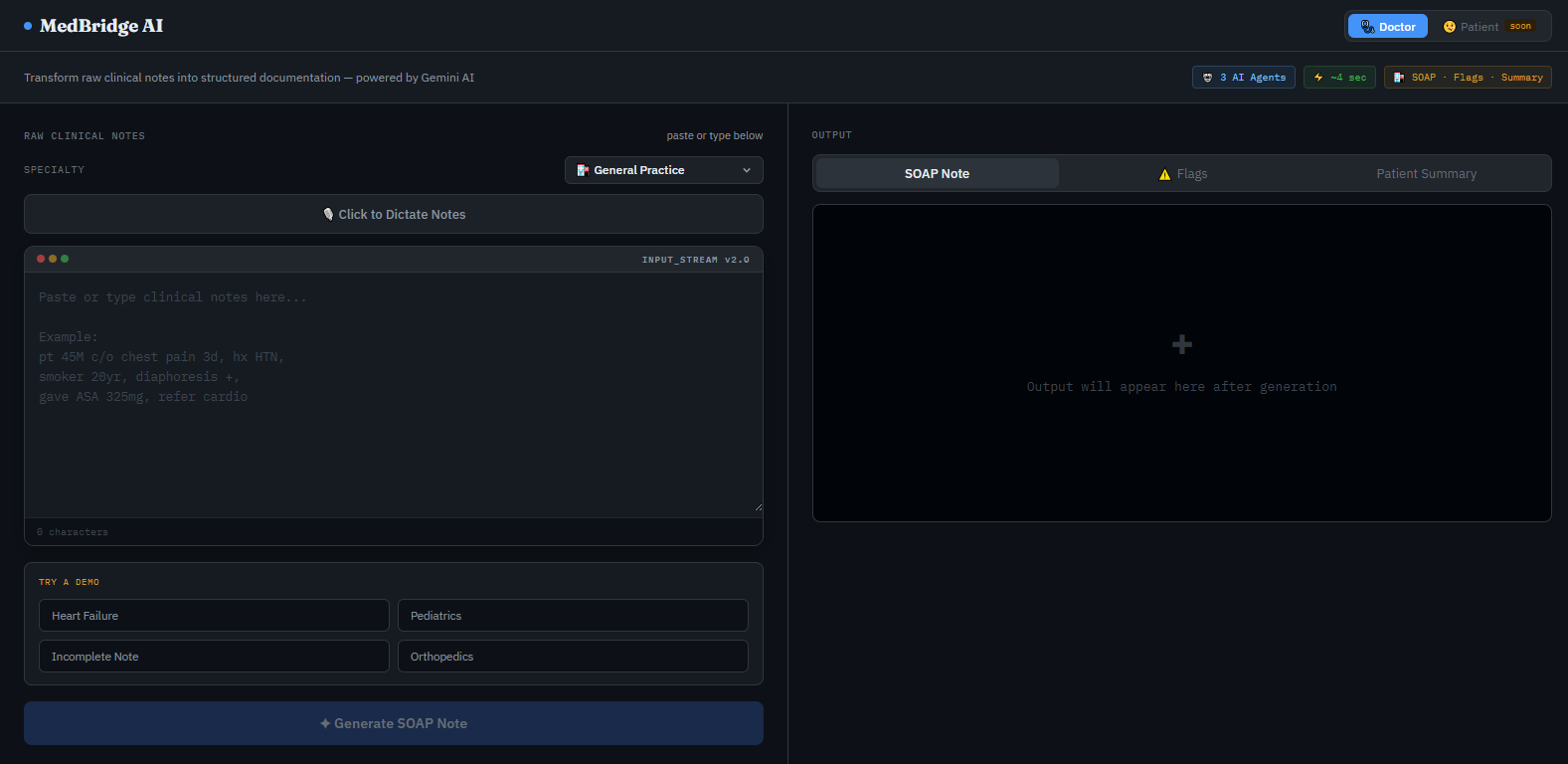
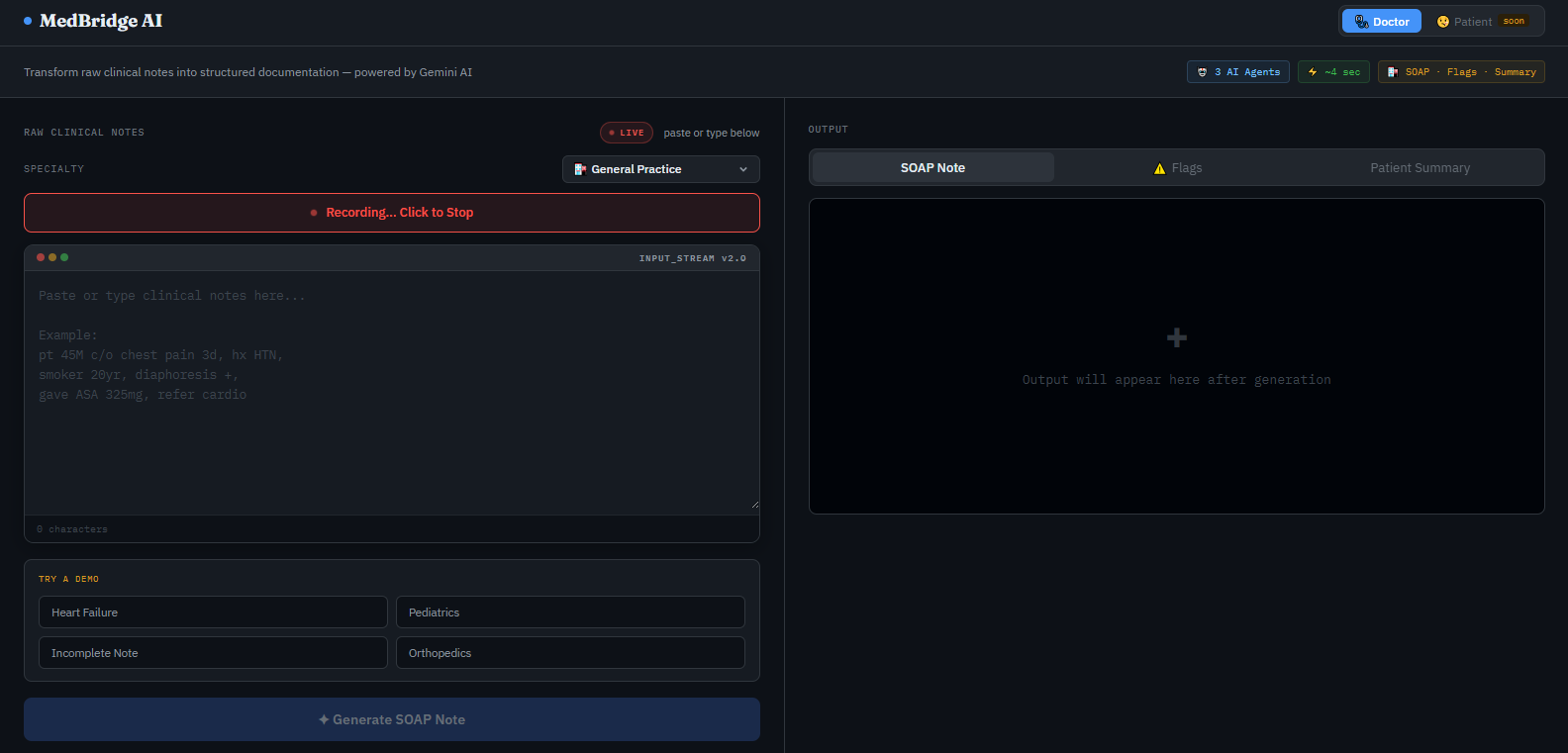
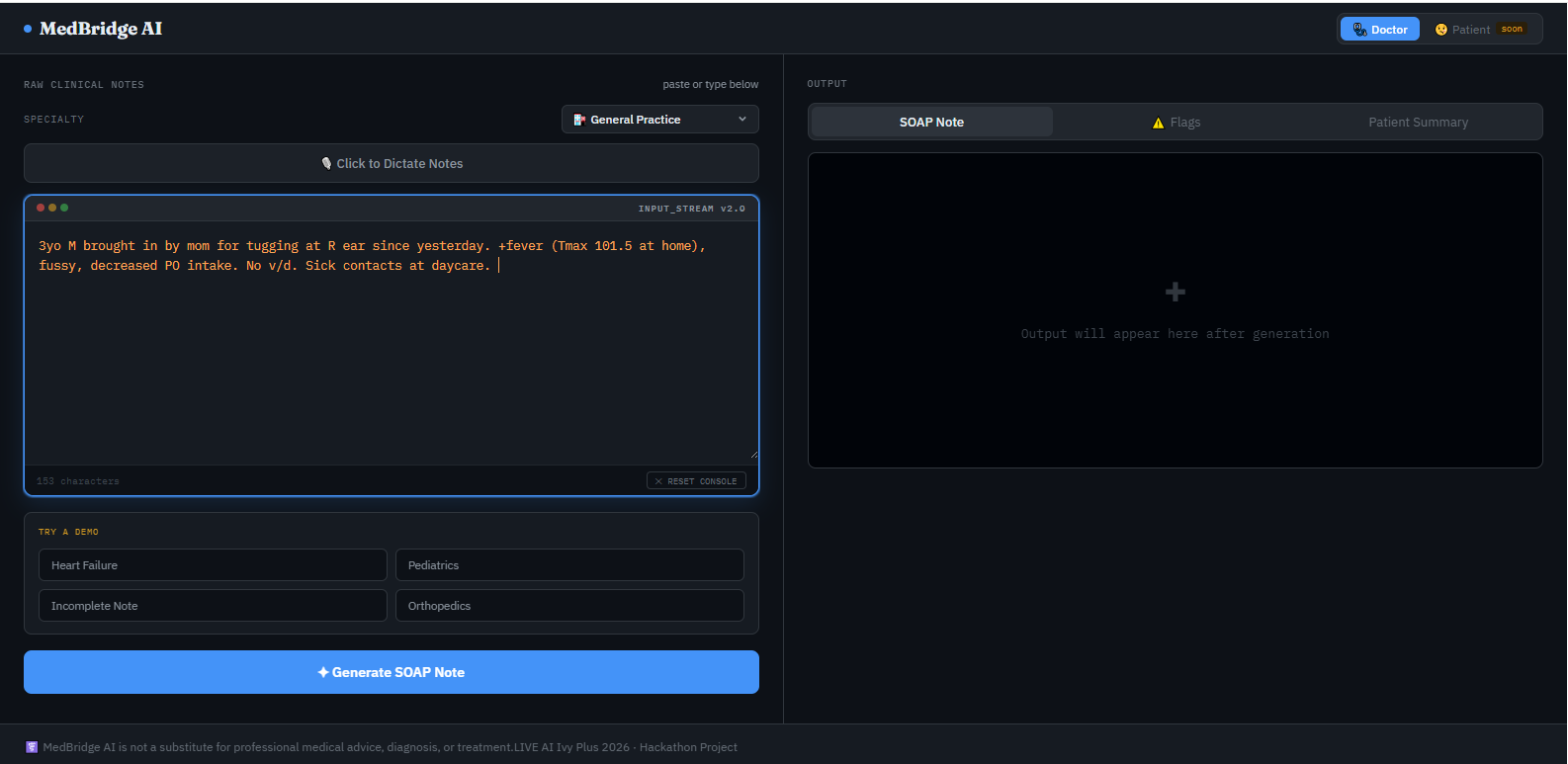
MedBridge AI provides a high-performance "Clinical Console" where healthcare providers can input disorganized shorthand or use Live Voice Dictation to record patient encounters.
Once submitted, the input is handled by a "Choreographed Agent" workflow powered by Google Gemini 1.5 Pro, which parallel-processes the data into three distinct outputs:
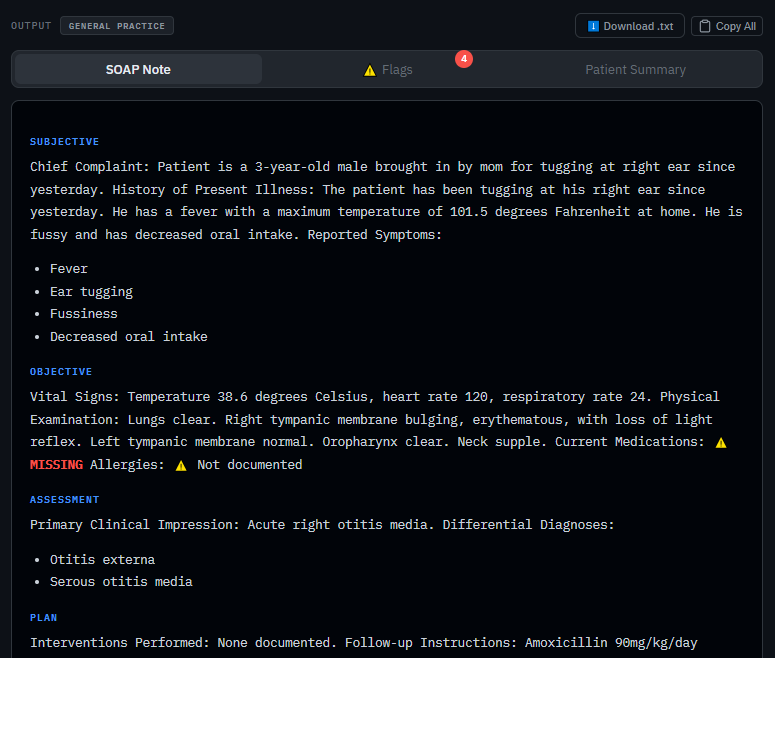
- 🏥 The SOAP Agent: Transforms messy notes into a professional Subjective, Objective, Assessment, and Plan (SOAP) note, automatically expanding medical acronyms (e.g., "SOB" → "Shortness of breath") and highlighting missing vitals.
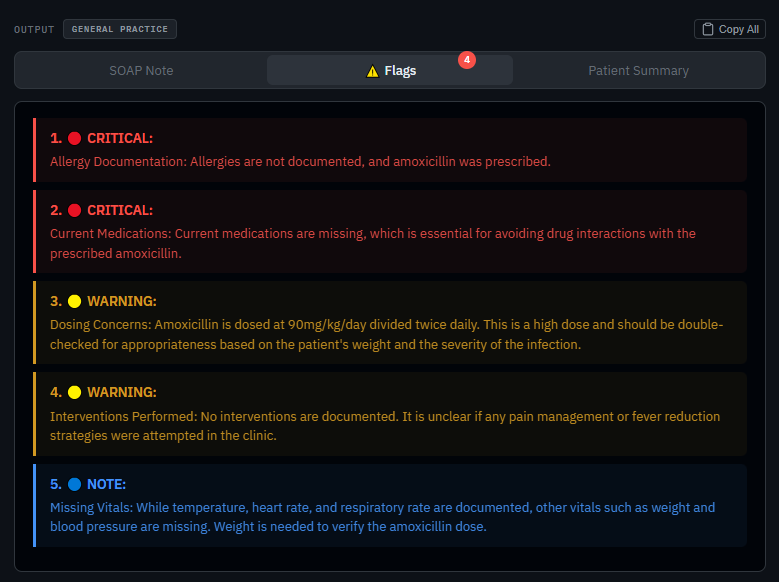
- ⚠️ The Safety Flag Agent: Acts as an automated clinical reviewer, scanning the note for critical documentation failures, drug interactions, or missing follow-up plans, graded by severity.
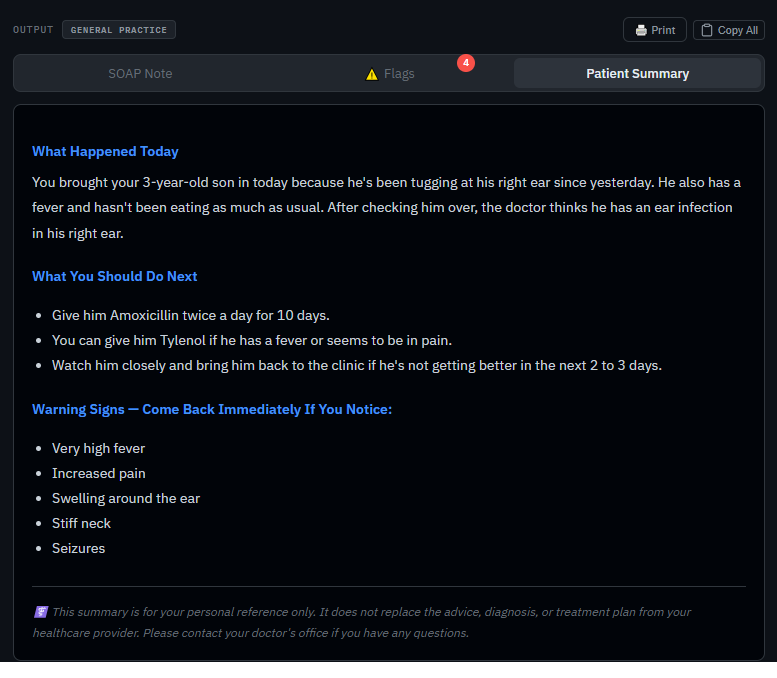
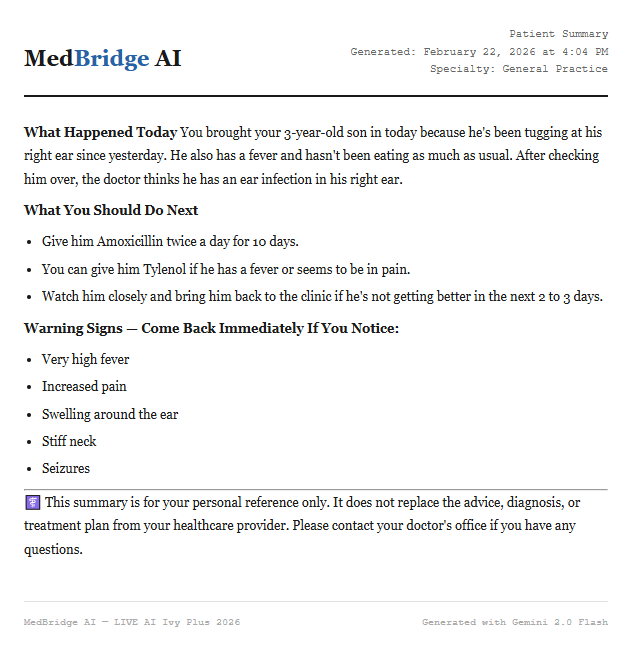
- 🤒 The Patient Summary Agent: Translates complex medical jargon into a warm, reassurance-focused discharge summary written at an 8th-grade reading level, so patients leave knowing exactly what to do next.
🛠️ How we built it
- Frontend: A premium, high-contrast React + Vite interface built with 100% custom CSS (no UI libraries) to ensure maximum performance and a native "Clinical Tool" aesthetic.
- Voice Engine: Integration of the native Web Speech API for real-time dictation, providing a zero-latency experience for physicians on the move.
- AI Orchestration: Custom-built parallel processing logic to hit the Gemini 1.5 Pro API. We implemented a robust retry system with exponential backoff to handle rate limits and ensure "clinical-grade" reliability.
- Security: Developed a secure Vercel Serverless backend to route API calls, ensuring that sensitive AI keys are never exposed on the client side.
🚧 Challenges we ran into
- The Hallucination Hurdle: LLMs are naturally "helpful," which is dangerous in medicine. If a doctor forgets to mention a heart rate, we didn't want the AI to guess it. We spent dozens of hours refining our
system_instructionsto ensure the AI explicitly outputs⚠️ MISSINGrather than inventing clinical data. - Parallel Latency: Triggering three complex AI prompts simultaneously often hit rate limits or caused UI hangs. We solved this by implementing a staggered "orchestration" layer that manages the response streams and ensures a smooth user experience.
- CSS Precision: Avoiding UI libraries meant building the "Clinical Console" look from scratch, which required deep-diving into CSS keyframe animations and glassmorphism.
🎉 Accomplishments that we're proud of
- Speed to Structure: Successfully reducing a 4-minute manual documentation task into a 4-second automated process.
- Clinical Accuracy: Our "Flag Agent" is remarkably good at catching missing follow-up plans that a tired human might overlook.
- Premium UX: Building a dark-mode interface that feels less like a website and more like a high-end medical terminal.
🧠 What we learned
- Prompt Choreography: We learned that one giant prompt is less effective than three specialized agents working in parallel. Specificity is the enemy of hallucination.
- Browser API Nuances: We discovered the intricacies of the Web Speech API and how to handle background noise and "medical terminology" recognition.
- LLM "Safety" Barriers: We learned how to "jailbreak" the LLM's tendency to be vague and instead forced it to be a precise clinical auditor.
🚀 What's next for MedBridge AI
- Direct EHR Export: Integrating FHIR/HL7 standards to push notes directly into Epic and Cerner with one click.
- Patient Chatbot: Allowing patients to upload their discharge summary and ask follow-up questions ("Can I take Advil with my new meds?") via an interactive, safe AI assistant.
- Multilingual Support: Automatically translating the patient discharge summary into the patient's native language while keeping the doctor's note in English.

Log in or sign up for Devpost to join the conversation.