Inspiration
MEDBLOCK was inspired by personal experiences with the healthcare system.
When my grandmother fell seriously ill, our family struggled with fragmented medical records. Each hospital visit required repeating the same history, submitting paper files, and relying on memory to fill gaps. Important details were often delayed, misplaced, or misunderstood.
Around the same time, I was dealing with an eye condition that required consultations across different clinics. Every visit meant explaining my medical history again and again, sometimes without access to prior test results. This repetition wasn’t just inconvenient—it introduced risk.
These experiences highlighted a fundamental problem: medical data is not owned by patients, not portable, and not trusted across institutions.
That gap became the foundation for MEDBLOCK.
What it does
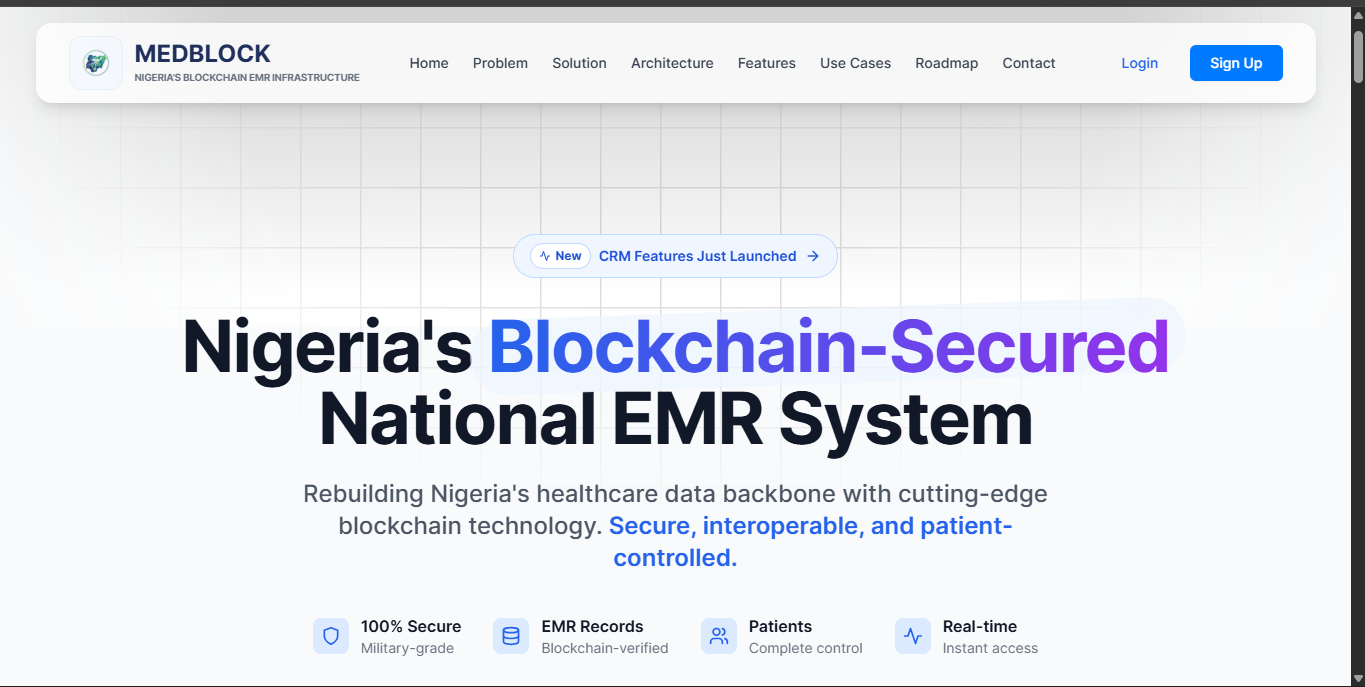
MEDBLOCK provides a blockchain-secured electronic medical records (EMR) infrastructure that enables secure, interoperable, and patient-controlled healthcare data sharing across hospitals, clinics, labs, and healthcare providers.
Specifically, MEDBLOCK:
Creates a single, verifiable medical record for each patient that can be accessed across multiple healthcare institutions
Secures medical data integrity by anchoring record hashes and access logs on a blockchain
Keeps sensitive health data off-chain, storing encrypted records in secure databases or decentralized storage
Gives patients control over access, allowing them to grant, revoke, or time-limit permissions to providers
Eliminates repetitive record sharing, reducing delays, errors, and administrative overhead
Improves continuity of care, ensuring providers always work with accurate and up-to-date information
In practice, MEDBLOCK acts as a trust layer, not a data silo—allowing healthcare systems to interoperate without needing to fully trust each other.
How we built it
MEDBLOCK was built using a modern, scalable web stack with blockchain at its core, designed for security, interoperability, and long-term growth.
Frontend
React was used to build the user interface for patients and healthcare providers
TypeScript ensured type safety, maintainability, and reduced runtime errors
Component-driven design enabled reusable and consistent UI across the platform
Backend & Logic
Core application logic was written in TypeScript, enabling shared types between frontend and backend
Secure APIs handle authentication, record indexing, and permission workflows
Role-based access control differentiates patients, doctors, and institutions
Blockchain Layer
Cardano was used as the blockchain layer for:
Recording cryptographic hashes of medical records
Logging access permissions and consent changes
Ensuring immutability and auditability of healthcare data
Smart contracts define how records are registered, accessed, and verified without exposing sensitive data on-chain.
Conceptually: On-chain Trust=Record Hash+Consent Logic+Immutable Ledger
Data Storage
Medical records are encrypted and stored off-chain
Only verification hashes and metadata are committed to the blockchain
This approach ensures privacy, scalability, and regulatory compliance
Design Philosophy
Rather than building a single hospital system, MEDBLOCK was designed as infrastructure—a neutral layer that existing healthcare systems can integrate with without giving up data ownership.
Challenges we ran into
One of the biggest challenges I faced was designing a system that could handle highly sensitive medical data without ever exposing it on-chain. Balancing privacy, security, and transparency required careful architectural decisions, especially around encryption, consent management, and off-chain storage.
Another challenge was healthcare interoperability. Different hospitals and clinics operate with varying standards, workflows, and levels of technical maturity. Building MEDBLOCK as a neutral infrastructure layer—rather than a rigid application—meant I had to constantly think about flexibility, integrations, and long-term adoption.
Working with blockchain also introduced complexity. Cardano’s smart contract model is powerful but requires deliberate design and testing to avoid mistakes, particularly when handling immutable records and permission logic that cannot be easily changed once deployed.
Finally, scaling the vision beyond a prototype was difficult. MEDBLOCK is intended for national-level use, which involves regulatory considerations, governance models, and stakeholder alignment that go far beyond writing code. Translating a personal problem into a sustainable, real-world infrastructure solution was both technically and strategically challenging..
Accomplishments that we're proud of
I successfully transformed a deeply personal healthcare experience into a clear, scalable infrastructure concept rather than just a single application. MEDBLOCK shows how blockchain can be applied responsibly in healthcare—focusing on trust, data integrity, and patient consent without exposing sensitive information on-chain.
I designed and implemented a working architecture that combines a TypeScript and React-based application with Cardano smart contracts, demonstrating the technical feasibility of a patient-controlled, interoperable EMR system. Separating on-chain verification from off-chain encrypted storage was a major achievement in balancing privacy and immutability.
I’m especially proud that MEDBLOCK was built with a long-term, national perspective in mind. Beyond code, I considered interoperability, auditability, and governance, positioning the project as a foundation for real-world healthcare adoption rather than just a prototype.
What we learned
Through building MEDBLOCK, I gained a deep understanding of how complex and fragmented healthcare systems can be, and how critical trustworthy data is for patient care. I learned that technology alone isn’t enough—privacy, consent, and interoperability must be designed hand-in-hand with real-world workflows and regulations.
I also learned how to apply blockchain responsibly: using it as a trust and verification layer rather than trying to store sensitive data on-chain. Balancing on-chain immutability with off-chain encrypted storage taught me valuable lessons in security, scalability, and system architecture.
Beyond the technical aspects, I learned the importance of thinking long-term. Designing infrastructure meant considering governance, adoption, and sustainability, not just coding a functional prototype. Most importantly, I realized how personal experiences can inspire impactful solutions that address systemic problems.
What's next for Medblock
Next, I plan to move MEDBLOCK from prototype to real-world adoption. This involves engaging hospitals, clinics, and healthcare providers to pilot the system, testing interoperability, consent workflows, and scalability in real healthcare environments.
I also aim to refine the blockchain layer, optimizing Cardano smart contracts for efficiency and usability, while ensuring patient data remains private and secure. Expanding integrations with labs, diagnostic centers, and other healthcare stakeholders is a key focus, making the system truly national and interoperable.
Beyond technical development, I’m exploring partnerships with government agencies and regulatory bodies to align MEDBLOCK with national healthcare policies. Ultimately, my goal is to create a patient-centered, secure, and sustainable EMR infrastructure that improves healthcare delivery across Nigeria—and eventually, other regions facing similar challenges.
Built With
- aiken
- cardano
- nestjs
- react.js
- typescript

Log in or sign up for Devpost to join the conversation.