-
Medbay's Infographic
Inspiration
The Covid-19 is hitting America soon and we need precautionary measures to be put in place to contain the spread of the virus. One of the main reasons why the infection was so rampant in China was that people with "COVID-19"-like symptoms who did not actually have the virus were making unnecessary trips to the hospital, overcrowding hospital resources and depriving those who actually needed medical care. These people also ended up contracting the virus even if they didn't originally have it as these hospitals are crammed with previously infected people. The virus then further spread to their communities. Thus, we believe that our simple solution can solve this huge problem.
What it does
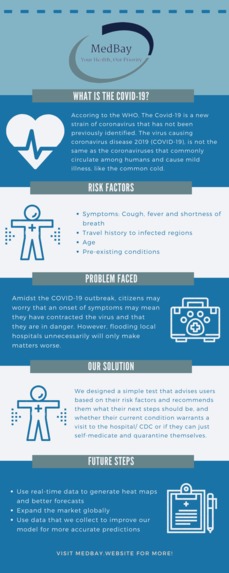
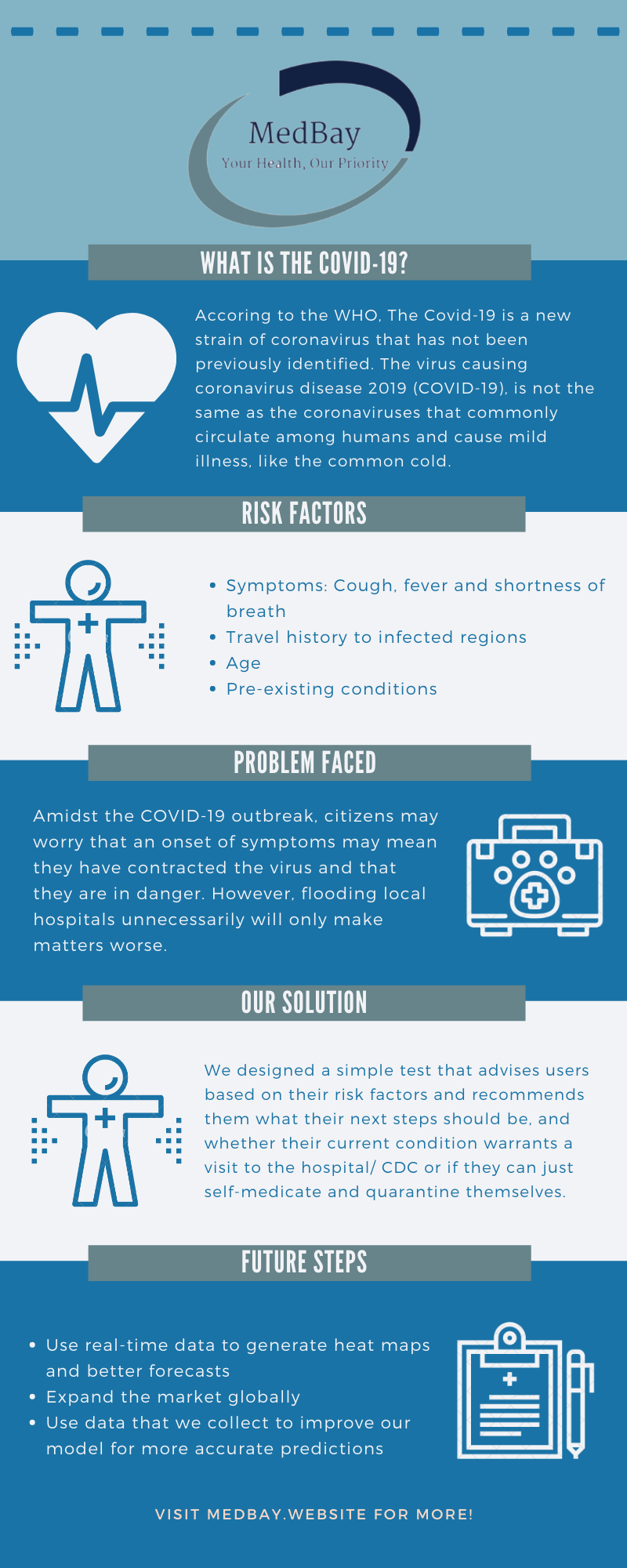
We designed a simple test that advises users based on their risk factors and recommends them on what their next steps should be, and whether their condition warrants a visit to the hospital or disease centre.
How we built it
Using probabilities and risk determination, we allocated risk scores to each symptom that users disclose. The risk factors that were used to allocate the risk scores are recent travel history, age, symptoms and pre-existing conditions. The risk scores were determined based on the percentage of infections or death, determined by number infected over the total infected.
Challenges we ran into
3 of us came to this hackathon without prior coding knowledge, and we spent a good few hours watching videos and learning html/css before we even began building our web markup. Robert faced many challenges including setting up the heroku server which took longer than expected, setting up the domain and the javascript, in general, was a struggle.
Accomplishments that we're proud of
We're proud to have been able to come up with a pretty decent web mark up on our first try, and we managed to solve many problems we ran into by ourselves.
What we learned
We learned the basics of HTML and CSS, e.g. setting up the nav bar, adding a background image, etc. We also learned the basics of git and web development which will be useful for future hackathons.
What's next for MedBay
We want to extend the market to the whole world, as epidemics aren't just an American concern, but a global one. Additionally, we want to link our risk scores to real-time data, as data on the coronavirus is constantly changing. As of now, we will be updating the risk scores manually based on real-time data but we aim to outsource that to a machine-learning algorithm in the near future. We also want to include more data variables and risk factors so that we can provide a more accurate prediction.

Log in or sign up for Devpost to join the conversation.