-
-
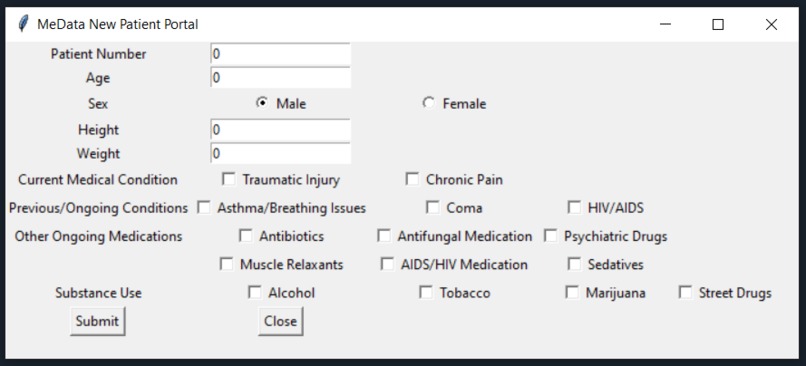
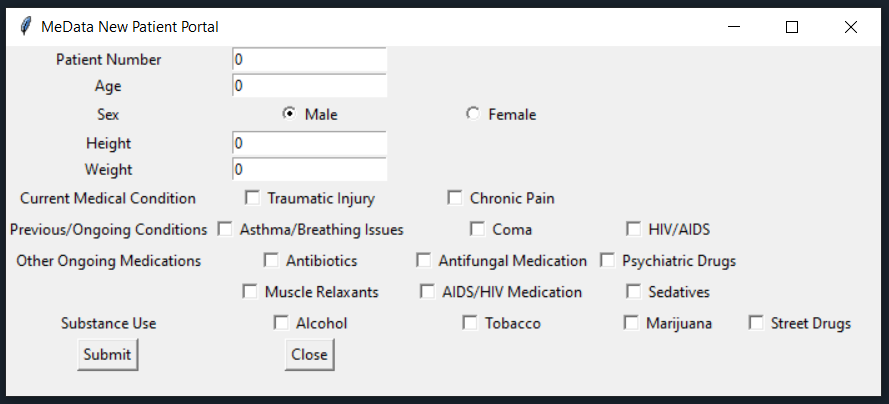
UI for New Patient Data Collection
-
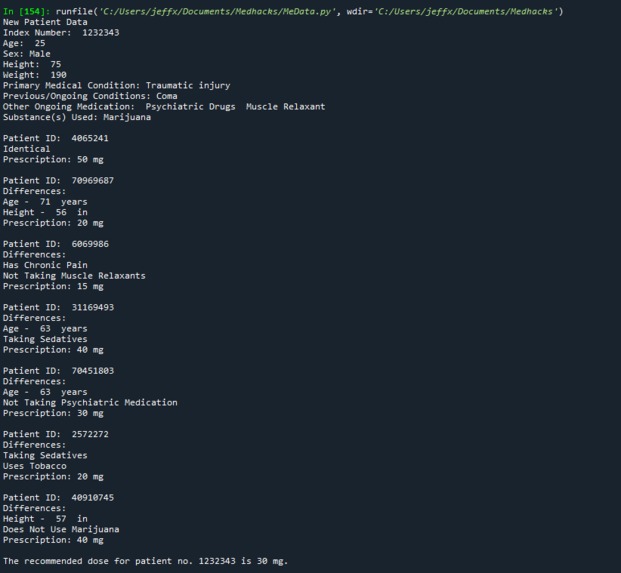
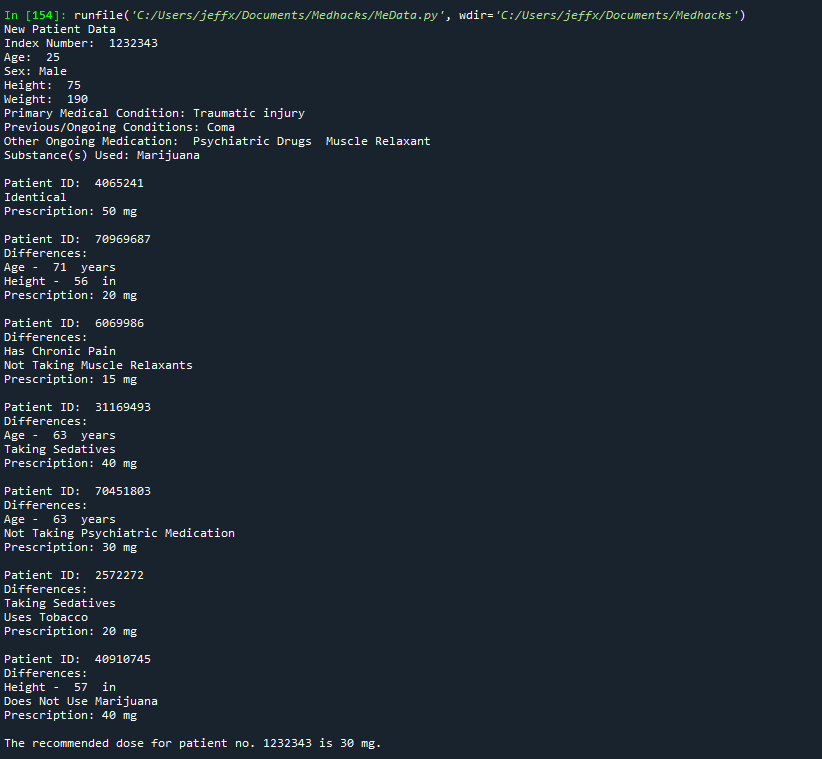
Test Demonstration Using Pseudo Dataset
Inspiration
The opioid crisis has been a major growing issue in US healthcare for the past few decades, and there has been no clear solution in sight. We decided to attempt our solution to the opioid crisis through this hackathon, which would be a great way to spread our passion for problem solving and teamwork.
What it does
MeData is a system that compares new opioid-prescribed patient data with a large database of existing or past patients' data. The comparison narrows down to a list of database subjects who share nearly all the same attributes as the new patient. Their dosages are then averaged to give the recommended dosage for the new patient. This tackles both the issue of inconsistent prescriptions across different healthcare providers, as well as the issue of reselling or overdosing on extra medicine. The MeData portal is meant for use by doctors, so that they have a guideline to help them prescribe the right amount of opioids to their patients.
How we built it
We used Python to make the frontend GUI to collect new patient data, as well as write the backend algorithms for searching and comparing between patients. Since we didn't have a real database of patients, we used MATLAB to mimic a database containing 113,153 patients, all with unique attritubes, such as age, height, weight, sex, previous medical conditions, ongoing medical conditions, and other ongoing prescriptions. During our testing, the pseudo dataset proved to be an excellent source for comparison, and we believe it serves as an excellent substitute for a real database. To increase efficiency, we split tasks for creating each section. Jeff handled frontend, Fil handled backend and Peter synthesized the test database. Afterwards, we joined together to merge the three parts, which took most of our time.
Challenges we ran into
We were all rusty at Python to begin with, so writing the 363 lines of our final code wasn't easy. There was a lot of learning on the fly for the tkinter and numpy libraries, and we ran into many logical errors even when there were no compiling errors. As expected, most of our time was spent debugging.
Accomplishments that we're proud of
As challenging as it was, the exhilaration of solving intermediate issues along the way proved to be a great motivation for moving forward. The moment we completed a successful test after merging the three parts was pure ecstasy.
What we learned
We learned that being familiar with a mainstream programming language is extremely useful to get a good head start on our projects. Time management is also a good skill to have, especially when planning out a 36-hour group project. Most importantly, we learned much more in depth about the opioid crisis and its negative impact on our citizens and economy, and that our efforts today will lead to breakthroughs tomorrow.
What's next for MeData Intelligent Opioid Prescription Tracker
MeData seems very promising in this elementary stage, since everything works well so far. We have a lot of room to make our algorithm more precise and efficient, as well as make a cleaner, more presentable UI. As a proof of concept, our 2020 Medhacks submission isn't bad, but our motivation to improve will definitely push MeData forward.
Log in or sign up for Devpost to join the conversation.