-
-
-
MedAssistLive

Inspiration
What it does
How we built it
Challenges we ran into
Accomplishments that we're proud of
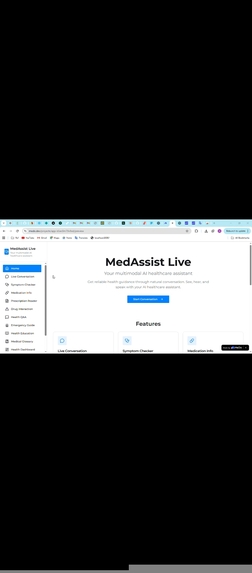
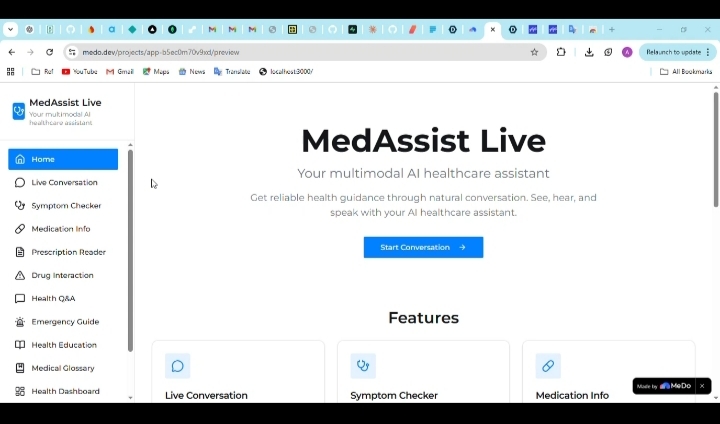
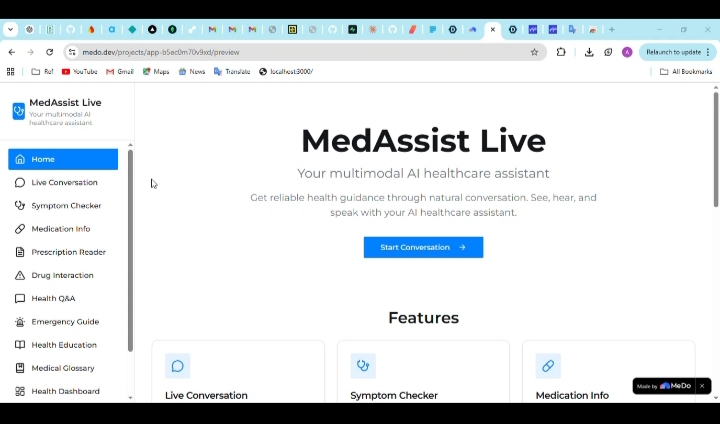
Inspiration Millions of people in underserved communities across Nigeria and Africa have little to no access to reliable health information. A simple question like "what does this rash mean?" or "can I take these two drugs together?" can go unanswered for days or weeks. I built MedAssist Live to change that. What it does MedAssist Live is a multimodal AI healthcare assistant that can see, hear, and speak. Users can speak their symptoms and hear the response. They can upload a photo of a rash, wound, or prescription and get an instant analysis. The app works in English, Igbo, Yoruba, and Hausa — making it accessible to users who may not be comfortable in English. Features include: Voice input and output Image analysis via OCR for prescriptions and wounds Symptom Checker with plain language explanations Medication Explainer with dosage, side effects and warnings Prescription Reader Drug Interaction Checker Emergency First Aid Guide Health Education Cards for malaria, typhoid, diabetes, hypertension, cholera and HIV/AIDS Personal Health Dashboard with persistent storage Patient Notes Tool for health workers Medical Glossary Multilingual support in English, Igbo, Yoruba and Hausa How I built it I built the entire app through natural language conversation with MeDo. I described each feature I wanted and MeDo generated the full application including persistent backend storage, AI integration, voice input and output, image analysis, and multilingual support — no manual coding required. As a first year Biochemistry student with no professional development background, MeDo made this completely possible. I also integrated Baidu ERNIE AI through Baidu AI Studio for the AI responses, Speech-to-Text and Text-to-Speech plugins for voice features, OCR plugin for image and prescription reading, and Google Text Translation for multilingual support. Challenges I faced The biggest challenge was connecting the AI backend to all the features in the app. Getting the voice input, image analysis, and multilingual responses to all work together seamlessly required multiple iterations with MeDo. Configuring the Baidu ERNIE API authentication was also technically complex but MeDo helped navigate it. What I learned I learned that with the right AI tools, anyone can build a fully functional production application regardless of their technical background. MeDo completely changed what I thought was possible as a Biochemistry student. I also learned a lot about healthcare application design, multilingual support, and AI integration. What's next Fix and fully activate all AI backend connections Add offline mode for areas with poor internet connectivity Add medication reminders and push notifications Expand language support to more Nigerian languages Partner with community health workers in Nigeria to deploy the app
What we learned
What's next for MedAssist Live
Fix and fully activate all AI backend connections Add offline mode for areas with poor internet connectivity Add medication reminders and push notifications Expand language support to more Nigerian languages Partner with community health workers in Nigeria to deploy the app
Built With
- baidu-ai-studio
- baidu-ernie
- google-text-translation
- medo
- ocr
- speech-to-text
- text-to-speech

Log in or sign up for Devpost to join the conversation.