-
-
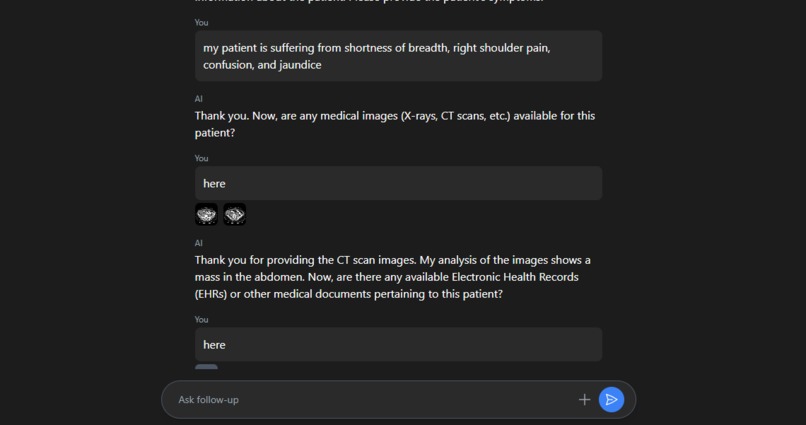
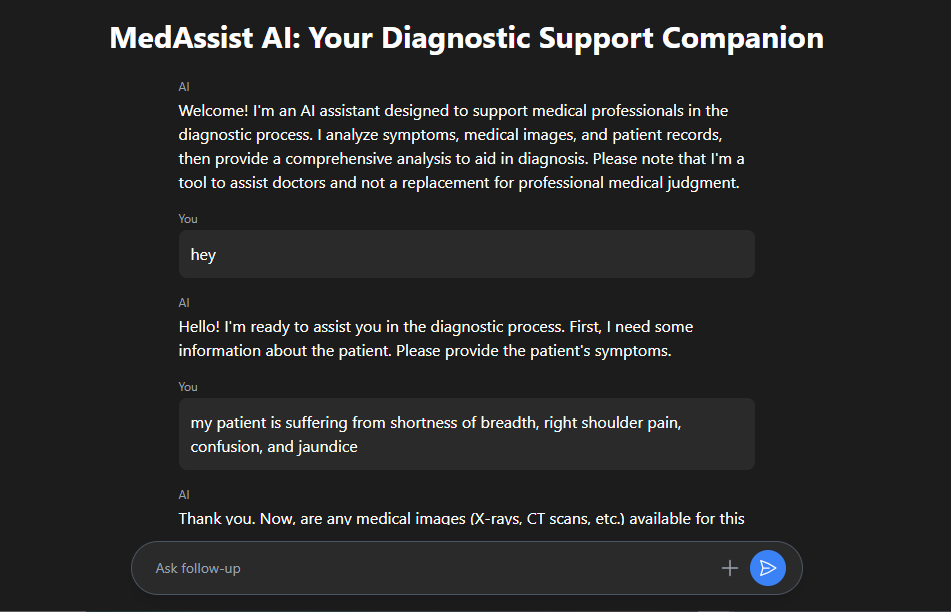
user interface
-
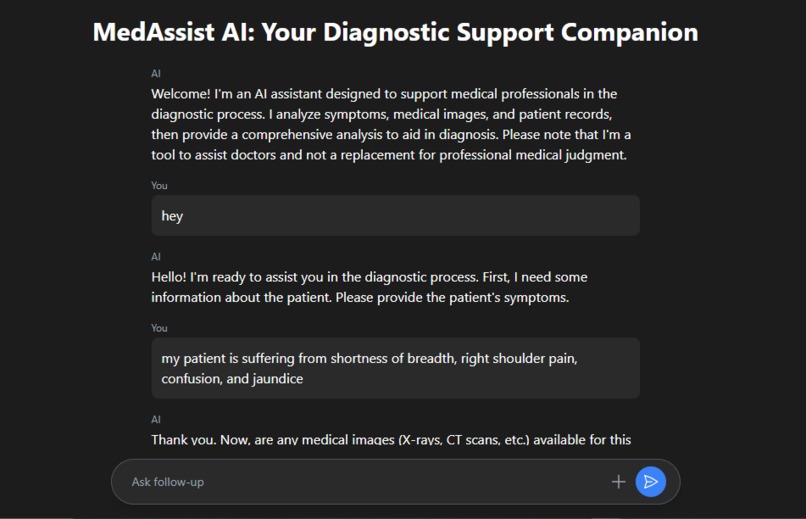
user interface
-
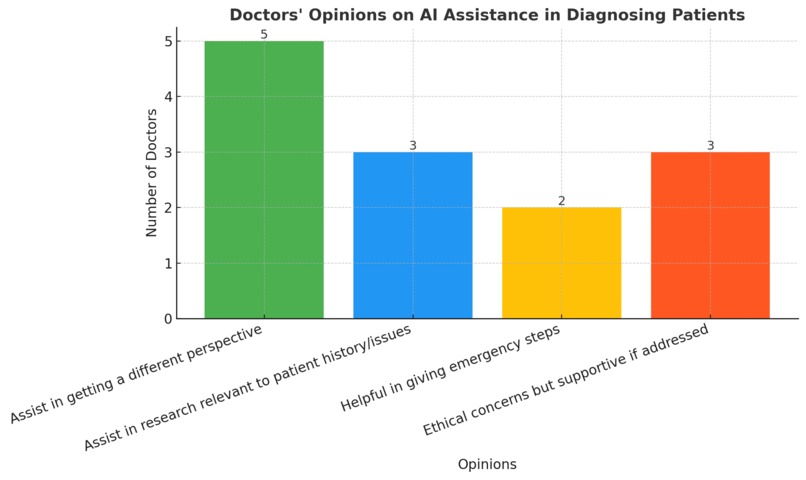
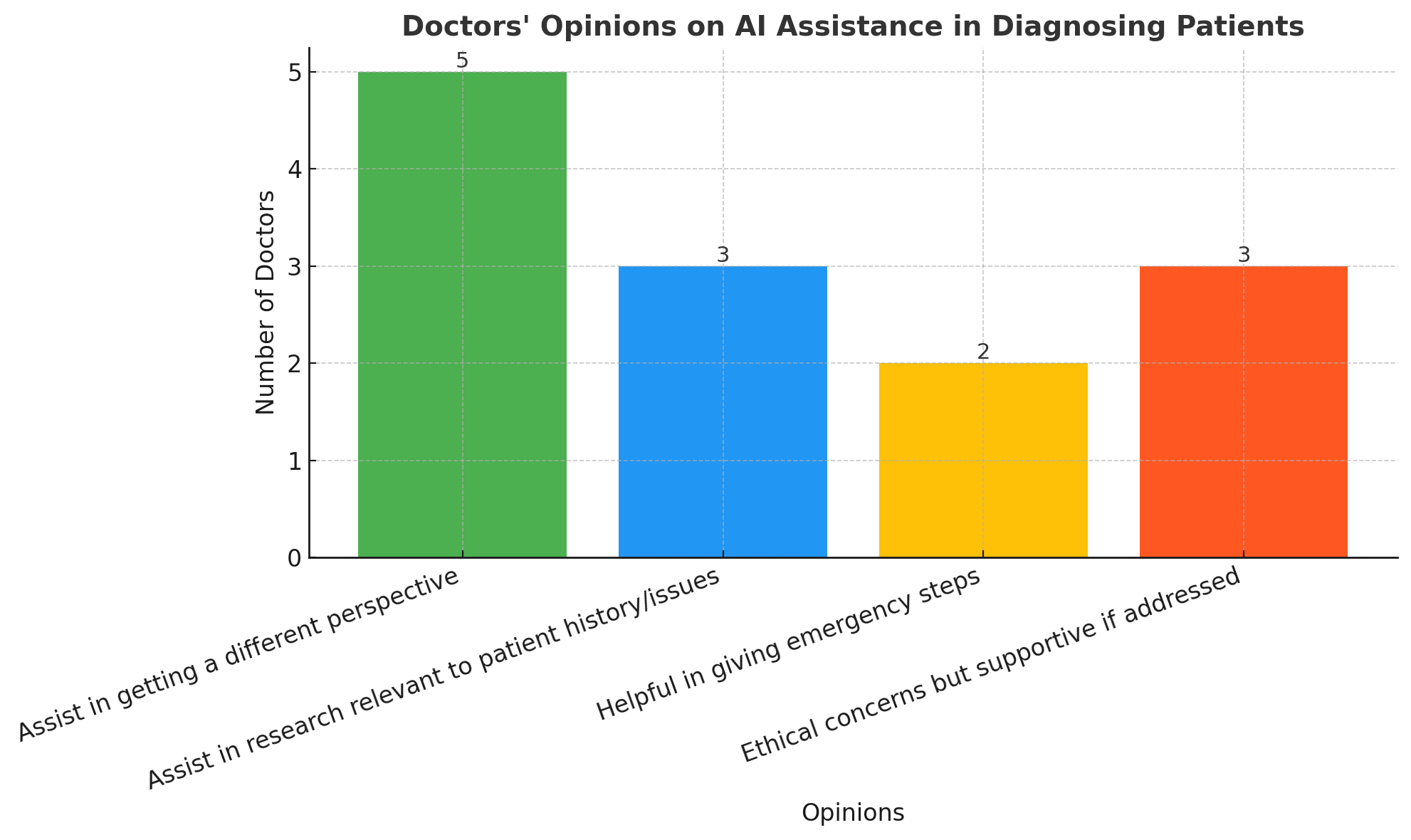
Doctors survey I did
Inspiration
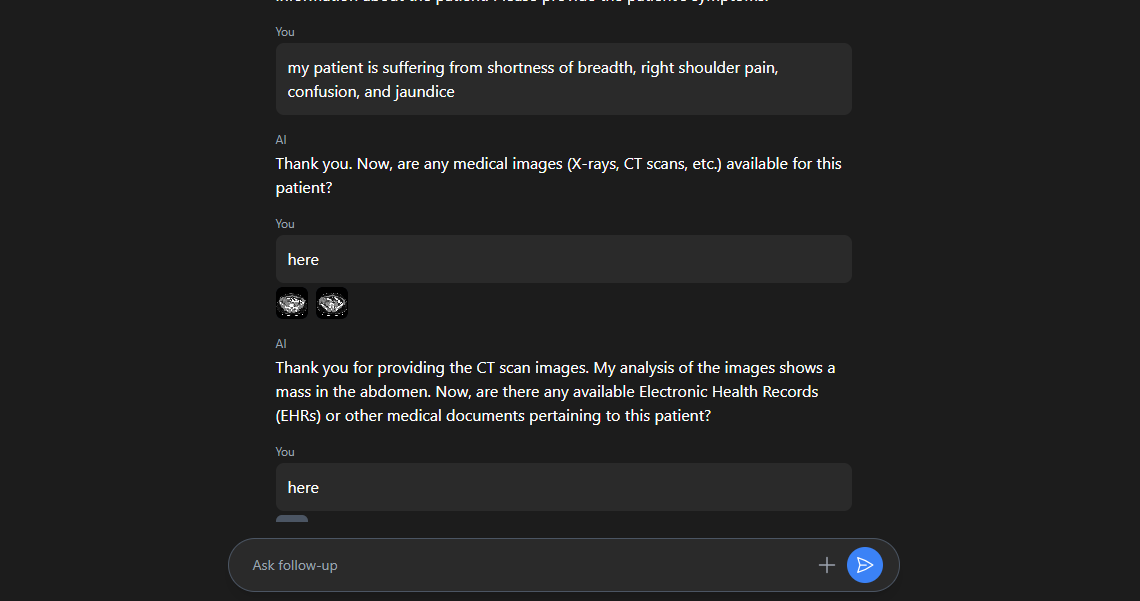
A few weeks ago, I began to work on MedAssist when I went to visit my doctor. I was waiting, and the doctor was looking for something on ChatGPT. Intriguing, I had to ask him immediately if he used AI at all in his medical practice. He seemed very lukewarm and filled with skepticism. At that moment, it hit me that doctors needed an AI tool for their particular needs, not just a general chatbot.
It was after this incident, along with my concern about the slow and/or inaccurate diagnosis, that MedAssist finally struck me. I thought of an AI capable of empowering doctors to achieve the following:
- Faster, more accurate diagnosis: Reduce errors and save lives.
- Access to latest research: Keep doctors abreast of the latest findings in the medical world.
- Alternative perspectives: Help doctors review diagnoses that may have been overlooked.
- Explainable AI: Shining a light into the decision process of the AI in trust and collaboration.
To validate this hypothesis, I took a survey among 13 doctors, and the immensely positive response firmed up my resolve for MedAssist. The project was my humble attempt at creating better health care in my community and elsewhere. This is the proof-of-concept, and I look forward to continuing to develop and refine it.
What it does
MedAssist is an indefatigable medical companion that stands by the doctor, always, in his quest for an appropriate and timely diagnosis. Imagine having an indefatigable assistant, one who could go through complex medical images, sift through mountains of patient data, and keep abreast with the latest research in the medical field-such is MedAssist in a nutshell.
Here is how it performs its magic:
- Image Analysis: MedAssist goes through medical images, such as X-rays, MRI, and CT scans, to identify any anomaly and point out particular areas that the doctor should look at more closely. It acts like an extra pair of expert eyes going through every scan.
- Data Processing: It deeply interfaces with patients' records, extracting critical data from electronic health records, laboratory test results, and case history. A big-picture view like this fosters dot-connecting for the physician. • Knowledge Savvy: The domain knowledge base upon which MedAssist rests is not solely dependent on preexisting knowledge but informs the newest medical research. It brings new insights and cutting-edge findings to the diagnosis process. • Explainable AI: Different from a black box, this describes its reasoning using concepts of XAI. This helps in building trust and demonstrates the "why" for the AI's suggestions to the doctors.
With MedAssist, physicians are able to diagnose more confidently, have alternate perspectives, and finally treat their patients much better. It's a proof of concept that has the potential to revolutionize health care.
How we built it
MedAssist is built with a core of Python, flexing its muscle with diverse and rich libraries in AI development. I avoided using any complex frameworks and tried to stick to developing a lean and mean setup.
The hood includes:
- LLM Powerhouse: The
llmpackage from Google provides the backbone for the language processing that powers MedAssist to understand and respond to complex medical queries. - Research Guru: The
gpt-researcherdoes much more than shallow web searches; instead, it digs deep into good sources for complete medical information. - Open-Source Embeddings: To help make the system more accessible, I integrated an open-source embedding model from Together AI, with care for keeping costs low without sacrificing performance. • Agentic Collaboration: This collaborative agentic environment, MedAssist, would have various agents specializing in image analysis, data processing, and research. In other words, seamless integration of outputs for comprehensive insights. • Unfussy but Effective Frontend: A clean and intuitive frontend with Next.js ensures ease for doctors.
While this uses Google Gemini as the base model, in the near future I plan to include more domain-specific models that deal with medical data. This proof of concept shows us the possibilities with MedAssist, and I am super excited to continue optimizing and growing it.
Challenges we ran into
Building MedAssist was rewarding and, in the same breath, wrought with a lot of challenges. Most of the time, working usually solo, this would mean lots of solitary work. Solitary and doubting, I just pushed forward, determined to make the vision live.
One of the really hard parts was just getting the frontend to play nicely with the backend. Trying to get the user interface to do some kind of useful work with complex AI processing was almost an unsurmountable hurdle. It took days of debugging and experimentation to simply get a basic amount of integration.
Another challenge was based on my decision to use an open-source embedding model. This made the project more accessible but meant a little sacrifice of speed. The researcher tool, at times, can be a bit slow.
Despite this, I am proud of where MedAssist is. I'll be refining the frontend and optimizing performance, but even in this state, it's a showcase to the tremendous potential of AI in healthcare. This proof of concept is a statement of perseverance and a stepping stone toward a better future in medical diagnosis.
Accomplishments that we're proud of
Developing MedAssist has been a tough yet enriching experience. Besides technical achievements, the thing that I could really boast of is the great possible consequences this can bring about in health care.
What makes MedAssist special is:
- Aiding Doctors, Saving Lives: MedAssist helps doctors in diagnosis; therefore, this contributes to speedier and more appropriate diagnostic considerations. These could be the ways for better treatment outcomes and saved lives.
- Empower the Medical Community: The doctors form the backbone of our healthcare system. Being able to provide them with a tool that will enhance their capabilities and make life easier for them is something I take great pride in.
- Community Support: The responses and encouragement from the 13 doctors I polled have been invaluable. Sometimes, knowing that MedAssist falls on the hearts of those it aims to serve motivates me.
- A Proof of Concept with Promise: MedAssist is a case in point as far as the old adages-trying hard and working harder-are concerned. This is a proof of concept that shows AI has the ability to change healthcare.
I believe supporting doctors means working toward the good health of my community, my country, and the world. After all, we entrust our lives to their care. It's an honor to contribute to their vital work.
What We Learnt
Developing MedAssist has been a journey into technical and personal learning. The following are key highlights of what we gained from it:
- Community-Centric Development: For one to develop something for the community, they have to understand their needs and hurdles. By interacting with doctors directly, I got the required insights that shaped up the development of MedAssist.
- Collaboration Awesomeness: It gets things rolling really fast when working alone, but I have realised that collaboratively is the only way forward for long-term sustainability. Having said this, I am excited to get friends on board and share this journey to give a better foundation to MedAssist.
- Ethics and Privacy First: In medicine, it is a mirror to ethics and data privacy. I have been learning how redacting personal information and giving users control over their information is important, and these will be in the front as I am developing MedAssist.
- The Value of Perseverance: An application that brings together AI features is not an easy one to develop. Moments of frustration and doubt were not a novelty, but perhaps the most important thing learned was to plug away at bringing a vision to life.
These above-learned lessons have been guiding me down the path of further development and refinement of MedAssist, ensuring it remains an instrument of value and ethics for the medical community.
What's Next for MedAssist
That was just the starting point for MedAssist! This proof-of-concept thing has fired up a thing or two in my veins, and I am getting back right into its development with lots of passion and energy. A little sneak peek as to what is in store for MedAssist:
- Teamwork makes the dream work: I will be joining some great friends in order to form a focused team. This will be able to drive challenges with greater efficiency and speed up development. • Frontend Face Lift: The frontend is an area that needs some love; we are going to make it more responsive, mainly for the research tool but also to ensure the user experience is easy for doctors. • Specialized AI Models: While Google Gemini was a great core, we will be exploring and integrating much more powerful models of AI that are specifically trained in the medical domain, pushing out more accuracy and extending the capabilities for MedAssist. • Improved Privacy and Security: We are committed to ensuring a high level of data privacy and security. Strong measures will be in place for the redaction of personal information and data control by the user. • Scope Expansion: We envision MedAssist to be a platform that will evolve to support doctors through their workflow, starting from diagnosis, treatment planning, and patient education.
Naturally, a long-term objective would be to establish MedAssist indispensible for the doctor to give the best to the patient. All the best for this exciting journey ahead; I cannot wait but to see where things go.
Built With
- gemini
- google-genai
- gpt-researcher
- tavily
- togetherai


Log in or sign up for Devpost to join the conversation.