-
-
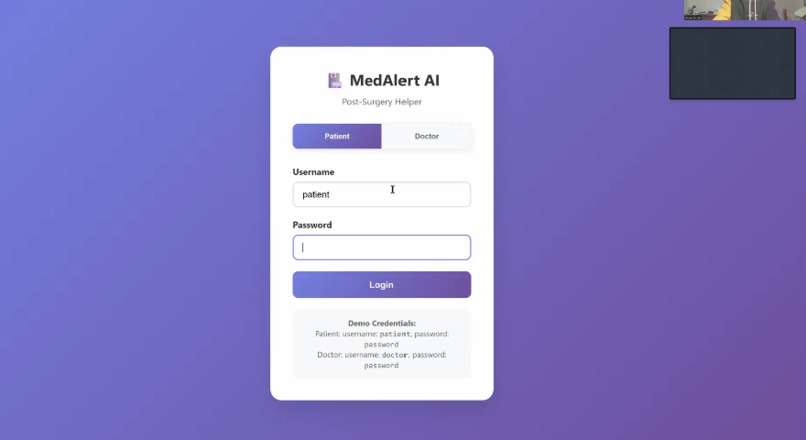
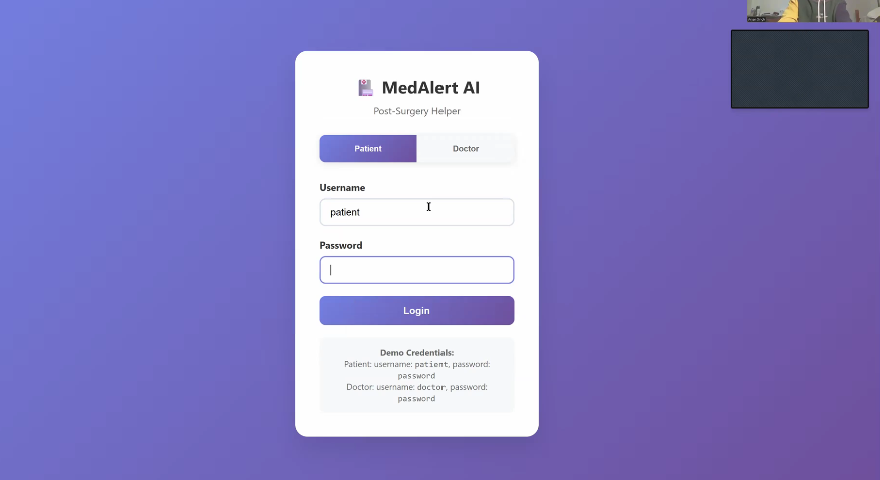
Login screen. Use demo credentials patient or doctor. Password = password.
Inspiration
Millions today in 20% of surgical operations suffer from severe post-op complications. But MedAlert is a little more personal to me than that. In the past, one of my own family members was in a taxi accident and ended up needing an emergency surgery on her femur. With a lack of post-operational support, it took a whole month for doctors to realize her body was rejecting the implant they gave. 11 surgeries and 2 total hip replacements later over the course of 20 years, each with their own mishaps, my Mom walks today without nonstop pain and a limp anymore. But nobody else needs to suffer from that.
I've seen the effects of post-op neglect, how every question required a doctor’s visit or phone call, and too often small issues escalated because communication broke down. MedAlert AI was born out of this frustration and a desire to make recovery safer, smarter, and more compassionate.
What it Does
MedAlert AI is a post-operative care assistant that bridges the gap between patients and doctors.
For Patients
A friendly AI chatbot checks in daily, asking about pain, mobility, medications, wound care, and prompting patients to upload photos of bandages or incisions. It follows up with contextual questions, guiding recovery with reassurance and clarity.
For Doctors
MedAlert AI filters responses into concise, actionable updates. Instead of vague notes, doctors see only what matters most---red flags, wound progression, and trends over time. This empowers early intervention and prevents small problems from becoming life-threatening complications.
How We Built It
We developed MedAlert AI using FastAPI for the backend and React for patient and doctor dashboards. The AI chatbot leverages the OpenAI API for natural conversations, while image uploads support wound tracking. Secure communication endpoints ensure privacy and reliability. Everything was designed with simplicity in mind: patients can simply “talk” to their AI care assistant, while doctors access a clean, efficient dashboard.
Challenges We Ran Into
- Technical integration: Training the AI to respond in medically structured yet conversational ways, while avoiding diagnosis/treatment overreach.
- System compatibility: Python and FastAPI dependency issues (e.g., pydantic mismatches) slowed backend progress.
- User experience: Designing an interface usable by elderly or less tech-savvy patients required multiple design iterations.
Accomplishments We’re Proud Of
- Built a working AI chatbot that actively checks in on patients and accepts photo uploads.
- Created dual interfaces---one for patients, one for doctors---bridging a communication gap hospitals have struggled with for decades.
- Transformed a deeply personal struggle into a potential solution that could save lives and prevent unnecessary suffering.
What We Learned
Healthcare technology is not just about code: it is about empathy. We learned to design for how patients truly feel during recovery---vulnerable, uncertain, sometimes scared. We also discovered how much doctors value clarity over information overload. Balancing patient reassurance with concise medical updates lies at the core of MedAlert AI.
What’s Next for MedAlert AI
Our roadmap:
- AI wound image analysis: Integrating computer vision to detect infection or complication risks.
- EHR/EMR integration: Seamless updates flowing directly into hospital systems.
- Multi-language support: Making MedAlert accessible to patients across diverse backgrounds.
- Scaling pilots: Partnering with clinics and hospitals to refine performance in real-world settings.
Our vision: to make MedAlert AI a standard of care for every post-operative patient---catching complications early, reducing readmissions, and giving patients peace of mind during one of the most vulnerable times in their lives.
Built With
- fastapi
- gemini-generative-api
- javascript
- mongodb
- node.js
- pydantic
- python
- react
- uvicorn


Log in or sign up for Devpost to join the conversation.