Inspiration
What it does
How we built it
Challenges we ran into
Accomplishments that we're proud of
What we learned
What's next for MedAgent
MedAgent
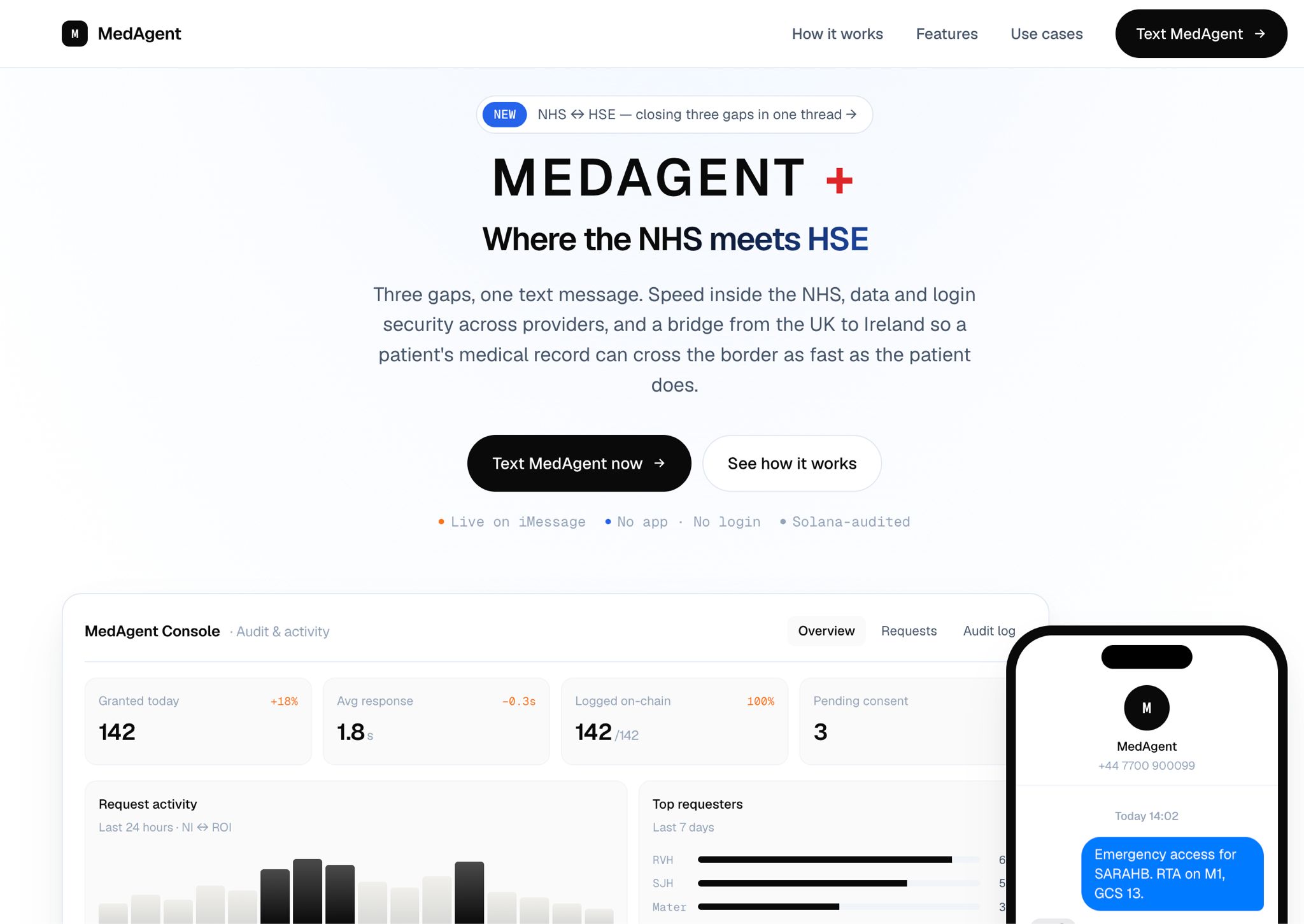
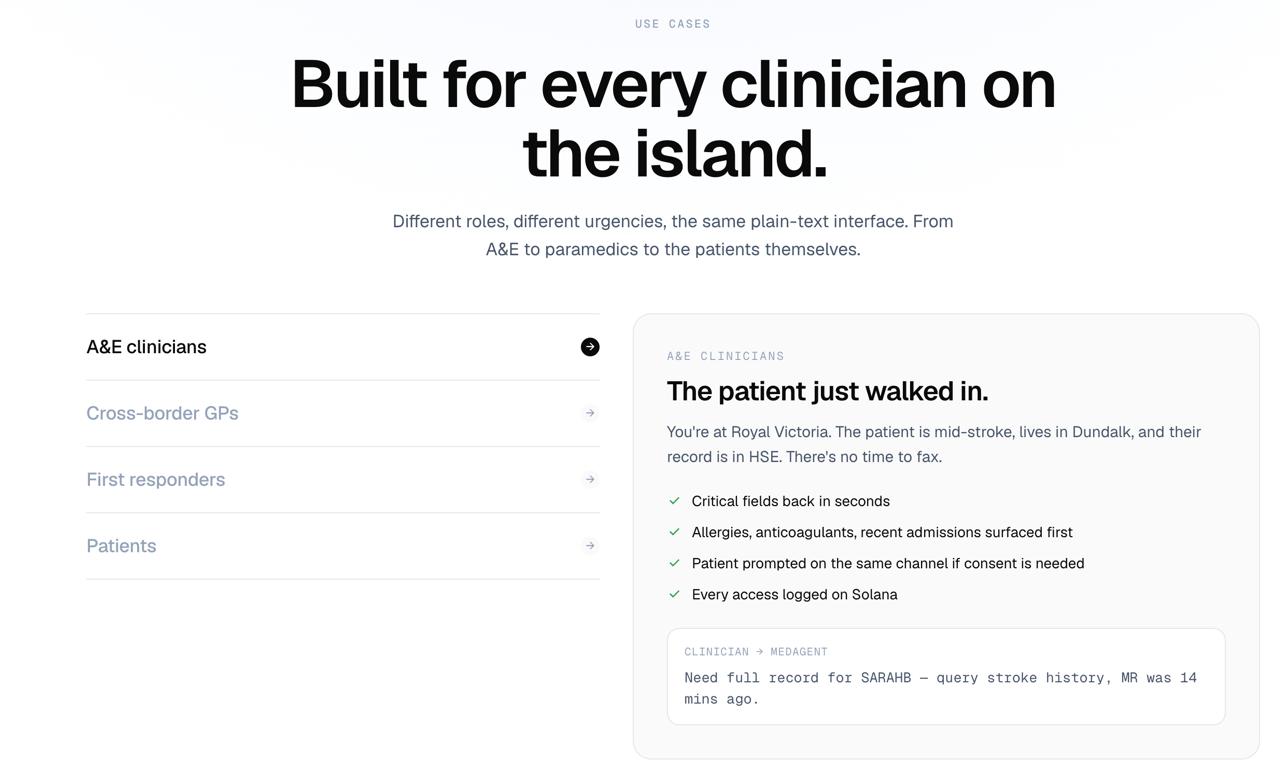
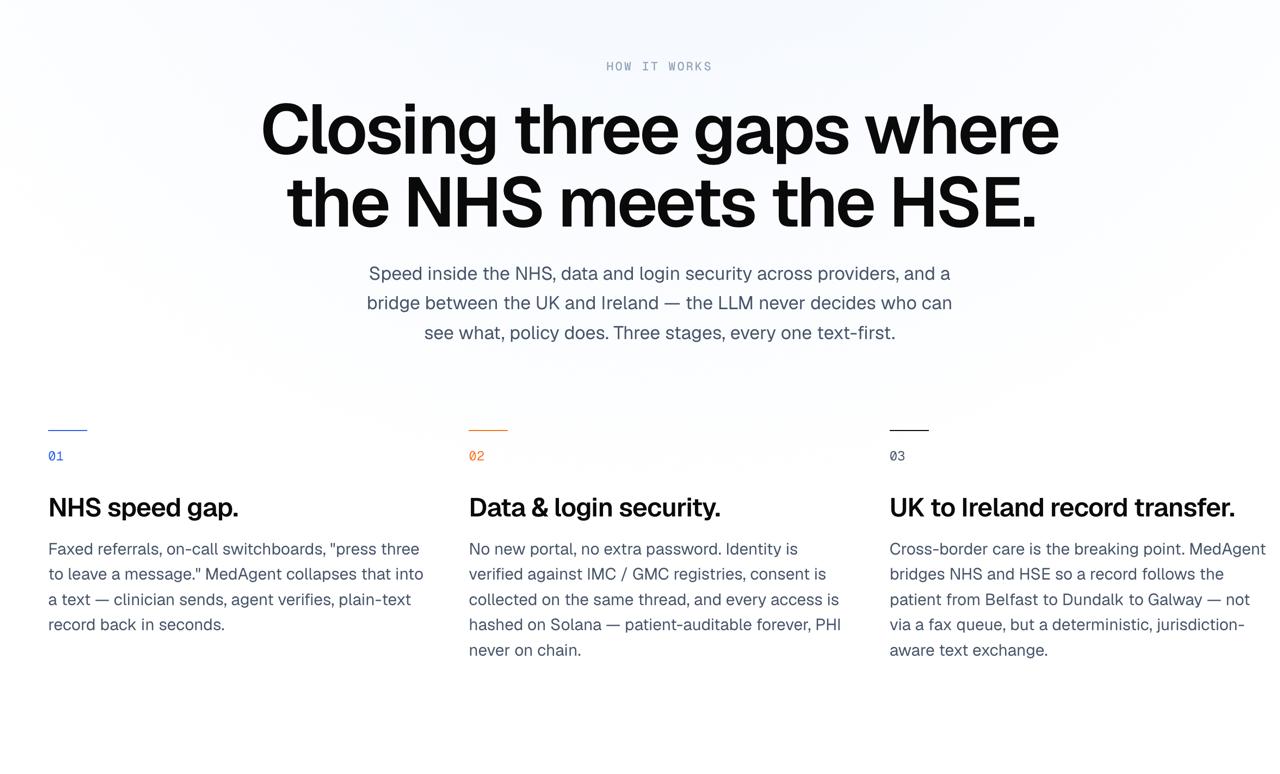
MedAgent is a deterministic emergency medical access system for cross-border healthcare on the island of Ireland. Designed for HackBelfast 2026's Belfast 2036 problem statement, it gives verified clinicians on either side of the NI/ROI border time-limited access to a traveler's emergency summary, with non-PHI interaction audit trails on Solana. The demo combines IMC/GMC doctor verification, patient dashboards, and a local macOS iMessage bridge.
Product Model
MedAgent v2 uses deterministic access and board-backed identity:
- Doctors verify with an IMC/GMC registration number seeded in
doctor_registry. - Web doctor login sends a 6-digit OTP through Resend and issues a 4-hour doctor JWT.
- Demo iMessage handles map to pre-verified personas for the live SMS/iMessage flow.
- Hackathon demo access currently grants the full emergency summary and records every release in the audit trail.
The AI layer does not decide access. The model is used for request interpretation, translation, briefing, and constrained follow-up answers after authorization. Policy decisions stay deterministic and outside the LLM.
Solana Audit Design
Audit logging is Solana-first in this branch.
- On-chain writes go through the
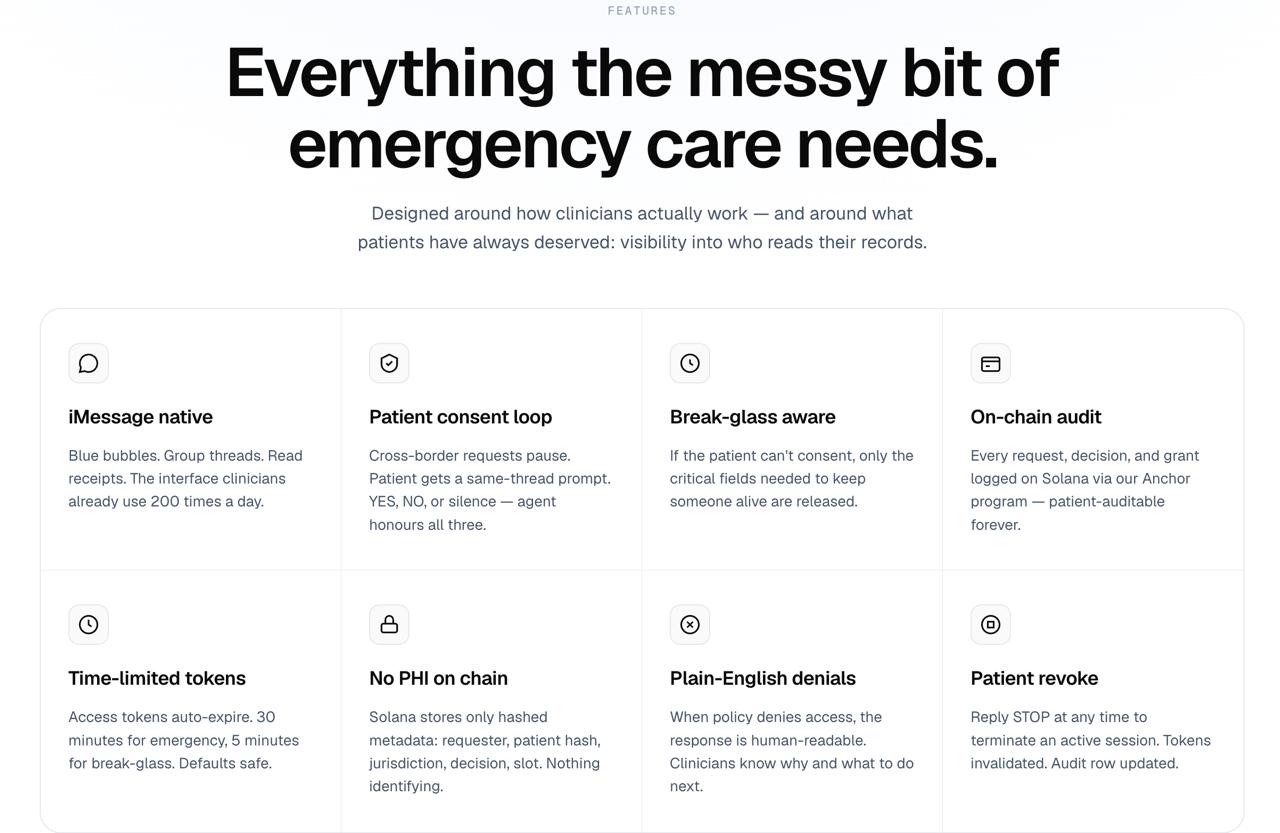
medagent_auditAnchor program. - Audit events are written with hashed or pseudonymous metadata only.
- No PHI is written on-chain.
- The app stores local copies of audit rows so the UI can deterministically replay and render the audit timeline.
- Audit viewer rows link to Solscan transaction URLs in the form:
https://solscan.io/tx/<signature>?cluster=devnet
Current audit event shape:
event_typerequest_iddoctor_hashpatient_hashjurisdictiondecisiontoken_expirytimestampinteraction_typesummary_hashfields_accessedduration_seconds
Architecture
medagent/: Next.js app, API routes, UI, testsmedagent/lib/agent/: LangGraph workflow and tool orchestrationmedagent/lib/solana/: Solana client, readiness checks, audit storeprograms/medagent_audit/: Anchor program for on-chain audit writesmedagent/docs/: judge-facing and product-facing demo material
High-level runtime flow:
- Clinician submits a natural-language emergency request.
- MedAgent verifies the requester and applies deterministic tier policy.
- If needed, the workflow pauses for patient approval.
- Authorized fields are fetched, translated, and summarized.
- A short-lived session token is issued.
- Audit events are written through the Anchor program and reflected in the audit viewer.
Retrieval Freshness and Background Indexing
MedAgent now maintains local retrieval indexes with a background refresh path:
- First request for a patient with no usable index performs a synchronous build for safety.
- After first build, stale indexes are still servable while an index refresh is queued in the background.
- Background refresh updates a patient-scoped manifest (
ready/stale/building/failed) keyed by source fingerprint.
Retrieval caching is patient-scoped, query-plan-aware, and source-fingerprint-aware:
fresh: serve directly from cache.stale_servable: serve immediately and queue background recompute (stale-while-revalidate).expired: recompute synchronously.
Cache and index behavior are local-only and deterministic. Policy, tiering, evidence filtering, and synthesis boundaries remain unchanged: no cache or index path can widen data access beyond deterministic policy controls.
Retrieval Evaluation and Plan Optimization
MedAgent includes a local-first retrieval evaluation harness and a deterministic planner optimizer.
- Evaluation runner executes retrieval-only checks (no reviewer/synthesizer) across multiple modes:
lexical_only,lexical_plus_rerank,cached, andcold_start. - Metrics include recall@k, precision@k, MRR, nDCG-lite, field/note-type coverage, latency, cache-hit rate, stale-cache serve rate, background-refresh rate, and rerank deltas.
- Planner optimizer uses prior retrieval telemetry to recommend deterministic plan settings (
precision_first,balanced,recall_first), boundedtopK, and mode ordering. - Optimizer is optional and flag-gated:
MEDAGENT_ENABLE_PLAN_OPTIMIZERandMEDAGENT_PLAN_OPTIMIZER_PROFILE.
This evaluation and optimizer layer does not alter deterministic policy boundaries, access controls, or synthesis safety constraints.
Run evaluation locally:
cd medagent
npm run eval:retrieval
Create a local eval baseline:
cd medagent
npm run eval:retrieval -- --make-baseline --baseline=./data/retrieval-observability/eval/baseline.json
Compare current retrieval behavior against a saved baseline:
cd medagent
npm run eval:retrieval -- --compare-baseline --baseline=./data/retrieval-observability/eval/baseline.json
Retrieval Observability and Regression Gates
MedAgent also includes a local-first observability and regression pipeline around retrieval planner execution.
- Each planner invocation can emit a deterministic retrieval metrics snapshot (latency, cache/index freshness, candidate counts, zero-result/pruning diagnostics).
- Latency budgets classify planner health as
healthy,degraded, orbudget_exceededwithout interrupting request flow. - Metrics snapshots are persisted locally and can be compared against baseline snapshots to detect regressions in latency and retrieval quality trends.
- Query-plan health diagnostics expose indexed-path signals (FTS usage, patient scoping, expensive scan hints) via structured flags.
- Eval artifacts now support baseline generation and baseline comparison for local regression gating.
- Workflow checkpoint state is persisted locally so pause/resume flows survive process restarts during demos.
- Readiness checks use dry-run validation and do not submit probe events on-chain.
Feature flags:
MEDAGENT_ENABLE_RETRIEVAL_OBSERVABILITY=true|falseMEDAGENT_RETRIEVAL_BUDGET_PROFILE=default|strictMEDAGENT_RETRIEVAL_SAVE_METRICS=true|falseMEDAGENT_RETRIEVAL_REGRESSION_BASELINE=<path>MEDAGENT_RETRIEVAL_HEALTHCHECK_EXPLAIN=true|false
Defaults are local deterministic behavior with observability enabled, metrics persistence enabled, and explain-based health diagnostics enabled in non-production environments.
Workflow API Boundary
The request workflow boundary is now:
runMedAgentWorkflow({
  input: {
    patientId,
    requesterId,
    naturalLanguageRequest,
    targetLocale,
    emergencyMode,
    presentedCredential,
  },
});
Resume flows use:
runMedAgentWorkflow({ resumeRequestId });
The compatibility shim in medagent/lib/agent/medagent.ts re-exports the public workflow helpers used by routes, scripts, and tests.
Local Setup
App
cd medagent
npm install
npm run seed:demo
npm run imessage:live
Open http://localhost:3000.
Environment
Optional .env.local values:
OPENAI_API_KEY=...
OLLAMA_HOST=http://127.0.0.1:11434
OLLAMA_MODEL=llama3.1:8b
IMESSAGE_OLLAMA_PARSE_ENABLED=true
SOLANA_PRIVATE_KEY=[...]
SOLANA_CLUSTER=devnet
SOLANA_RPC_URL=https://api.devnet.solana.com
SOLANA_WALLET=/absolute/path/to/solana/id.json
JWT_SECRET=...
ENCRYPTION_PEPPER=...
IMESSAGE_BRIDGE_KIND=macos-local
# Optional
IMESSAGE_CHAT_DB_PATH=/Users/<you>/Library/Messages/chat.db
IMESSAGE_POLLER_INTERVAL_MS=2000
IMESSAGE_POLLER_BATCH_SIZE=25
IMESSAGE_POLLER_BOOTSTRAP=latest
IMESSAGE_POLLER_SKIP_HISTORY_ON_START=true
IMESSAGE_POLLER_ONLY_IMESSAGE_SERVICE=true
# Optional sender allowlist (comma-separated); default uses mapped MedAgent handles
IMESSAGE_POLLER_ALLOWED_HANDLES=+353871000001,+447700900201
IMESSAGE_WEBHOOK_SECRET=...
SENDGRID_API_KEY=SG....
[email protected]
DOCTOR_SESSION_SECRET=...
PATIENT_SESSION_SECRET=...
APP_BASE_URL=http://localhost:3000
NGROK_PUBLIC_URL=
Notes:
- If
SOLANA_PRIVATE_KEYis missing, the app falls back to local-only audit markers instead of live chain submission. - If
OPENAI_API_KEYis missing, translation/follow-up fall back to deterministic local behavior. - iMessage bridge runs live-only on macOS Messages.app (AppleScript + local chat.db polling). BlueBubbles and mock modes are disabled.
- Use
GET /api/imessage/health(withx-webhook-secretorAuthorization: Bearer <secret>when configured) to verify local bridge connectivity. - Run
npm run dev:tunnelfrommedagent/for globally reachable share links, ornpm run imessage:live:tunnelto start ngrok, the app, and the inbound iMessage poller together. - Run
npm run imessage:liveonly when local-only links are acceptable. - Advanced/manual mode: run
npm run devandnpm run imessage:pollseparately. - Poller defaults to iMessage service only and forwards only allowlisted handles to avoid SMS shortcodes/system senders.
- Poller defaults to
IMESSAGE_POLLER_SKIP_HISTORY_ON_START=true, so each launch starts from the current message tail and does not replay old history. - Demo readiness checks validate RPC/program availability without polluting the audit log.
Anchor.tomlnow resolves wallet via${SOLANA_WALLET}for cross-platform compatibility. Set it to an absolute path before running Anchor commands:- macOS/Linux:
export SOLANA_WALLET=\"$HOME/.config/solana/id.json\" - Windows PowerShell:
$env:SOLANA_WALLET=\"$env:USERPROFILE\\.config\\solana\\id.json\"
- macOS/Linux:
Anchor Program
From the repo root:
NO_DNA=1 anchor build
NO_DNA=1 anchor deploy --provider.cluster devnet
This branch has been wired so the app-side Solana audit layer invokes the Anchor program directly rather than using an opaque memo-only write path.
If you are doing purely local chain development, use --provider.cluster localnet and keep app/runtime URLs aligned to localnet values.
Useful Commands
From medagent/:
npm run dev
npm run imessage:live
npm run seed:demo
npm run demo:reset
npm run demo:readiness
npm run imessage:poll
npm run eval:retrieval
npm run test
npm run test:agent
npm run build
From repo root:
cargo check -p medagent_audit
NO_DNA=1 anchor build
Demo Flow
Recommended demo path:
- Run
npm run demo:readiness - Open
/doctor/loginand verifyMC12345orGMC7953798with the emailed/dev-console OTP. - Use the iMessage bridge demo handle for Dr. Aoife Murphy or Dr. Chidi Okonkwo to request Sarah Bennett.
- Open
/patient/loginor/patient/register, then/patient/dashboardto inspect the patient's interaction timeline. - Open
/audit/sarah-bennettfor the Solana-backed audit viewer.
What to point out:
- deterministic board-backed doctor verification
- patient-owned interaction dashboard
- full emergency-summary release for the hackathon flow
- short-lived session
- workflow trace
- Solana slot + transaction signature + Solscan link in the audit view
Verification
App quality gates:
cd medagent
npm run test
npm run build
Program quality gate:
cargo check -p medagent_audit
Readiness check:
cd medagent
npm run demo:readiness
Expected readiness outcome in a live-configured environment:
- credentials available
- RPC reachable
- dry-run write path validated against
medagent_audit
Why This Is Agentic
MedAgent is not a chat wrapper over a records store.
- The workflow is graph-based.
- Branching depends on tool outputs and policy state.
- Human approval is a first-class control point.
- The LLM is constrained to tasks that are safe after access control.
- The app exposes the trace so operators can inspect what happened.
Status
This branch is Solana-first for audit logging and is intended for demo and hackathon use. It is built to prove:
- narrow emergency-only release
- clear policy boundaries
- auditable on-chain evidence without PHI leakage
- a visible, inspectable agent workflow

Log in or sign up for Devpost to join the conversation.