-
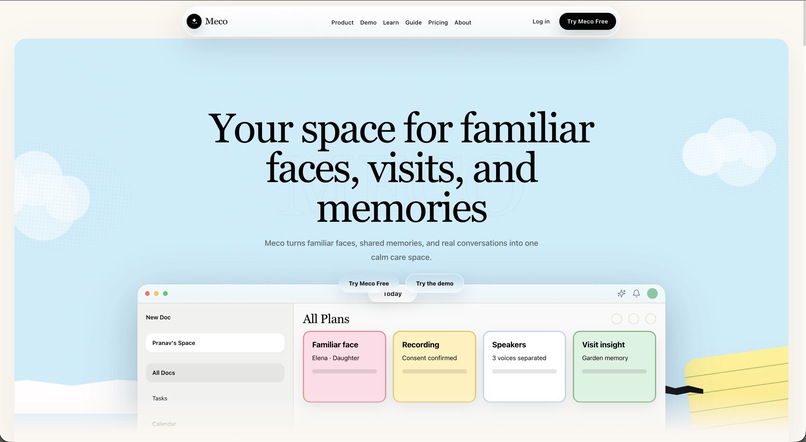
Hero
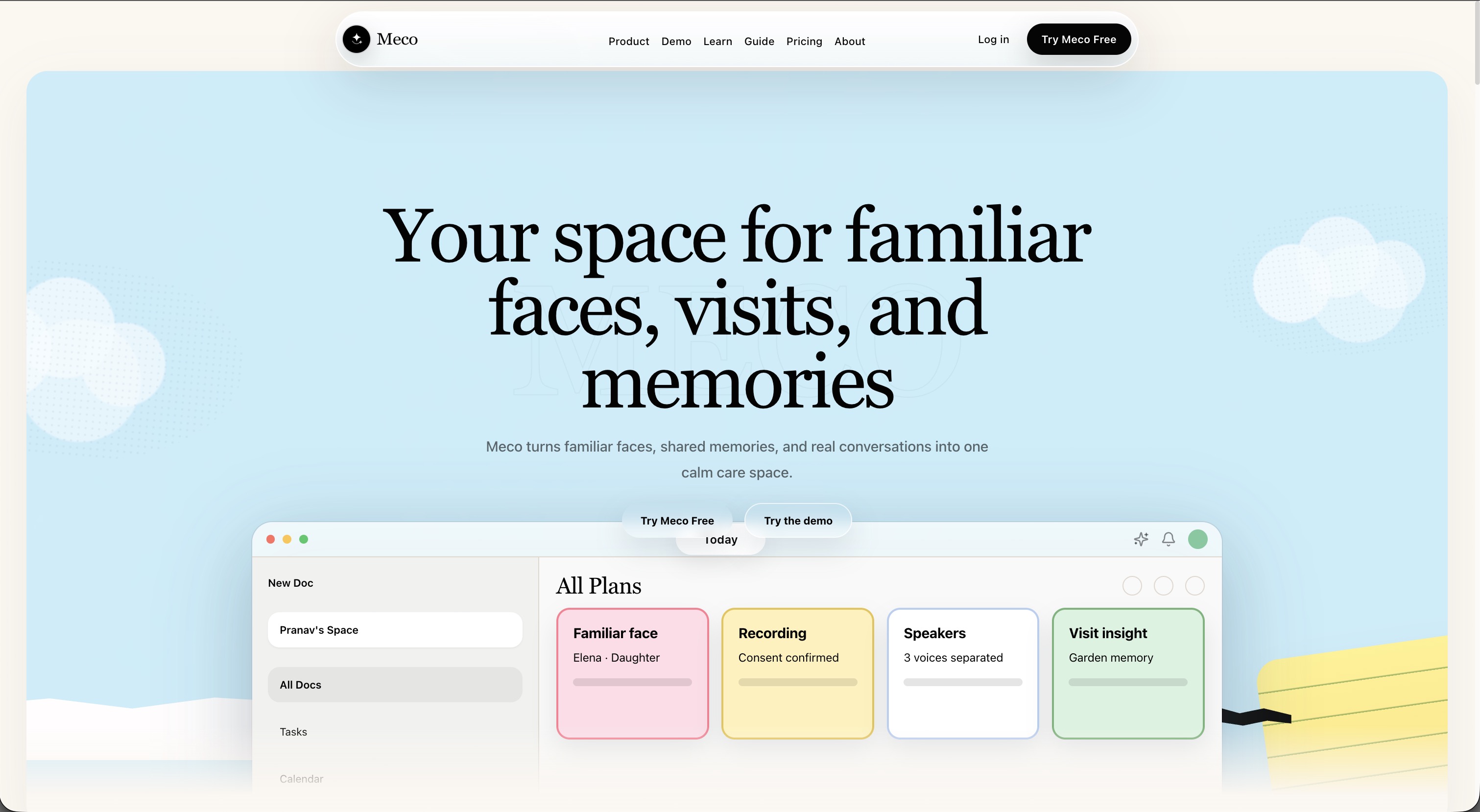
What if one day you looked at your own family... and couldn't remember who they were?
Imagine waking up and not recognizing the face of your spouse. Imagine forgetting the conversation you had just five minutes ago or missing an important doctor's appointment because you simply couldn't remember it happened. For millions of people living with dementia, this is their reality.
Every 3 seconds, someone in the world develops dementia. More than 55 million people currently live with the condition, and that number is expected to nearly triple by 2050. While AI has transformed how we record information, it still does little to help people remember it.
That's why we built Meco.
Inspiration
Most transcription apps can tell you what was said. They can't tell you who said it, why it mattered, or how it fits into your life.
We wanted to build something fundamentally different—not another note-taking app, but a digital memory layer that helps people living with dementia preserve conversations, recognize familiar people, and recall important moments.
Our vision was simple: technology shouldn't just capture memories—it should help protect them.
What Meco Does
Meco listens to conversations in real time and transforms them into meaningful, searchable memories.
Instead of producing pages of raw transcripts, it:
Transcribes conversations live. Identifies who is speaking using AI-powered speaker diarization. Recognizes familiar faces to provide context. Generates concise AI summaries. Extracts important events such as medical appointments or reminders. Creates a searchable timeline so users can revisit moments whenever they need.
Rather than remembering everything, users can quickly search for what matters most.
How We Built It
Meco combines several AI systems into one seamless pipeline.
The frontend is built with React and TypeScript, while serverless Node.js APIs coordinate communication between each AI service.
For speech recognition, we use Deepgram Nova-3, providing accurate real-time transcription.
Speaker identification combines Pyannote Audio with Resemblyzer, allowing Meco to distinguish between different voices during conversations.
Conversation summaries and memory extraction are generated using Llama 3.3 70B via Groq, with Gemini acting as a fallback model for reliability.
Facial recognition is powered by TensorFlow.js and MediaPipe, enabling the application to associate conversations with familiar people.
Authentication is handled by Clerk, while user data and memories are securely stored using Appwrite.
Each component runs independently in a modular architecture, making the platform scalable and allowing individual AI services to evolve without affecting the rest of the system.
Challenges
The biggest challenge wasn't building each AI feature individually—it was making them work together in real time.
Transcription, speaker diarization, face recognition, summarization, and event extraction all have different processing speeds and accuracy requirements. Synchronizing these outputs while maintaining low latency required redesigning our architecture into independent AI microservices that communicate efficiently.
Balancing speed, accuracy, and reliability became one of the most rewarding engineering problems we solved.
What We Learned
Building Meco taught us that creating meaningful AI products is far more than connecting APIs.
We learned how to architect modular AI systems, manage multiple machine learning models simultaneously, and design software that prioritizes accessibility and human impact.
Most importantly, we learned that AI can do more than automate work—it can help preserve something deeply human: our memories.
What's Next
This is only the beginning.
Future versions of Meco will include:
Personalized long-term memory retrieval. Automatic calendar and reminder synchronization. Caregiver dashboards. Emergency assistance features. Emotion-aware conversation insights. Wearable device integration for continuous support.
Our goal is to create an AI companion that doesn't simply remember information—it helps people remember their lives.
Because memories shouldn't disappear just because a disease says they should.
Built With
- 3
- api
- appwrite
- artificial
- clerk
- deepgram
- diarization
- face
- flask
- gemini
- groq
- language
- llama
- machine
- mediapipe
- natural
- node.js
- processing
- python
- react
- recognition
- speaker
- speech-to-text
- tensorflow.js
- typescript

Log in or sign up for Devpost to join the conversation.