Inspiration
In biology, seeing one outcome does not always identify the mechanism that produced it. Different pathways can explain the same measurement. Mechanism Duel makes that ambiguity visible and turns it into a practical next question: which variable, timepoint, or intervention would best separate the competing explanations?
What it does
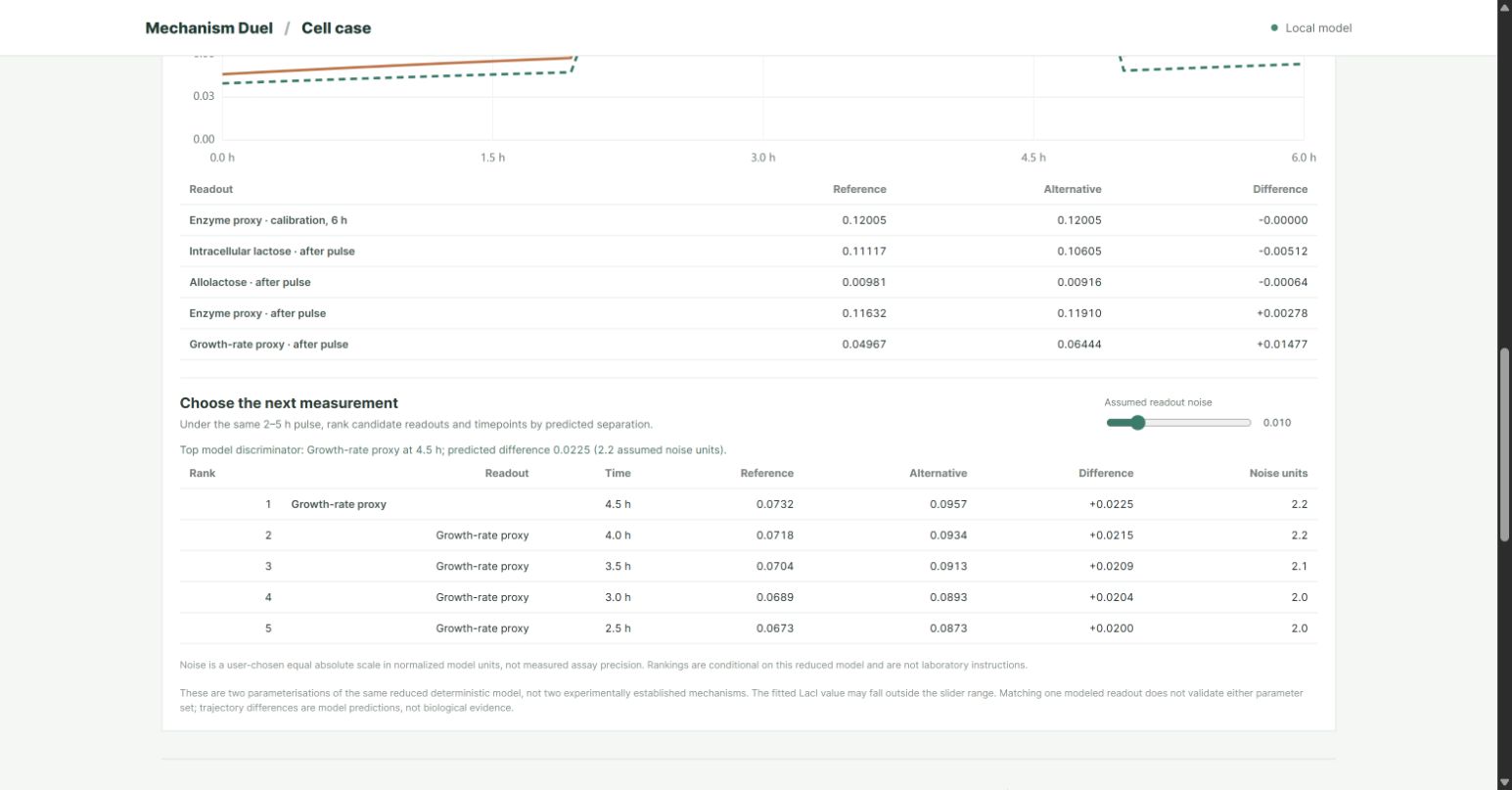
The prototype starts with a synthetic mechanism-discrimination case and adds an interactive reduced model of E. coli lactose regulation. In Case 01, it compares a direct reaction (S → P) with a two-step route (S → I → P) and ranks candidate measurements. In Case 02, users can schedule multiple changes to external lactose and glucose context, then observe intracellular lactose, allolactose, enzyme-expression, and growth-rate proxies evolve continuously across the intervention times. A history challenge compares a steady culture with a short lactose pulse. A parameter-identifiability challenge tunes a second parameterisation to match the same 6 h enzyme proxy, then applies the same pulse and compares the predicted state trajectories. The app then ranks candidate readout/timepoint pairs by predicted separation under a user-chosen equal absolute noise scale, making the model's suggested next observation inspectable. This compares parameterisations of the same reduced model, not established competing mechanisms; the noise scale is not measured assay precision. LacI repression and growth coupling can also be varied. This is a bounded experiment composer over two modeled medium variables, not an arbitrary-chemical or whole-cell simulator.
How it was built
The browser interface uses HTML, CSS, and JavaScript. The reaction ODEs are integrated using @tangent.to/ode (MIT). No AI model or external data is used by the running app. The models and intervention are deliberately small and explicit so users can inspect the assumptions.
Prior art and contribution
Optimal experimental design for model discrimination is established research, including biochemical-network methods described by Mélykúti et al. (2010). Existing biological modeling environments such as Cell Collective also support interactive network modeling. The lac case is informed by Zander et al. (2017), which studied graded versus bistable induction and growth-dependent dilution in the natural lactose system. Mechanism Duel does not claim a new scientific algorithm or reproduce that paper's fitted model. Its contribution is an inspectable experiment-design interaction: users can compare different parameterisations that fit one modeled readout, apply the same temporal protocol, and inspect which predicted states diverge.
Scope and limits
The lac case is a reduced, deterministic, dimensionless model. The experiment timeline permits repeated changes only to lactose and a normalized glucose-context input; an unmodeled chemical cannot be added and assigned invented effects. It omits stochastic single-cell variation, detailed DNA-loop operator states, full metabolism, and cell division. It is not a validated whole-cell simulation, a reproduction of experimental data, a medical tool, or an experimental protocol. The separation score is not the probability that either mechanism is correct. Real tests require validated mechanisms, feasible perturbations, measurement calibration, and controls for off-target effects.
AI-use disclosure
AI coding assistance was used to draft implementation and tests. The project author must review and understand the code, verify the model behavior and attribution, and approve the final public materials before submission.
