-
-
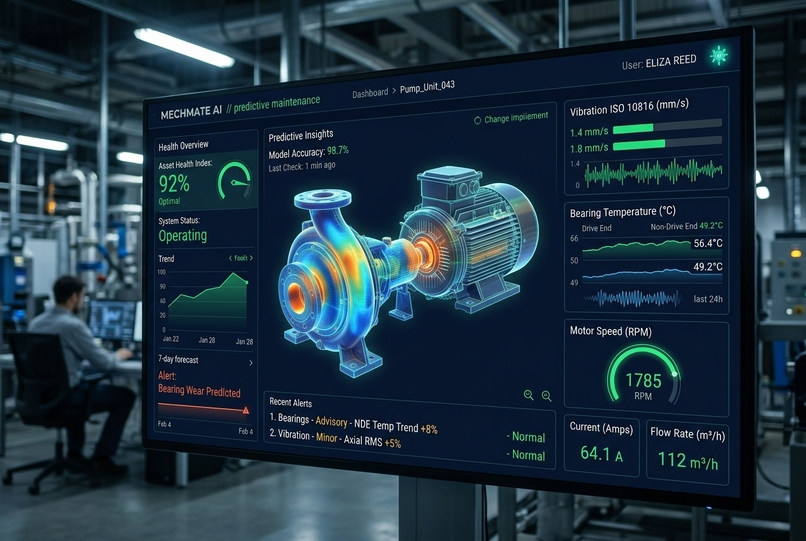
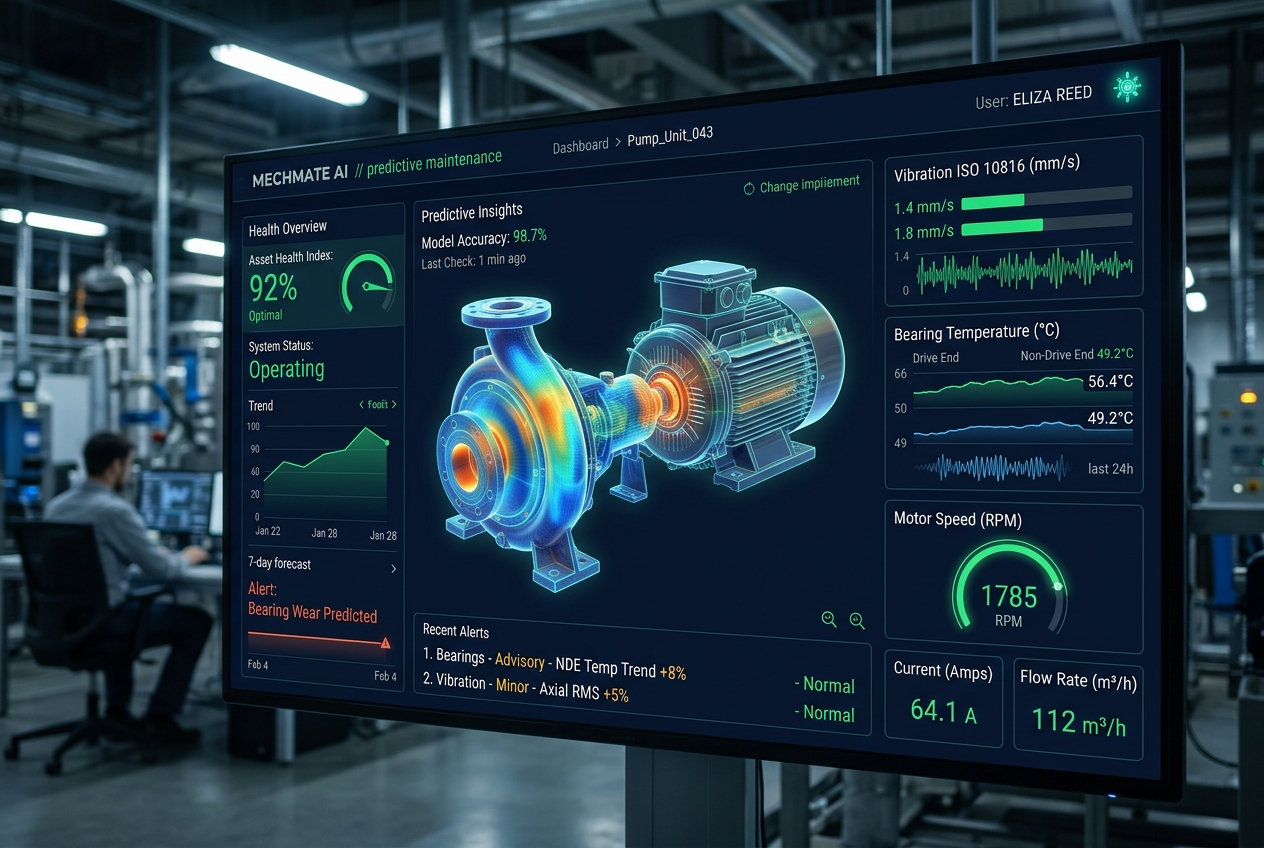
Interactive 3D Digital Twin showing real-time ISO 10816 vibration harmonics, thermal hotspots, and predictive health index.
-
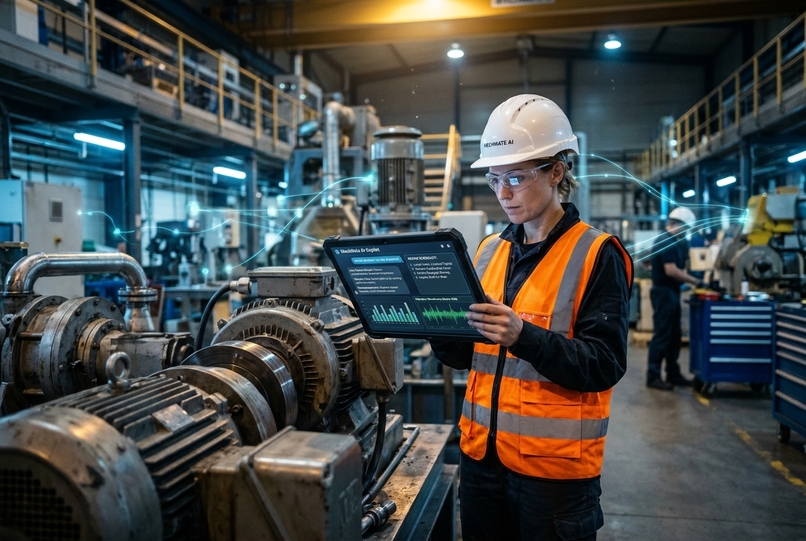
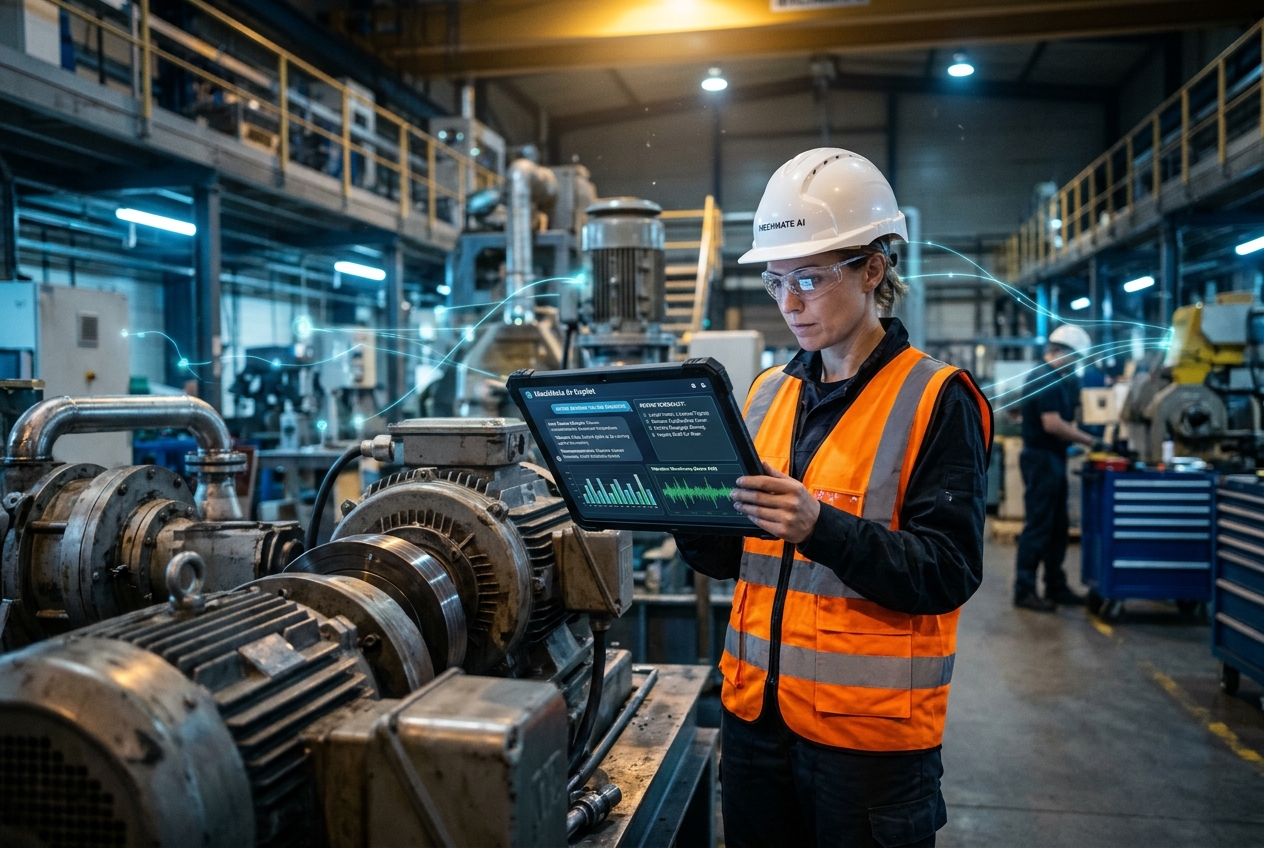
On-floor technician using MechMate AI Copilot on rugged tablet for physics-informed root cause analysis & SOP checklists.
-
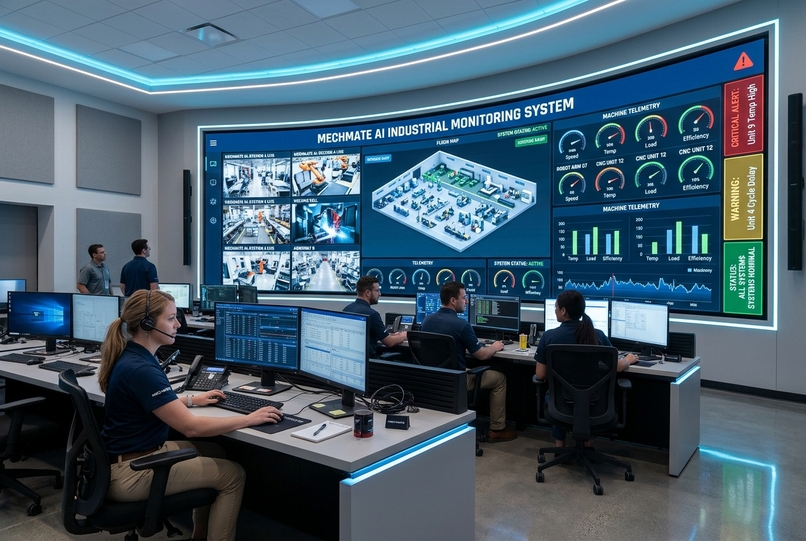
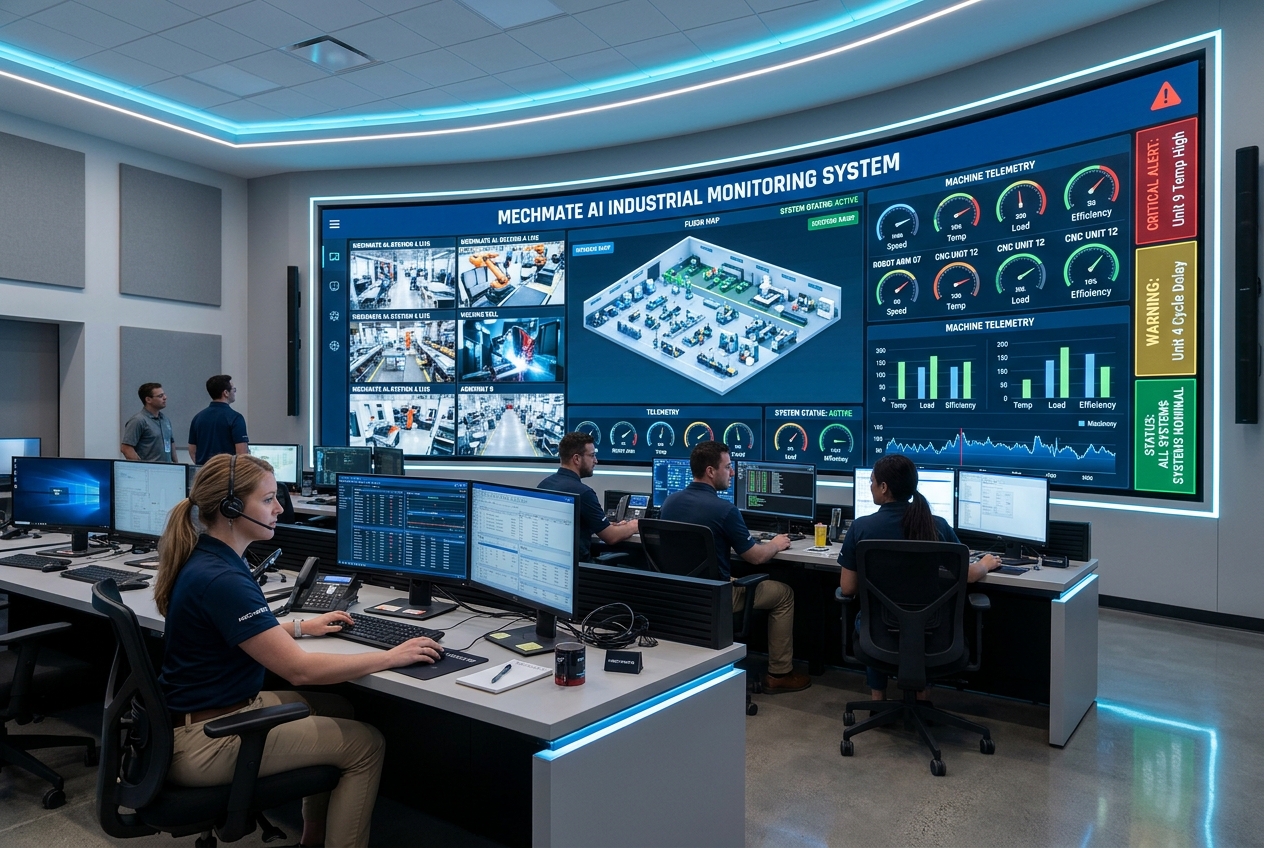
10-foot Fire TV control room dashboard and security perimeter zone monitoring for plant-wide reliability.
Inspiration
MechMate AI is an AI-powered industrial engineering workstation that predicts rotating machinery breakdowns, isolates physical root causes using live telemetry and 3D digital twins, and dispatches automated maintenance actions before catastrophic downtime occurs.
What it does
In industrial plants, unexpected breakdowns of heavy rotating equipment—such as gearboxes, motors, slurry pumps, and compressors—cost millions in downtime. Traditional SCADA screens display endless charts of raw numbers but fail to tell operators why a machine is failing or what immediate action to take. MechMate AI bridges this gap through a 6-stage engineering paradigm: Observe → Understand → Reason → Simulate → Recommend → Explain. Live Multi-Sensor Ingestion & Anomaly Detection: Continuous monitoring of drive-end/non-drive-end bearing temperatures, housing vibration RMS (ISO 10816 standards), shaft rotational speeds, electrical/mechanical load, and sump oil quality. It computes rolling statistics and multivariate Z-scores to catch subtle micro-deviations before threshold alarms trigger. Physics-Informed Mechanical Reasoning: Instead of relying on a black-box probability score, our engine calculates mechanical torque ( ), exact reduction gear ratios, and ISO 281 bearing life derating to determine structural stress and lubrication breakdown risk. Interactive 3D Digital Twin: Operators can inspect a responsive 3D model of the machine, isolating housing, shafts, roller bearings, and gear meshes to visually identify thermal hotspots and degraded components. "What-If" Simulation Lab: Plant engineers can test hypothetical operational adjustments (e.g., boosting load by 15% or changing motor RPM) in a virtual sandbox to verify thermal margins and safety limits before applying changes on the factory floor. Cross-Device Action Dispatch: When a critical anomaly is confirmed, MechMate automatically compiles a prioritized ISO 17359 inspection checklist, triggers audio beacons on factory Fire TV control-room boards, dispatches haptic pulse alerts to technicians' Bee/smartwatch wearables, and correlates plant camera footage (Ring) in restricted zones.
How we built it
We engineered MechMate AI as a full-stack, modular platform with a unified core engine: Frontend & 3D Visualization: Built with React 19, TypeScript, and Tailwind CSS. We integrated Three.js and WebGL for parametric 3D CAD digital twin rendering, complete with component isolation and camera orbit controls. Backend & Real-Time Engine: Built with a Node.js and Express architecture running on TSX, with Vite middleware mounted for local development. We created a centralized in-memory machine store that maintains rolling sensor streams, physics calculations, and alert dispatching. AI & Intelligent Reasoning: We integrated the Google Gemini 3.8 Flash SDK for causal diagnostic reasoning, utilizing tool calling (function declarations) and Retrieval-Augmented Generation (RAG) against technical manuals and SKF bearing catalogs. We also engineered a 100% deterministic local physics fallback so the workstation functions seamlessly even offline or without external API keys. Model Context Protocol (MCP): Implemented a native Streamable HTTP MCP server (JSON-RPC 2.0 protocol) running at /api/mcp with 7 grounded tools (get_machine_status, get_high_risk_machines, get_failure_prediction, etc.) for direct consumption by Alexa+ and external AI agents. Reporting & Audio: Utilized jsPDF for single-click, multi-page engineering diagnostic PDF reports and the native Web Audio API for control-room alert chimes.
Challenges we ran into
Bridging Black-Box AI with Strict Engineering Physics: Problem: Standard LLMs often produce vague or purely probabilistic guesses (e.g., "There is an 82% chance of failure"), which certified plant engineers cannot trust. Solution: We built a dual-layer architecture. We fed rigorous mechanical formulas ( , gear ratios, ISO 10816 vibration thresholds) directly into the prompt context and structured tool calls, forcing the AI to validate its findings against physical cause-and-effect laws before generating a verdict. Synchronizing Cross-Device Experiences from a Single Core: Problem: Supporting 10-foot TV displays, voice agents, wearable smartwatches, and perimeter cameras often results in fragmented, disconnected demo code. Solution: We designed a single authoritative machineStore on the backend. When a critical threshold or perimeter event is ingested, state transitions cascade simultaneously across the Fire TV feed, the Bee wearable notification queue, and the Alexa MCP server without data duplication. Smooth 3D Rendering with Dynamic Sensor Hotspots: Problem: Keeping the interactive 3D digital twin fluid and lightweight on tablet and mobile viewports while dynamically coloring components based on live heat and vibration metrics. Solution: We built a parametric component hierarchy in Three.js with optimized procedural geometries and dynamic material shaders, minimizing draw calls while maintaining clean component isolation.
Accomplishments that we're proud of
Zero Mock Black-Boxes: The Model Context Protocol (MCP) server actually implements the formal specification over Streamable HTTP and responds to genuine JSON-RPC 2.0 tool calls. A True "What-If" Simulation Sandbox: Operators aren't just looking at past data—they can actively manipulate speed and load sliders to observe projected thermal dissipation and lubrication degradation in real time. High-Density, Production-Grade UI: The interface balances dense industrial data with high aesthetic polish: tablet-optimized scaling, TV remote D-pad navigation, high-contrast gauges, and instant exportable PDF inspection reports. Offline Reliability: If the cloud or Gemini API is unreachable, the system automatically falls back to deterministic engineering calculation models without breaking or stalling.
What we learned
Industrial Standards Matter: Working with ISO 10816 vibration severity charts and ISO 281 bearing life equations taught us how condition monitoring is evaluated in certified plant environments. Protocol-First Agent Architecture: Implementing the Model Context Protocol (MCP) revealed how AI agents can interact reliably with real industrial telemetry when tools are strictly typed and deterministic. Responsive Multi-Viewport Ergonomics: Designing interfaces that work equally well on a 65-inch control-room TV (D-pad remote navigation) and a field technician's tablet required careful layout scaling and contrast tuning.
What's next for Mech Mate AI
Direct Edge Ingestion (MQTT / OPC-UA): Adding native industrial protocol connectors to ingest telemetry directly from Siemens, Allen-Bradley, and Beckhoff PLCs on the shop floor. Acoustic Emission Analysis: Integrating raw high-frequency audio spectrograms to detect micro-cracking and cage flutter in rolling-element bearings before vibration sensors pick them up. Automated Work-Order Generation (ERP/CMMS): Connecting the automated inspection checklist directly to plant maintenance software (SAP PM, IBM Maximo) to automatically schedule technician dispatch and spare-part orders. Augmented Reality (AR) Overlay: Building a mobile/WebXR view that projects the 3D digital twin and thermal heatmaps directly onto the physical machine through a tablet camera.
Built With
- amazon-alexa
- digital-twin
- express.js
- fire-tv
- google-gemini-api
- html5
- iot-telemetry
- iso-10816
- javascript
- json-rpc
- jspdf
- model-context-protocol-(mcp)
- node.js
- physics-informed-ml
- predictive-maintenance
- react
- rest-api
- ring-api
- tailwind-css
- three.js
- typescript
- vite
- webgl
- webhooks

Log in or sign up for Devpost to join the conversation.