-
-
Measure Merge
Inspiration
Headaches. More precisely, the mental pain of knowing that something in a pile of measurement spreadsheets is blocking effective work—duplicate billing, missing evidence, conflicting addresses—but not yet being able to see exactly where or why. MeasureMerge began as a real operational response to that pain. For OpenAI Build Week, I used Codex with GPT-5.6 to turn the existing internal workflow into a privacy-safe, independently deployable reviewer edition.
What it does
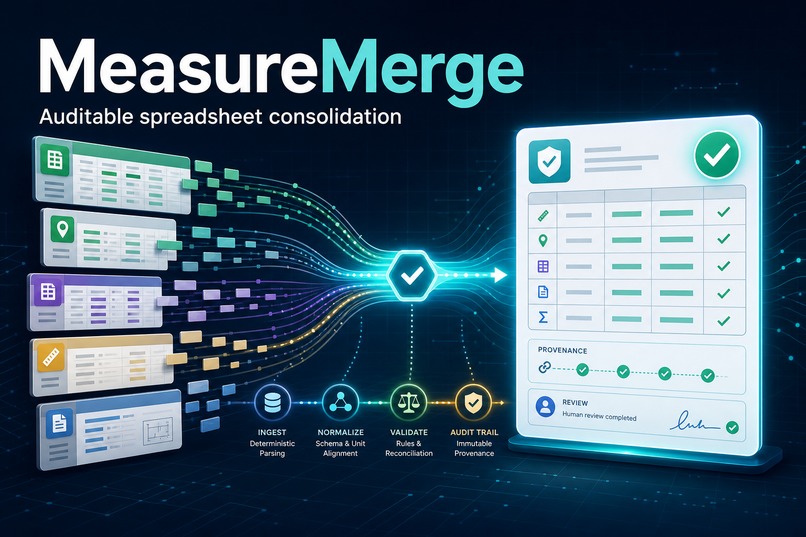
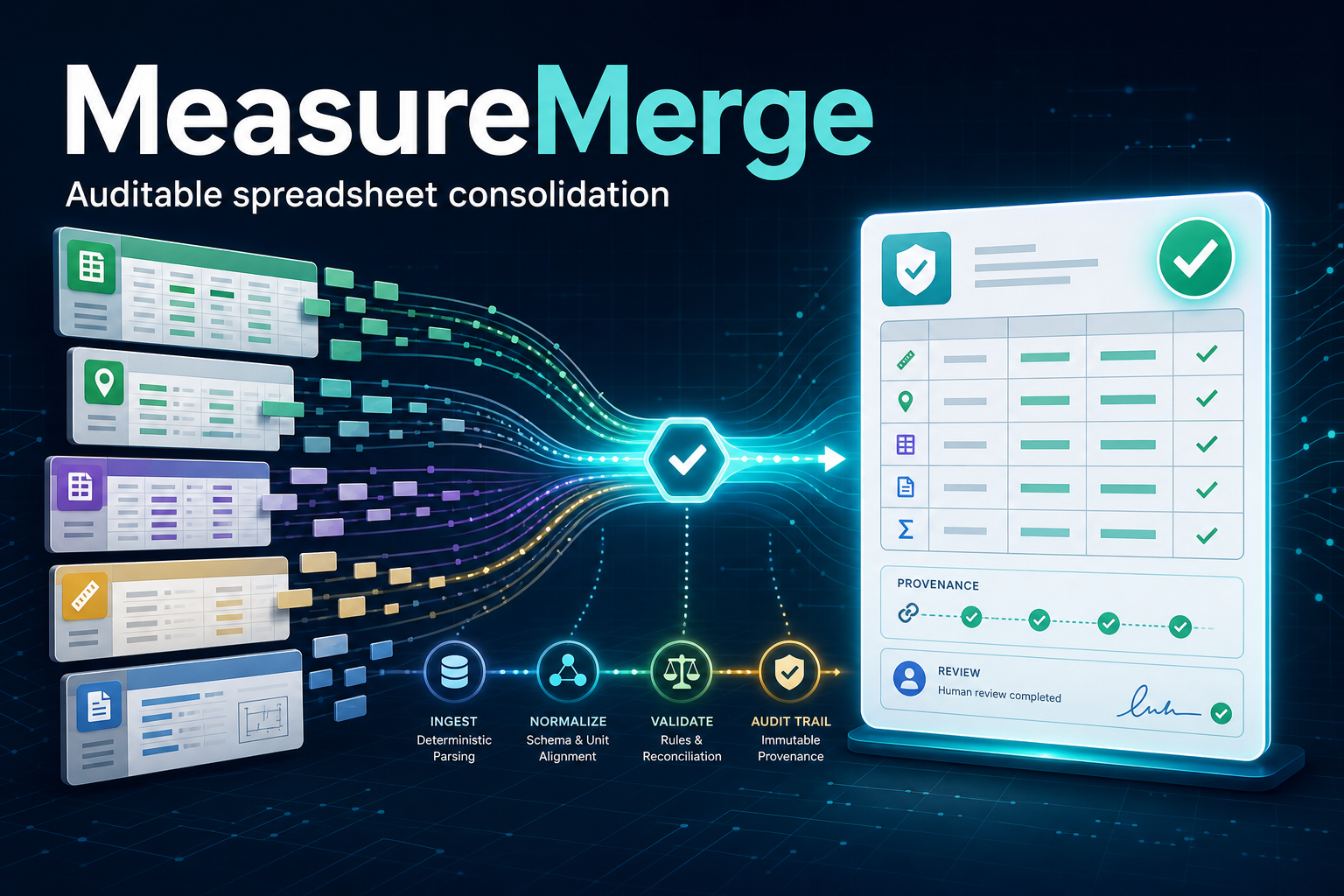
MeasureMerge makes files agree. It imports XLSX object lists and converts every detected service-position quantity into an address-level evidence trail. It recognizes order and partial-measurement identifiers, keeps addenda linked to the correct base measurement, and applies deterministic domain rules before data can be accepted.
The workflow highlights unknown positions, duplicate or split measurements, implausible unit totals, address conflicts and other review cases. Address reconciliation normalizes spelling variants and uses a conservative Levenshtein threshold: distance 1 for short street names, 2 below 16 characters and 3 from 16 characters onward, with a minimum similarity requirement. Ambiguous results remain in the human review queue. Authorized users can correct an address or the official dwelling-unit reference manually, and every administrative intervention records the actor, reason, before/after state and affected evidence.
Clean previews can be accepted by an operator. Exceptions require an administrator and a written reason. The consolidated overview, unit reconciliation, conflict views and exports preserve provenance back to the source file, sheet and row. Automatic daily database backups, backups before destructive changes, a recoverable trash workflow and an exportable audit log protect operational accountability.
How I built it
The mature German rule engine predates Build Week. The eligible Build Week work is a meaningful extension, visible as a dedicated sequence of commits created during the event:
- extracted a standalone demo repository and deployment boundary;
- isolated all hosted tables with the
devt_prefix; - replaced addresses, order numbers and measurements with a synthetic Musterhausen dataset;
- removed deployment secrets and real mail recipients from version control;
- protected uploads, backups, application source and data folders from direct web access;
- added an English Decision Brief and a one-click synthetic end-to-end scenario;
- fixed reviewer-facing metrics and documented the product provenance;
- deployed and exercised the live workflow with Codex Computer Use;
- produced a narrated, subtitled demo under three minutes.
Codex with GPT-5.6 Sol inspected the existing application and Git history, mapped database dependencies, designed the privacy boundary, implemented the new reviewer experience, tested the rules, deployed the site and operated the hosted workflow end to end. Earlier product development used GPT-5.5; every Build Week extension shown in the submission was developed with GPT-5.6 Sol at the highest reasoning setting.
Challenges
The hardest part was not generating a toy replacement. It was preserving a mature, interconnected set of deterministic business rules while proving that the public edition could not touch production tables or reveal real addresses. The database prefix, synthetic reference data, configuration separation, upload protection and repository review all had to agree. A second challenge was demonstrating a predominantly German domain application clearly to English-speaking judges without rewriting service-position descriptions that are part of the tested behavior.
Accomplishments
The result is a runnable product rather than a mock-up. Judges can sign in to the hosted instance, create and import a complete synthetic scenario, inspect address matching and unit reconciliation, exercise human approval, view the audit trail and export consolidated evidence. The public-facing data is synthetic while the retained rule depth remains representative of the real workflow.
What I learned
Codex was most valuable as a persistent engineering collaborator across code, Git history, database design, deployment and browser verification. GPT-5.6 helped reason about changes that crossed many files and operational constraints at once. The project also reinforced that trustworthy automation is not the removal of humans: deterministic rules, explicit exceptions and provenance make human decisions faster and more defensible.
What's next
Next steps are a fully bilingual interface, additional synthetic regression scenarios, scheduled backup health reporting, richer role-specific dashboards and configurable rule packs for adjacent spreadsheet-heavy inspection workflows.
Built With
- codex
- gpt-5.6

Log in or sign up for Devpost to join the conversation.