Inspiration
MealMint (originally called Yummy Rewards) started from something simple that founder Mr. Rodgers noticed, restaurants have empty tables at certain times of day, while people are always looking for good deals when they eat out. But most restaurant promotions don't work very well. Instead, they use the same discounts for everyone, old-fashioned punch cards, or social media ads that don't really show if they're working. Meanwhile, almost everyone in Kenya uses digital payments like M-Pesa, but reward programs are all over the place and hard to use. Therefore we asked ourselves: what if rewards could happen automatically when people pay for meals, with no coupons, no apps, and no friction? That question became the foundation of MealMint.
What it does
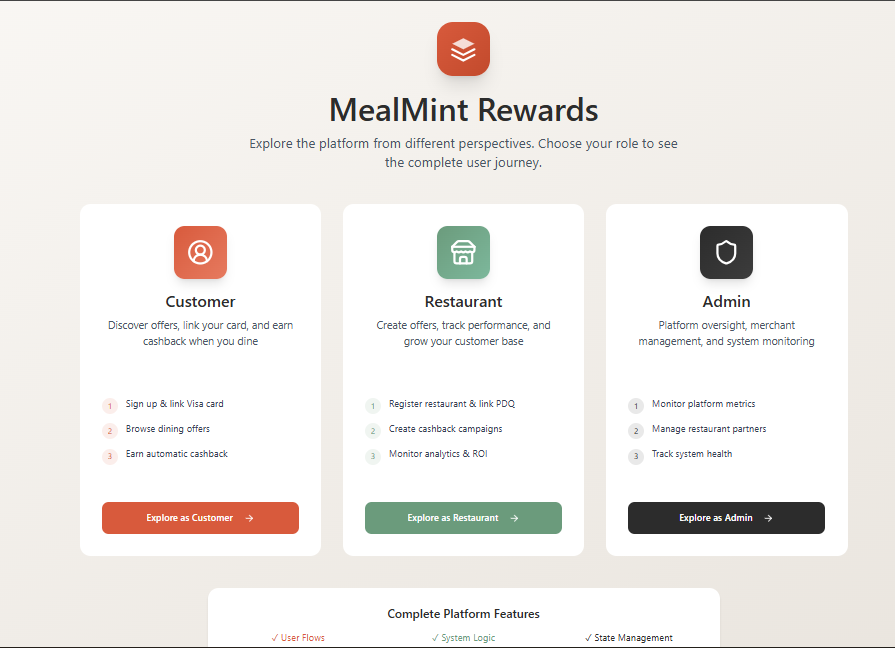
MealMint helps restaurants bring in more customers by giving cashback rewards. When people pay at partner restaurants using Visa (and soon mobile money), they automatically earn rewards. Restaurants only pay when customers actually buy something. They can set their own cashback rules based on time or how much people spend. Customers save money on meals without any extra effort. Through this. banks and payment companies benefit too since more people use their cards.
How we built it
We built MealMint as a payment-rail-agnostic rewards engine. Instead of starting with a consumer app, we focused on infrastructure that works behind the scenes. The core components include:
- A reward rules engine that applies logic based on time, spend, and frequency
- Integrations with payment rails (starting with Visa)
- A web dashboard for restaurants to create and manage offers
- Automated settlement flows through banks
Challenges we ran into
The major challenge was aligning with real market behavior. In Kenya, many customers pay with M-PESA. So focusing only on cards raised valid concerns from merchants. This forced us to think carefully about sequencing and building a system that can support multiple payment rails over time.
Also Gemini integration was a little bit challenging for my partner who's a backend engineer. It was more of trying to integrate AI to make it valuable to the system for the merchants to realize and use it. Because we just did want to become another digital product with an AI overlay.
Accomplishments that we're proud of
So far I'll say M-PESA integration because it was a hard nut to crack. Especially the technical architecture.
What we learned
We learned that local context is everything which entails: payment habits, trust in banks, and merchant realities all shape product decisions. We also learned that strong unit economics and a clear path to break-even are critical for credibility especially when coming up with a business model that's scalable.
What's next for MEALMINT
Next, MealMint is focused on piloting with selected restaurants and bank partners to validate real-world ROI. We plan to refine our reward models, prove repeat-visit behavior, and build strong case studies.


Log in or sign up for Devpost to join the conversation.