-
-
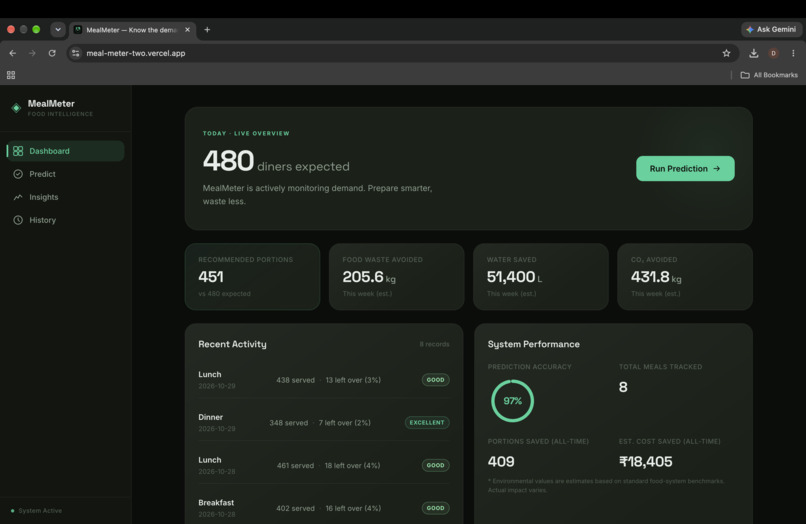
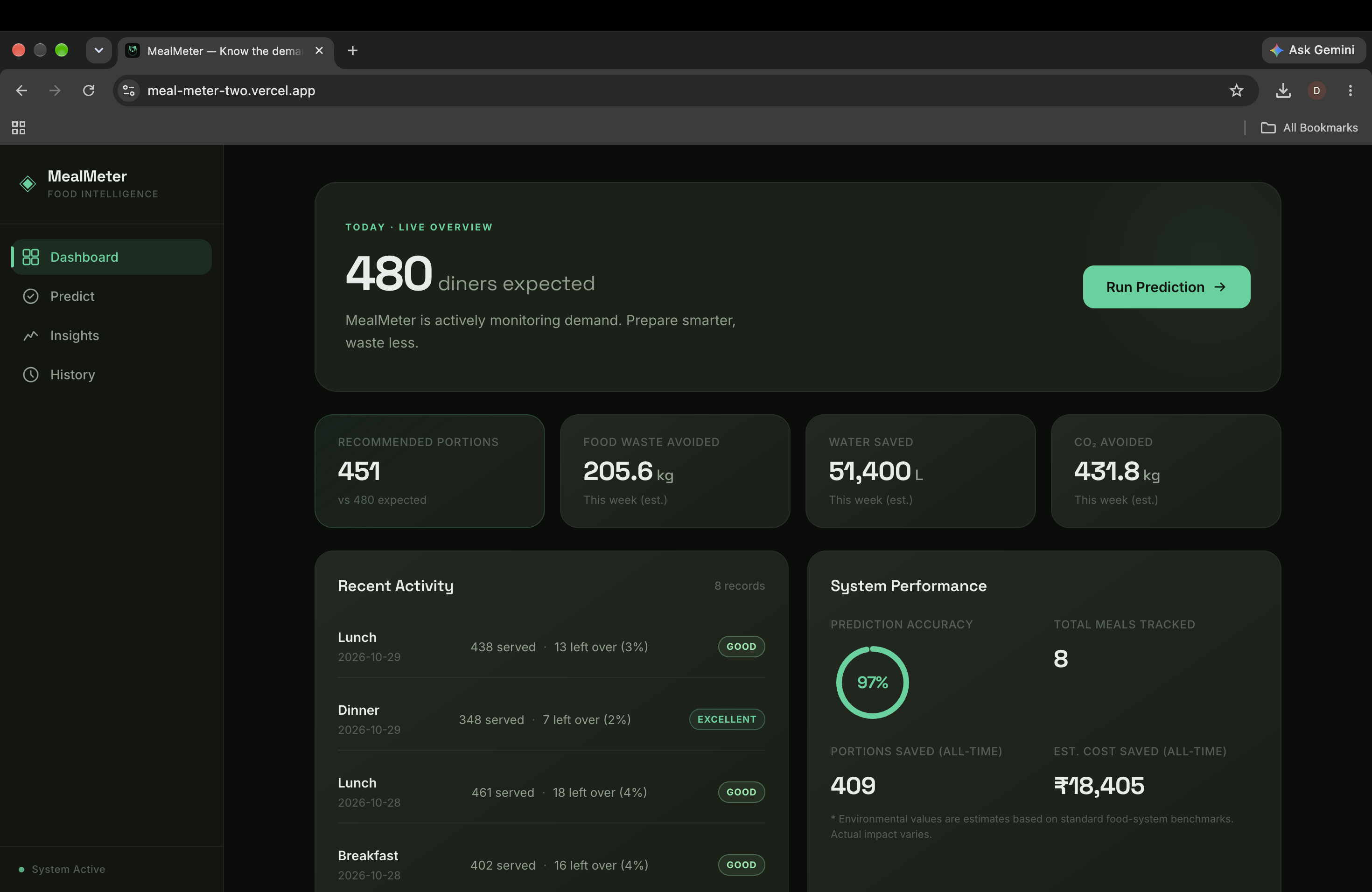
MealMeter dashboard showing expected demand, recommended portions, waste reduction, and system performance.
-
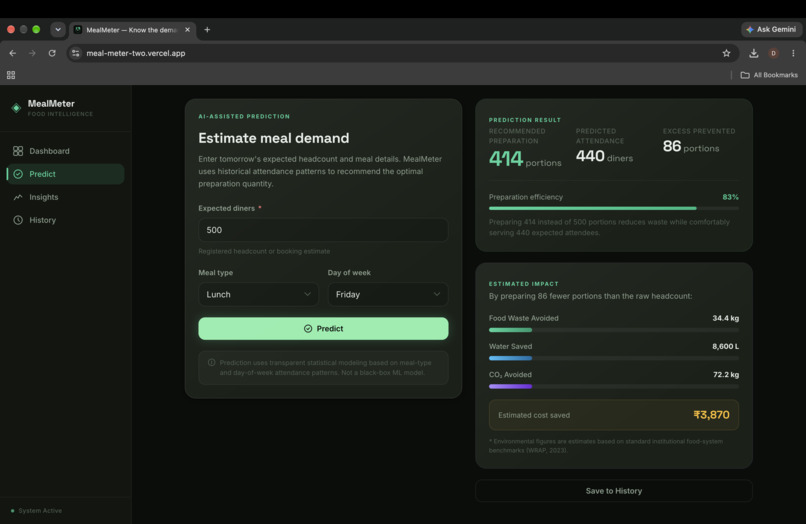
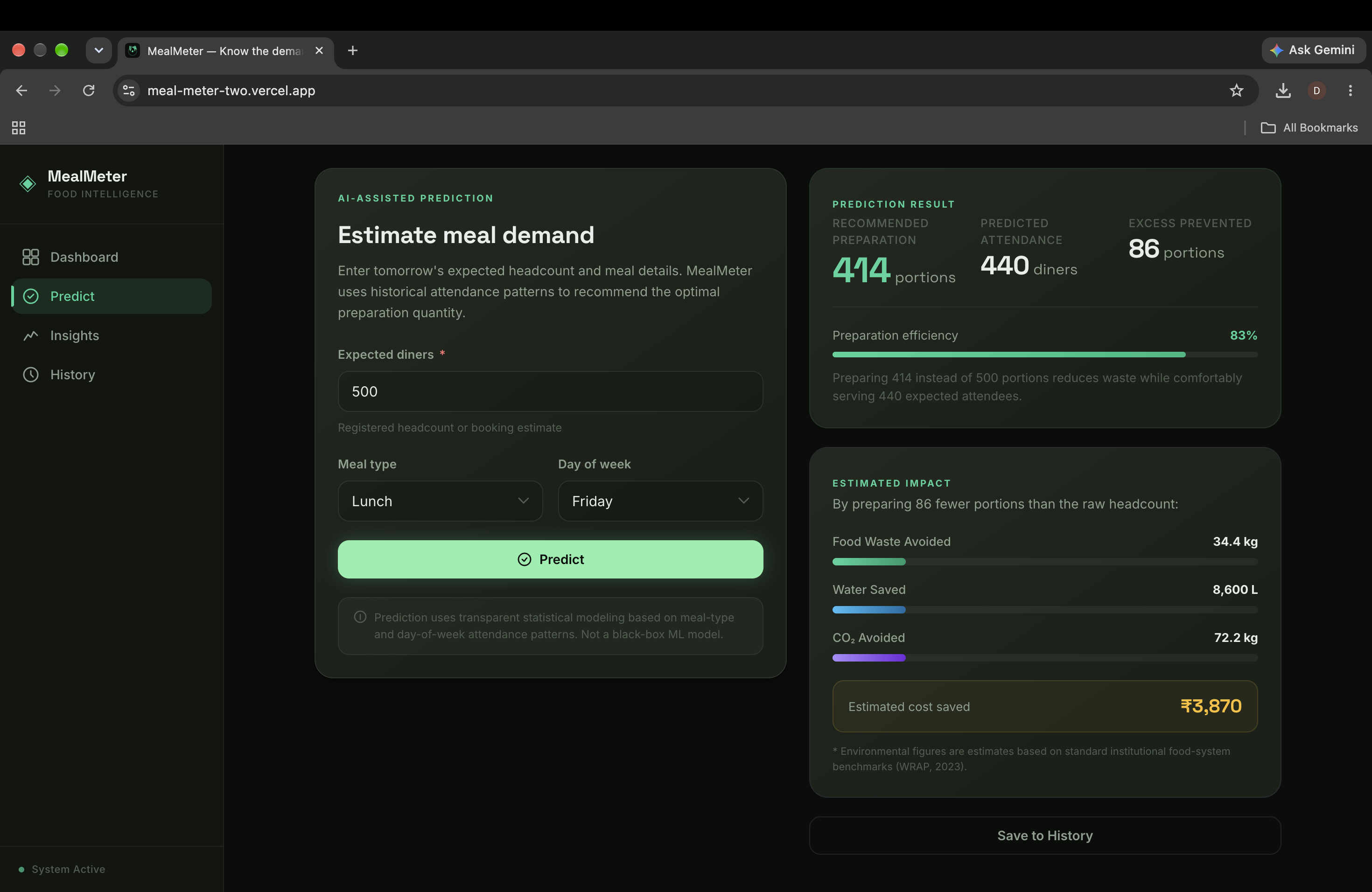
Demand prediction workflow showing recommended preparation, predicted attendance, and estimated environmental impact. 3. Insights
-
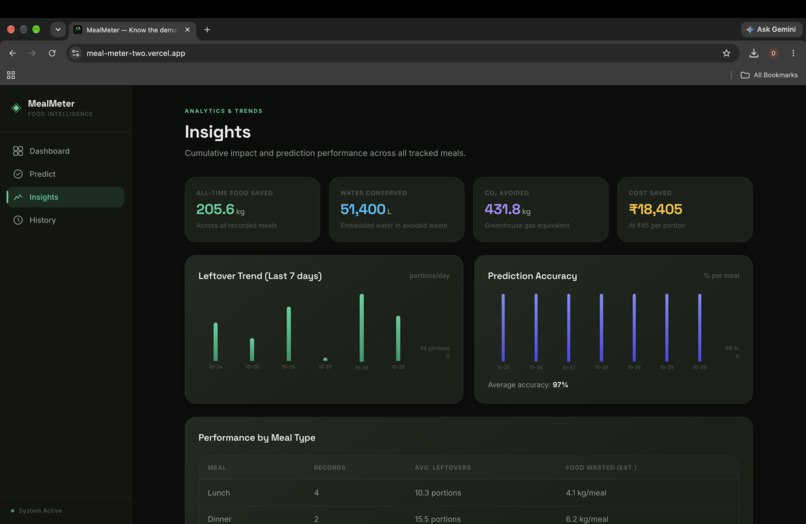
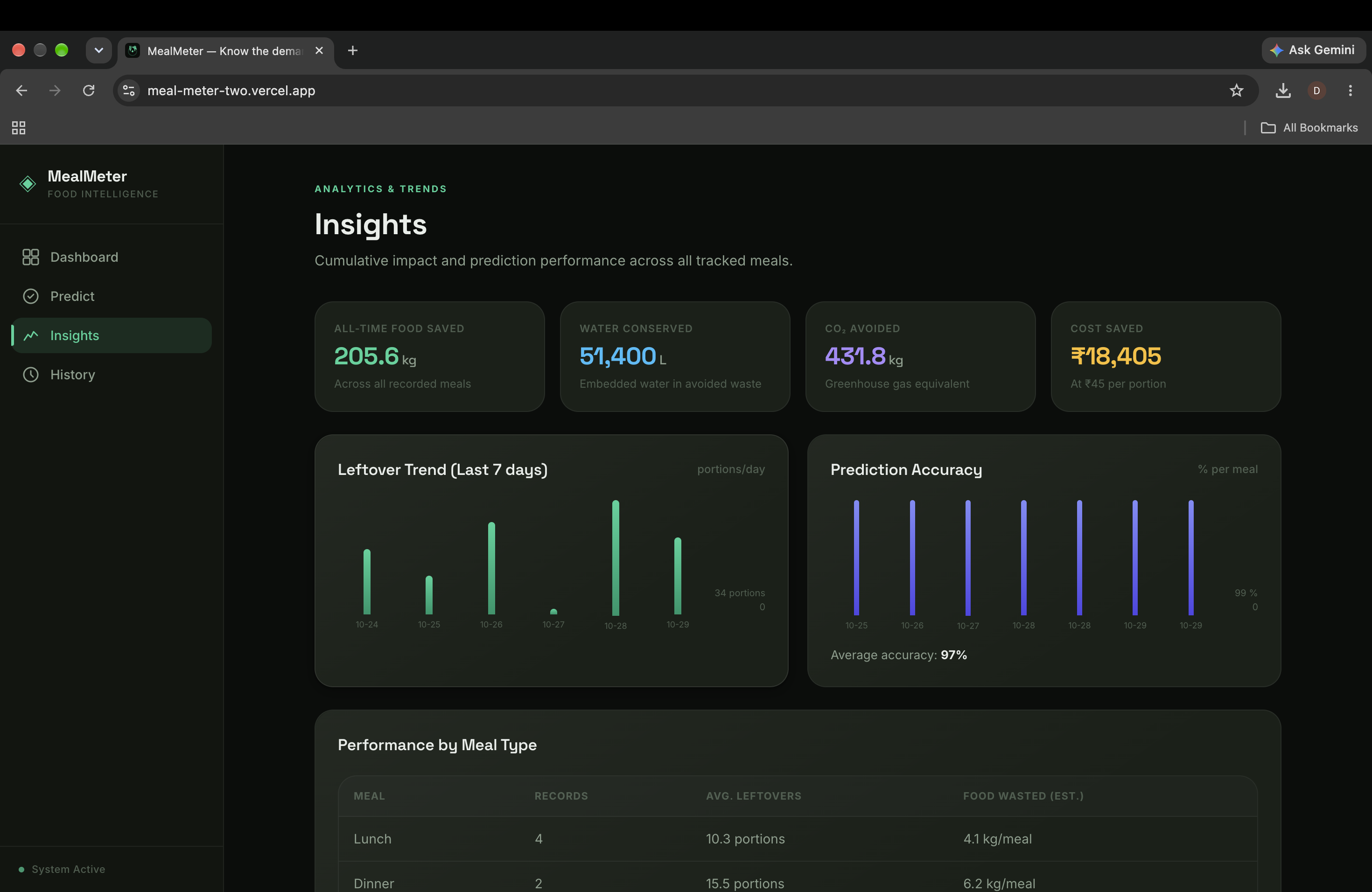
Analytics view showing food saved, water conserved, CO₂ avoided, and prediction performance.
-
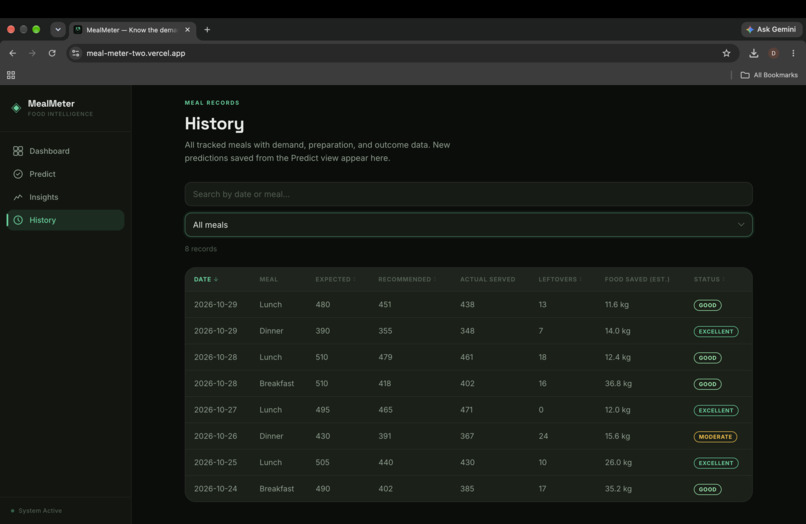
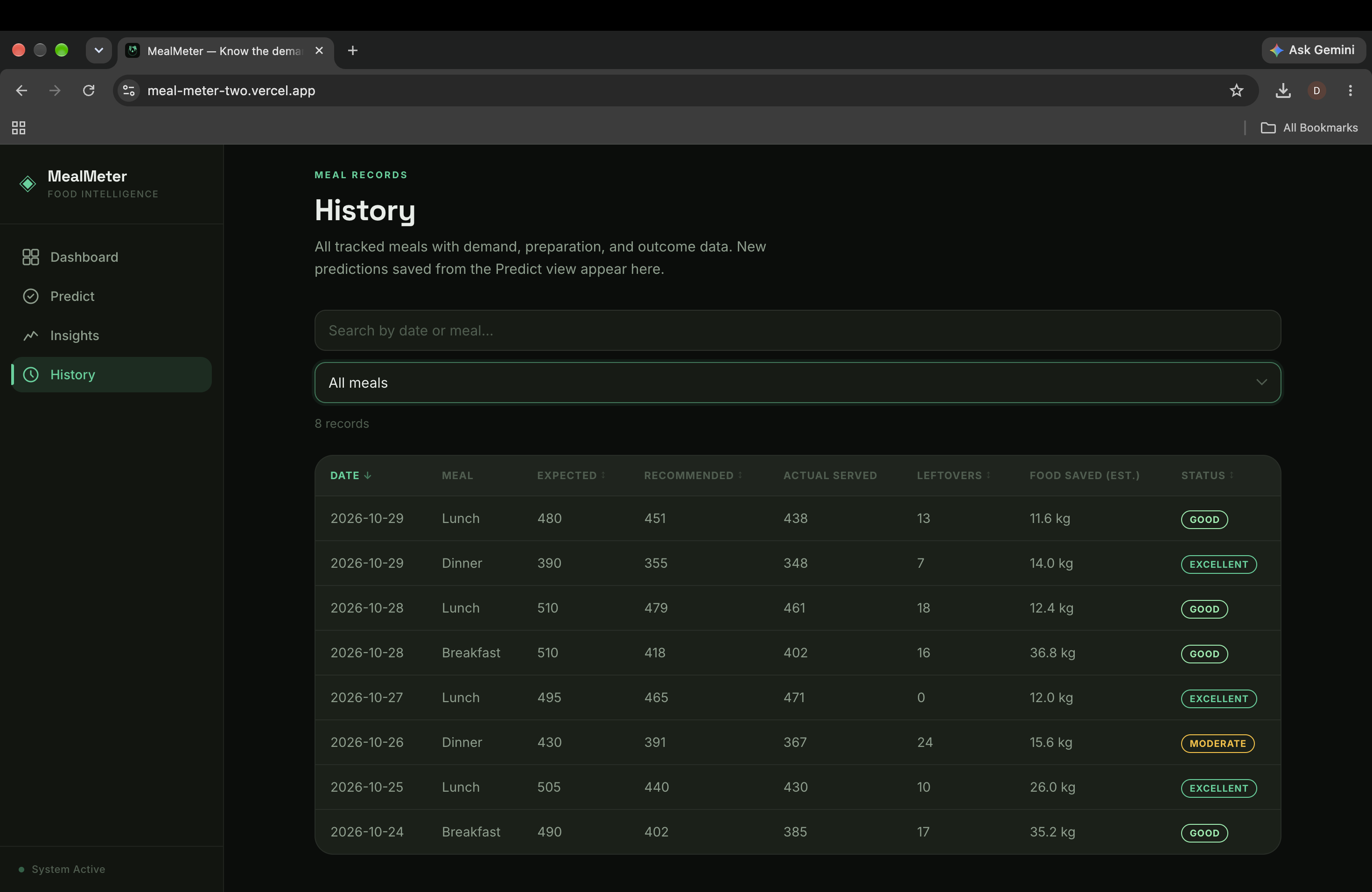
Meal history showing predicted demand, preparation, actual servings, leftovers, and estimated food saved.
The Problem
Food waste is a daily problem in college hostels, cafeterias, schools, and other large kitchens.
Meals are often prepared using rough estimates of how many people will eat. When demand is overestimated, excess food can become unnecessary waste. When demand is underestimated, there may not be enough food for everyone.
We focused on one simple question:
What if kitchens could estimate tomorrow's demand before preparing the food?
Our Solution
MEALMETER is a meal-demand prediction prototype designed to help institutional kitchens prepare closer to the amount of food actually needed.
Users enter the expected number of diners, meal type, and day. MealMeter analyzes historical attendance patterns and produces a predicted attendance along with a recommended preparation quantity.
The goal is simple:
Know the demand. Prepare the right amount.
How It Works
- Historical meal and attendance data is used as input.
- MealMeter analyzes patterns based on meal type and day.
- It predicts expected demand.
- It recommends how many portions to prepare.
- The result shows potential food, resource, and cost savings.
- Historical results can be tracked to support better future planning.
The current prototype uses local/sample data so the complete workflow can be demonstrated without requiring paid APIs or external services.
Sustainability Impact
Food waste represents more than wasted food. Producing food also requires water, energy, land, transportation, and other resources.
By helping kitchens prepare more accurately, MealMeter aims to reduce avoidable food waste and improve resource efficiency.
The prototype provides estimated values for food waste avoided, water saved, CO₂ avoided, and potential cost savings to demonstrate the possible impact of better demand planning.
These environmental and cost figures are estimates based on standard food-system benchmarks, rather than measurements from a real cafeteria deployment.
How We Built It
MealMeter was built as a working web prototype using React and Vite, with JavaScript, HTML, and CSS.
Instead of presenting the prediction as a black-box AI system, we focused on a transparent statistical approach so that the reasoning behind the recommendation can be understood and evaluated.
The application is deployed as a public web prototype that can be tested directly.
Challenges & What We Learned
One of our main challenges was designing a useful prediction system while working with limited real-world cafeteria data.
Food demand can change because of attendance, weekdays, meal types, events, and other factors. This showed us that sustainability solutions do not always need complicated models.
A transparent and understandable prediction approach can still help people make better everyday decisions.
Future Improvements
With real cafeteria deployment data, MealMeter could learn from actual attendance, leftovers, holidays, events, weather, and other factors.
Future versions could also integrate real-time kitchen records, improve prediction accuracy, and provide recommendations for individual food items.
Our long-term goal is to make food preparation more data-driven so kitchens can reduce waste while continuing to serve everyone who needs a meal.
Built With
- css
- data
- html
- javascript
- modeling
- react
- statistical
- vite