-
-
Cover Image
-
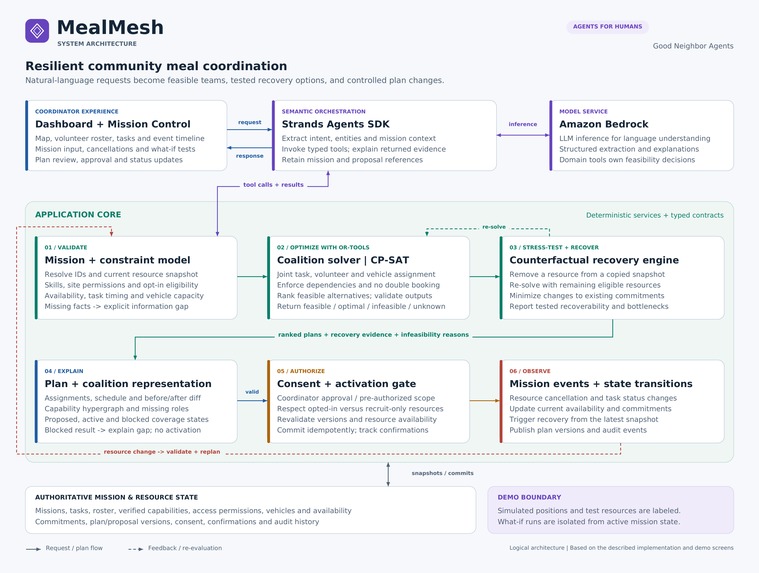
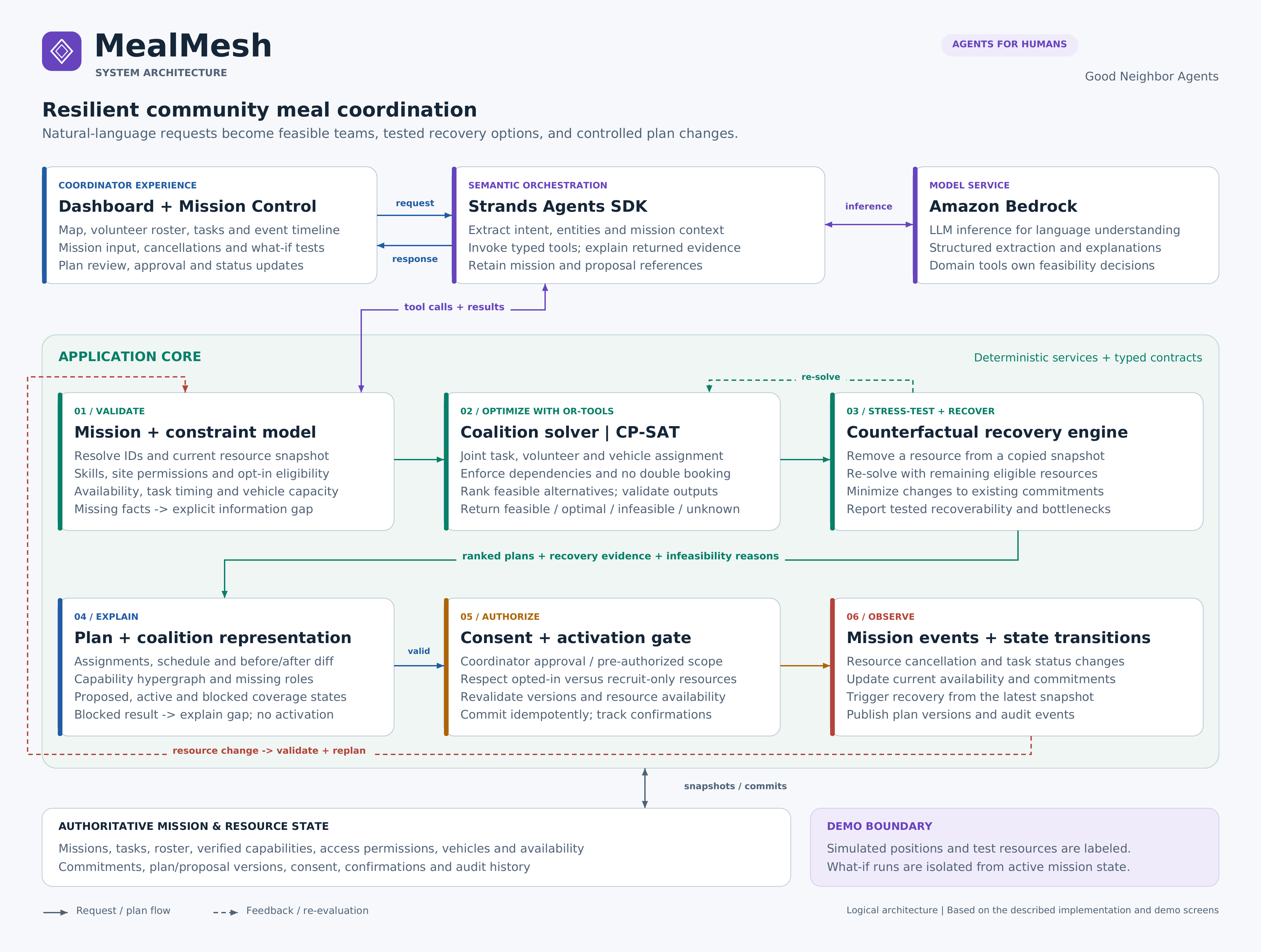
Architecture Diagram - Blocks
Inspiration
Every Thursday, Rosa manages a community meal distribution at Riverside Community Center that supports 200 families. If even one volunteer becomes unavailable, she may spend hours coordinating through calls, text messages, and spreadsheets. She must locate an eligible van driver, confirm food-handling coverage, ensure someone can open the facility, and verify that the entire team will arrive on time.
These last-minute changes consume 5–10 hours of her week time that would be more valuable if spent with the volunteers and families she supports.
According to Rosa, an appropriate backup exists for most disruptions. The difficult part is recognizing the complete replacement plan quickly enough. At the same time, the uncommon situation with no safe alternative the event capable of stopping the distribution can disappear within the noise of ordinary coordination.
We saw an ideal role for an AI agent: not another interface that recommends names or sends more alerts, but a quiet operational partner that resolves routine issues independently and includes Rosa only when a decision genuinely needs her experience and judgment.
That idea became MealMesh.
What It Does
MealMesh is an autonomous coordination system designed for community food-distribution operations.
The coordinator begins by expressing the required outcome in natural language:
“We need Thursday coverage at Riverside: a van driver, a food handler, and a site lead by 4 PM.”
From that request, MealMesh:
- creates a structured mission and validates every extracted field;
- determines the operational capabilities the mission requires;
- establishes whether a feasible coalition can be formed;
- finds the smallest valid team while enforcing skills, availability, capacity, timing, and all other hard constraints;
- tests the loss of every assigned volunteer to reveal fragile dependencies before the event;
- observes cancellations, volunteer returns, and newly available resources;
- rebuilds the coalition silently whenever a safe replacement is possible; and
- requests human attention only when the mission is no longer feasible or a consequential judgment is needed.
The practical outcome is clear: the coordinator is no longer interrupted by problems the system can solve and receives an alert only when her attention can make a difference.
How We Built It
Every part of MealMesh follows a single rule:
The language model interprets the situation, but it is never the decision-maker.
1. Guardrails
We protect the extraction layer with input cleaning and prompt-injection detection. The LLM has no permission to allocate resources, but we must still prevent malicious or malformed input from producing unreliable mission data.
2. Structured extraction with Strands
Using Amazon Bedrock Nova Lite, a Strands Agents SDK agent translates a natural-language request into a Pydantic-validated Mission. The structured object captures details such as the location, deadline, requirements, and constraints. If information is unavailable, the corresponding field remains null rather than being hallucinated.
3. Capability rules engine
A deterministic Python rules engine applies our domain ontology to the extracted mission and derives the capabilities required for execution. The agent identifies what the coordinator communicated; the rules engine establishes what those facts mean operationally. Cases that remain unknown or have low confidence are directed to a human review step.
4. CP-SAT coalition solver
Google OR-Tools models each eligible volunteer or resource as a decision variable. Hard constraints guarantee skill coverage, availability, capacity, and timing. Only this solver can make an allocation. It demonstrates whether the mission is feasible and finds the smallest coalition that satisfies every requirement.
5. Counterfactual resilience engine
After selecting a coalition, MealMesh excludes each assigned volunteer individually and re-runs the solver. These counterfactual tests show which absences have a safe alternative and which assignments create a single point of failure.
6. Hypergraph model
We use HyperNetX to represent emergent capabilities that ordinary one-to-one relationships cannot describe. For instance, mobile-delivery capability requires both an available van and a volunteer certified to drive it. A hyperedge treats that multi-resource combination as a meaningful operational structure.
7. Silent Deputy
The Sentinel listens for real-world state changes and runs the deterministic pipeline again whenever an event occurs. Its edge-triggered policy sends an escalation only when the severity of the situation increases. It also detects improvement and recovery, preventing repeated alerts while the system remains in an unchanged condition.
8. Advisor agent
A Strands ReAct agent gives coordinators a conversational interface to typed capabilities including assess_incident, get_available_resources, and get_resources_by_capability. Users can ask operational questions naturally, but the answers remain anchored to the deterministic source of truth.
9. Dashboard and API
An interactive dashboard is supported by a FastAPI backend. It provides sample missions, coalition health, geographic coverage, resilience results, and playback of Sentinel events. The solution is Docker-compatible and includes a deterministic local mode, allowing the complete demonstration to run without AWS credentials.
MealMesh demonstrates three complementary Strands patterns:
- structured extraction for transforming language into a mission contract;
- multi-tool ReAct for conversational operational assistance; and
- the
@tooldecorator as a typed connection between LLM-based reasoning and deterministic services.
Challenges We Faced
Establishing a real trust boundary
In our first implementation, the extraction model sometimes tried to be helpful by including volunteer recommendations. A prompt instruction alone could not guarantee a safe separation of responsibilities. We addressed this with a strict structured-output schema, Pydantic validation, and architectural isolation, ensuring that every assignment originates exclusively from the solver.
Preventing alert fatigue
The original Sentinel produced a notification during every polling cycle while a mission remained infeasible. We redesigned the logic to evaluate transitions instead of repeatedly reporting the current state. MealMesh now alerts only when severity increases and records when an issue improves or has been resolved.
Making the demo reproducible
Some judges and contributors may not have access to Amazon Bedrock credentials. To make the project easy to run, we implemented deterministic fallback behavior, local mission fixtures, direct invocation of tools, and dry-run notification delivery. The same typed functions behave consistently whether called by a Strands agent or by the test suite.
Accomplishments We Are Proud Of
The LLM never allocates a resource
Our most important safety guarantee remained true across all 27 test modules and throughout every demonstration scenario. The model interprets the coordinator's language, while domain rules and mathematical optimization retain complete control of operational decisions.
The Silent Deputy behaves as promised
Our simulated Thursday contains six state-changing events. The Sentinel silently repairs four of them and escalates only two: one when the sole van-certified driver becomes unavailable and another when the simultaneous loss of critical roles makes the mission impossible to satisfy.
Every layer is independently testable
Each major layer—guardrails, extraction, rules, optimization, resilience, hypergraph analysis, monitoring, and advising—has its own focused tests. The entire deterministic workflow can also be verified from start to finish without cloud access.
One trusted pipeline powers every surface
All product experiences depend on the same run_pipeline() sequence:
extraction → review → capabilities → solver → resilience → hypergraph
The Silent Deputy runs this sequence after state changes. The advisor reaches it through strongly typed tools. The dashboard invokes it through the API. As a result, each interface shares a single operational authority instead of implementing its own decision logic.
What We Learned
Agents become more trustworthy when their authority is constrained
At first, increasing the LLM's control appeared to make MealMesh more agentic. In reality, transferring policy enforcement, allocation, risk evaluation, and escalation logic to deterministic components made the system safer, easier to observe, simpler to test, and more dependable.
The most valuable pattern we discovered is:
Let the LLM provide a natural interface to deterministic authority.
Resilience should be calculated before failure
The technique is straightforward: remove one resource and solve the mission again. Its impact, however, is significant. Instead of knowing only that the current coalition works, the coordinator can see in advance exactly where it is vulnerable and which backup capability should be recruited.
Good automation knows when to stay silent
An autonomous system should not be judged by the volume of actions or alerts it produces. Its value comes from completing safe work without adding cognitive burden and from recognizing the precise moment when it must return control to a person.
Community coordinators deserve production-grade agents
AI agents often focus on developers, office workers, and individual consumers. Meanwhile, community coordinators may support hundreds of people using spreadsheets, messaging groups, and personal persistence. They deserve technology built with the same safety, reliability, and engineering discipline expected in enterprise systems.
What Is Next
Pilot with real community programs
Our next goal is to replace demonstration rosters with live volunteer schedules and evaluate MealMesh with coordinators managing real community operations.
Multi-site orchestration
Shared resources are already represented in our hypergraph. The next stage is joint optimization across locations, allowing the system to move a vehicle or qualified volunteer from a site with surplus capacity to another site facing a shortage.
Coordinator-native communication
Notifications are separated from any single communication platform. Adding SMS and WhatsApp will deliver the small number of meaningful escalations through the channels coordinators already monitor.
Always-on managed monitoring
Running the Silent Deputy through Amazon Bedrock AgentCore can turn the Sentinel into a persistent managed service without asking community organizations to maintain their own infrastructure.
An open community playbook
Our longer-term goal is to let any community organization connect a volunteer roster, describe its capabilities and constraints, select a preferred notification channel, and activate its own Silent Deputy.
Food distribution is only the first application. The same composition engine can help coordinate disaster relief, shelter staffing, healthcare outreach, and other missions in which success depends on assembling several capabilities under changing conditions.


Log in or sign up for Devpost to join the conversation.