Inspiration
As a restaurant manager, I watched peers guess meal costs—losing profit to vague math. At home, I struggled to stick to grocery budgets. I built this to turn guesswork into data-driven decisions for anyone cooking to eat (or sell).
What it does
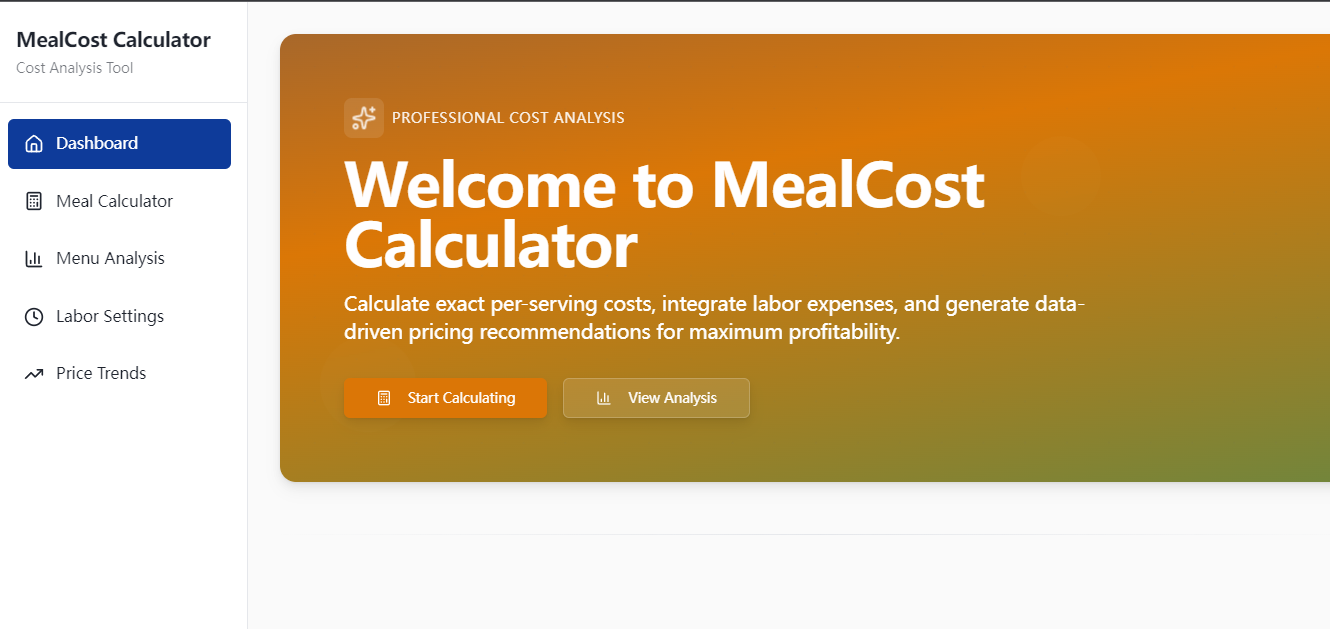
It calculates per-serving ingredient costs, adds labor expenses (via $\text{Labor Cost} = ((\text{Prep Time} + \text{Cook Time}) / 60) \times \text{Hourly Rate}$), tracks 6-month ingredient price trends, and recommends prices (Cost × 3 rule) for profitability.
How we built it
We started with core cost logic, built a React UI for input/output, integrated Chart.js for trends, used MongoDB to save meal templates, and tested edge cases (invalid inputs, empty meals) to harden error handling.
Challenges we ran into
Balancing simplicity (for home users) with depth (for restaurants) was tough—we iterated UI 3x to keep it intuitive. Ensuring unit consistency (oz, kg, piece) without auto-conversion also required careful input validation.
Accomplishments that we're proud of
The tool works seamlessly for both home cooks and restaurant owners, with responsive design for desktops/tablets. Pre-loaded meal data lets users test it instantly, and profit margin calculations are 100% accurate.
What we learned
We mastered translating business rules (like the Cost × 3 pricing rule) into clean code, and learned that user-centric error handling (clear messages for bad inputs) is as critical as core functionality.
What's next for this project
We’ll add batch production calculations, integrate real-time ingredient price feeds, and build an export feature for Excel reports—plus expand unit conversion to support more global measurements.

Log in or sign up for Devpost to join the conversation.