-
meal Relay
MealRelay – Rescue Food. Relay Hope.
Inspiration
Every day, restaurants, hostels, canteens, and events generate surplus food that often goes to waste, while many people struggle to access nutritious meals. We wanted to bridge this gap by creating a platform that makes surplus food redistribution faster, smarter, and more organized.
What it does
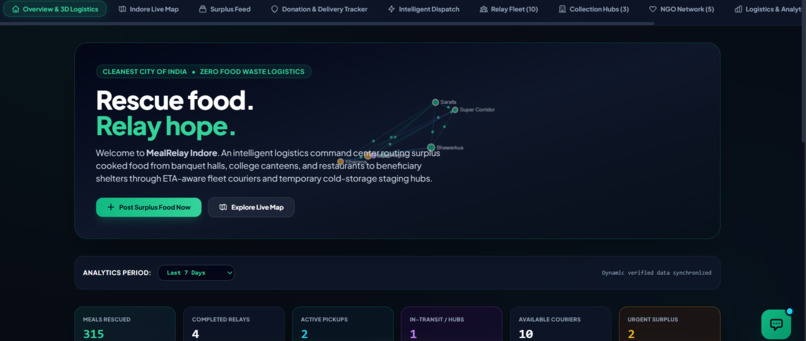
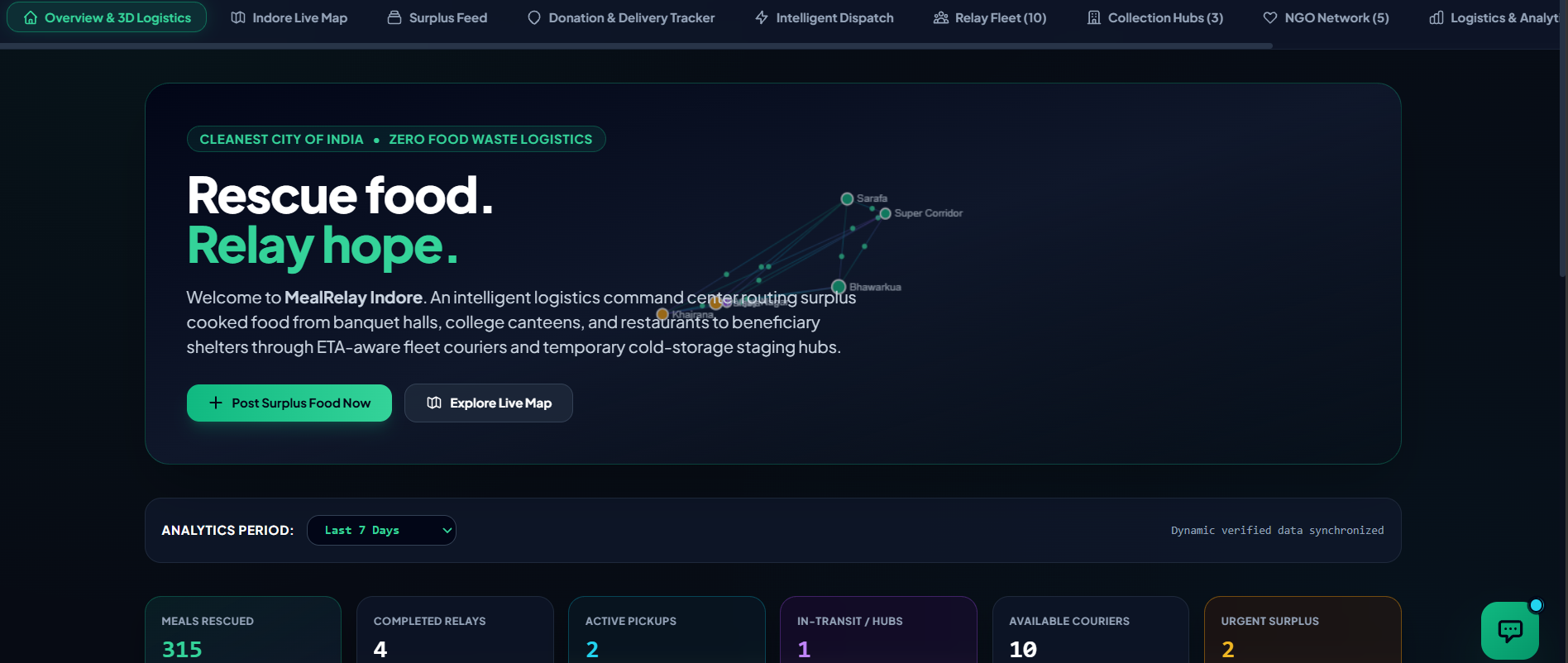
MealRelay connects food donors, NGOs, and volunteers through a unified platform. It helps donors list surplus food, identifies nearby volunteers and NGOs, coordinates pickups and deliveries, and supports temporary collection hubs. It also provides delivery tracking, operational analytics, leaderboards, and an AI assistant to help users handle common delivery-related issues.
How we built it
We designed MealRelay with a modern web-based architecture. React.js and TypeScript power the frontend, while Tailwind CSS provides responsive styling. Three.js supports the 3D visual experience. Google Maps provides location visualization, while H3 spatial indexing helps organize nearby locations and improve matching. The backend and database are designed to manage users, donations, volunteers, NGOs, and delivery updates.
Challenges we ran into
Our biggest challenge was designing an efficient logistics system. Matching nearby volunteers, coordinating multiple pickups, handling delivery deadlines, and ensuring food reaches the destination on time required careful planning.
Accomplishments that we're proud of
We are proud to develop a solution that addresses both food waste and food accessibility. Our key achievements include a location-based rescue network concept, multiple delivery models, an operational dashboard, and an AI-powered assistance experience.
What we learned
We learned how location-based technology can solve real-world problems, how to approach logistics challenges, and how frontend, backend, mapping, and AI technologies can work together to build a meaningful solution.
What's next for MealRelay
We plan to strengthen real-time tracking, improve AI-based volunteer allocation, introduce food safety verification, partner with more NGOs and restaurants, and expand MealRelay to more cities. Our long-term vision is to build a reliable network where surplus food reaches someone in need instead of going to waste.
