Inspiration
The inspiration for Meal Architect came from a universal moment of frustration: staring into a fridge full of random ingredients with no idea what to cook. We wanted to solve the "what's for dinner?" problem in a way that was not just practical, but also fun, creative, and educational. We imagined what it would be like to have a world-class chef by your side, transforming your leftovers into something extraordinary, and decided to build it.
What it does
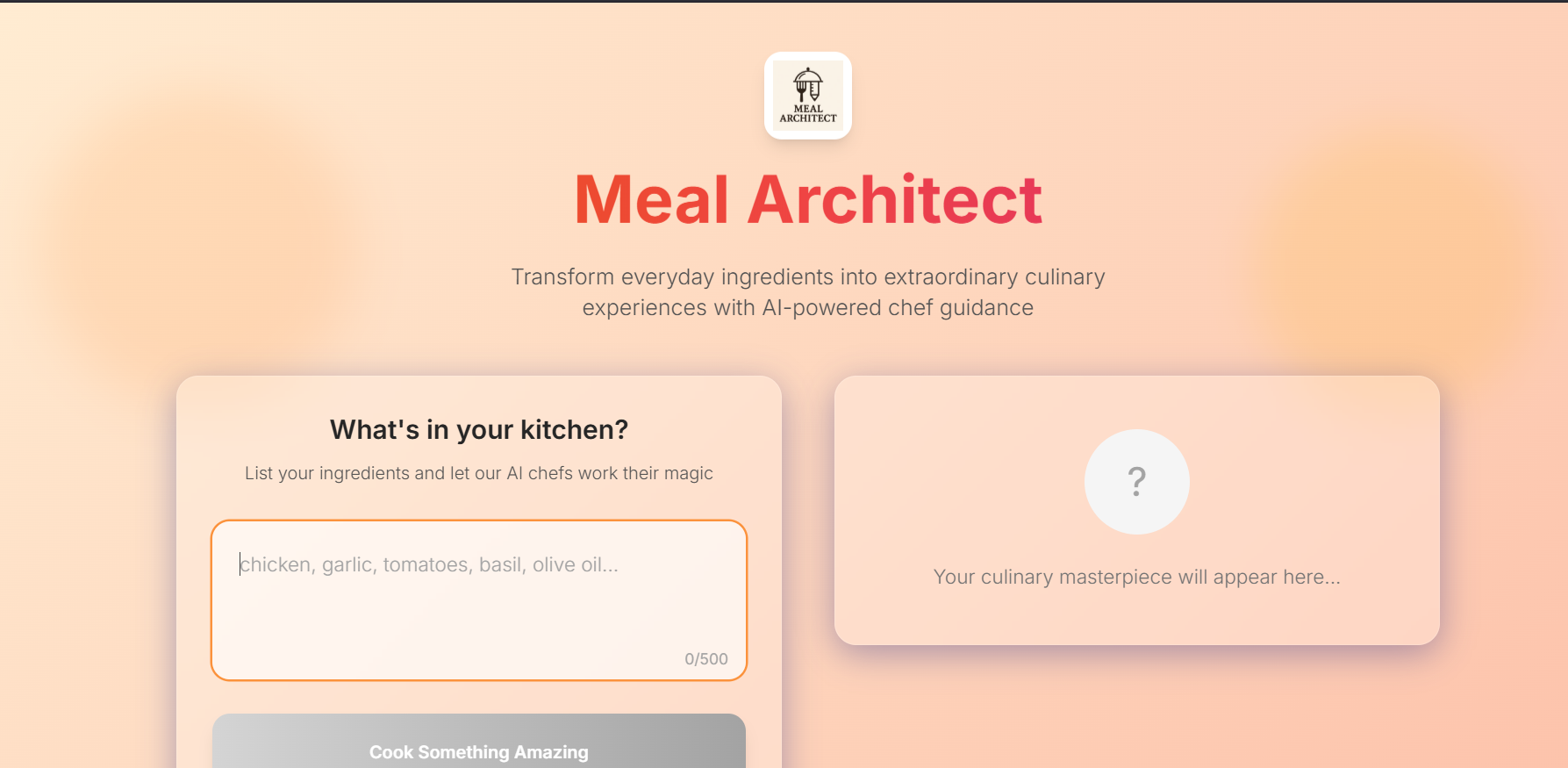
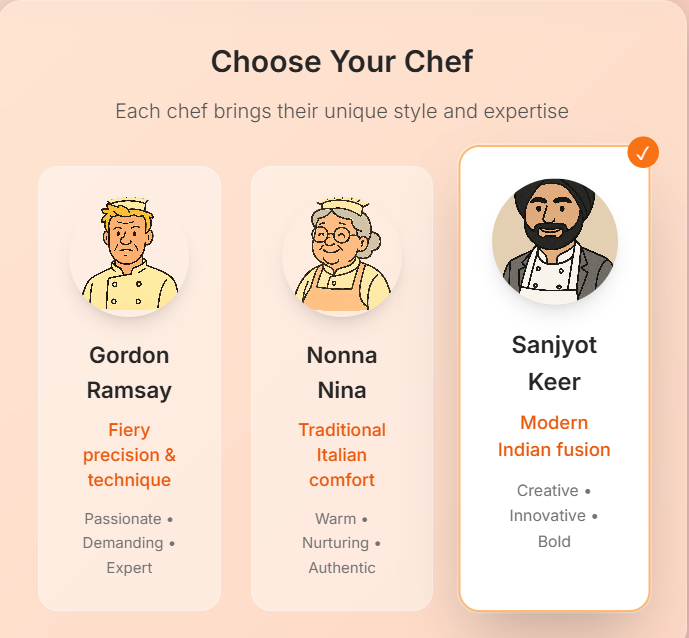
Meal Architect is a full-stack AI application that turns your available ingredients into unique recipes guided by distinct AI chef personalities. Users simply enter the ingredients they have, choose a culinary style from one of our three AI chefs—Gordon Ramsay, Nonna Nina, or Sanjyot Keer—and instantly receive a complete, step-by-step recipe tailored to that chef's philosophy. The same ingredients produce wildly different dishes, showcasing the power of AI to deliver personalized, creative culinary experiences.
How we built it
We built Meal Architect with a modern, robust, and scalable tech stack to ensure a seamless user experience from front to back.
Frontend: The beautiful and responsive user interface was built with React and Vite, and styled with Tailwind CSS.
Backend: A high-performance, asynchronous API was developed using Python and FastAPI.
AI Integration: We used OpenRouter to connect to and orchestrate multiple large language models, allowing us to "prompt engineer" our unique chef personalities.
Deployment: The frontend is deployed globally on Vercel, and the backend is live on Render, creating a reliable, production-grade application.
Challenges we ran into
Our journey was filled with real-world development challenges. Our biggest hurdle was ensuring the reliability and speed of the live AI responses. We initially faced frequent API timeouts and invalid model errors from our third-party service, which threatened our ability to create a working demo. We solved this by methodically debugging, researching alternative models, and re-configuring our backend to use a faster, more stable, and reliable LLM (Mistral-7B), all while implementing robust error handling on the frontend. We also overcame complex CORS issues between our deployed frontend and backend, a classic full-stack development problem.
Accomplishments that we're proud of
We are incredibly proud of building a complete, end-to-end, full-stack AI application from scratch in such a short amount of time. The standout accomplishment is the successful implementation of the AI chef "personalities." It’s one thing to get an AI to generate a recipe; it's another to have it generate three completely different recipes, in character, from the exact same set of ingredients. We are also proud of the polished and professional UI, complete with our own custom illustrations, which elevates the project from a simple tool to a delightful user experience.
What we learned
This project was a masterclass in full-stack development and agile problem-solving. We learned the critical importance of a clean Git workflow, the nuances of deploying separate frontend and backend services, and the necessity of robust error handling, especially when dealing with external APIs. Most importantly, we learned that the "last 10%" of a project—deployment, debugging live services, and ensuring reliability—is often the most challenging but also the most rewarding part of the process.
What's next for Meal Architect
The future for Meal Architect is exciting! Our next steps would be to:
Expand the Chef Roster: Introduce more AI chef personalities from different culinary traditions (e.g., a Japanese sushi master, a French patissier, a Mexican street food expert).
Save & Share Recipes: Allow users to save their favorite generated recipes to a personal cookbook and share them with friends.
Dietary Preferences: Add functionality for users to specify dietary restrictions (e.g., vegan, gluten-free) for even more personalized results.
Image Recognition: Implement a feature where users can simply take a photo of their ingredients, and the app automatically identifies them.
Built With
- css
- fastapi
- html
- javascript
- openrouter
- python
- react
- render
- tailwind
- vercel
- vite


Log in or sign up for Devpost to join the conversation.