-
-
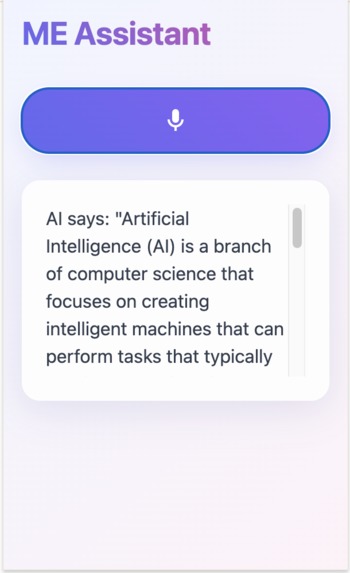
Ai Response
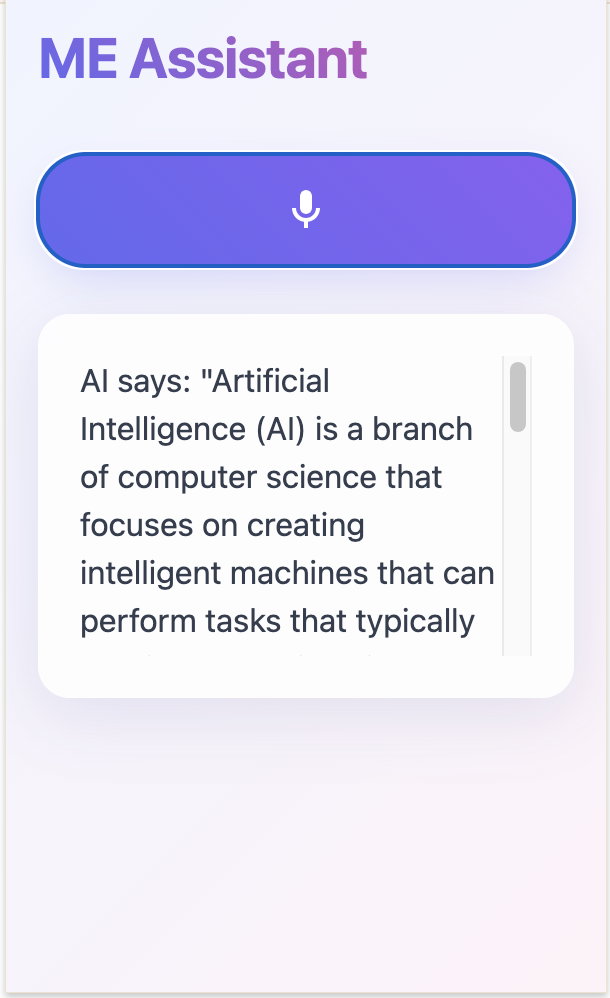
Inspiration
The inspiration came from the idea of creating a truly hands-free, intelligent assistant that seamlessly bridges multiple platforms, providing users with a unified and efficient way to manage their tasks, search for information, and perform actions with voice commands.
What it does
The assistant leverages voice recognition to perform tasks based on user commands:
- "Google": Searches the web using Google and returns relevant results.
- "Play": Searches and plays videos or music on YouTube.
- "Me": Queries a large language model (LLM) for context-aware answers, brainstorming, or creative assistance.
- "Open": Opens specific websites or apps directly based on user input.
How we built it
- Voice Recognition: Integrated speech-to-text technology using APIs like Google Speech-to-Text or Whisper for accurate and fast processing.
- Command Parsing: Developed a natural language processing (NLP) engine to interpret and categorize voice commands.
- Task Execution: Built modules for each functionality (web search, YouTube, LLM interaction, and URL opening) and connected them via a centralized controller.
- Frontend: Designed a user-friendly interface with visual feedback and an intuitive command flow.
Challenges we ran into
- Achieving high accuracy in understanding diverse accents and speech variations.
- Efficiently parsing commands to determine intent without delays.
- Ensuring smooth integration between APIs for Google Search, YouTube, and the LLM.
Accomplishments that we're proud of
- Creating a truly multi-functional assistant that works seamlessly across platforms.
- Successfully implementing voice-driven command parsing and task execution.
- Achieving low latency and high accuracy in voice recognition and task processing.
What we learned
- The importance of optimizing voice recognition models for real-world conditions.
- Effective ways to integrate multiple APIs for a cohesive user experience.
- User preferences in voice assistants and how to prioritize usability and functionality.
What's next for the Voice Recognition Assistant
- Personalization: Add user-specific preferences and personalized responses.
- Device Integration: Expand support for smart devices, enabling control over IoT gadgets.
- Offline Mode: Incorporate offline functionality for certain commands.
- Multi-language Support: Enhance accessibility with support for more languages.
- Proactive Assistance: Enable the assistant to suggest actions based on user habits and context.


Log in or sign up for Devpost to join the conversation.