Inspiration

MD_ASSIST began with a simple, frustrating experience: at a first specialist visit, the physician had no current patient data and spent 20–30 minutes reconstructing medical history before the patient opened MyChart and supplied recent results. That was the “aha” moment. Valuable clinical time should be spent understanding the patient and planning care—not hunting for information that already exists.

What it does

MD_ASSIST is designed to turn scattered patient-provided health information into a concise, clinician-ready brief before the visit. It helps surface the essential context a clinician needs so the conversation can begin from a shared understanding rather than from a blank page.

The project supports preparation and communication; it does not replace a clinician, diagnose disease, or prescribe treatment.

How we built it

MD_ASSIST was developed as a solo project with Codex as the primary development environment and GPT-5.6 at the center of the AI workflow. Codex supported rapid iteration across the product workflow, implementation, testing, and documentation.

To protect privacy during development and demonstration, we used synthetic patients and synthetic medical records rather than real patient data. We also created documented evaluations to test the system’s behavior and the usefulness of its outputs.

Challenges

The hardest challenge was balancing compression with clinical usefulness. A short brief can save time only if it preserves the facts that matter, distinguishes known information from uncertainty, and avoids presenting generated text as medical judgment.

A second challenge was treating safety and privacy as product requirements from the beginning—not as features to add later.

Accomplishments

  • Built a working end-to-end prototype as a solo developer
  • Produced a complete demonstration video
  • Used synthetic records and patients throughout the demo workflow
  • Created documented evaluations for repeatable testing
  • Established a clear boundary between information preparation and clinical decision-making

What we learned

The biggest lesson is that better clinical encounters do not always require more data. They require the right information, organized at the right moment, with clear provenance and responsible human oversight.

Codex made it possible to move from a personal insight to a tested prototype quickly while keeping the work structured and reviewable.

What’s next

Next steps include expanding evaluation coverage, strengthening source traceability, refining clinician-facing summaries, and validating the workflow with qualified healthcare professionals. Privacy, security, accessibility, and regulatory review will remain central as MD_ASSIST develops.

Built With

Share this project:

Updates

posted an update —

Update: Expanding MD_ASSIST Testing and Windows Support with GPT-5.6 and Codex

MD_ASSIST has entered a new engineering phase focused on controlled synthetic-data testing, stronger safety validation, and Windows compatibility. GPT-5.6 and Codex have played central roles in this development process, helping us analyze engineering evidence, design testing protocols, identify defects, develop repairs, and prepare cross-platform builds.

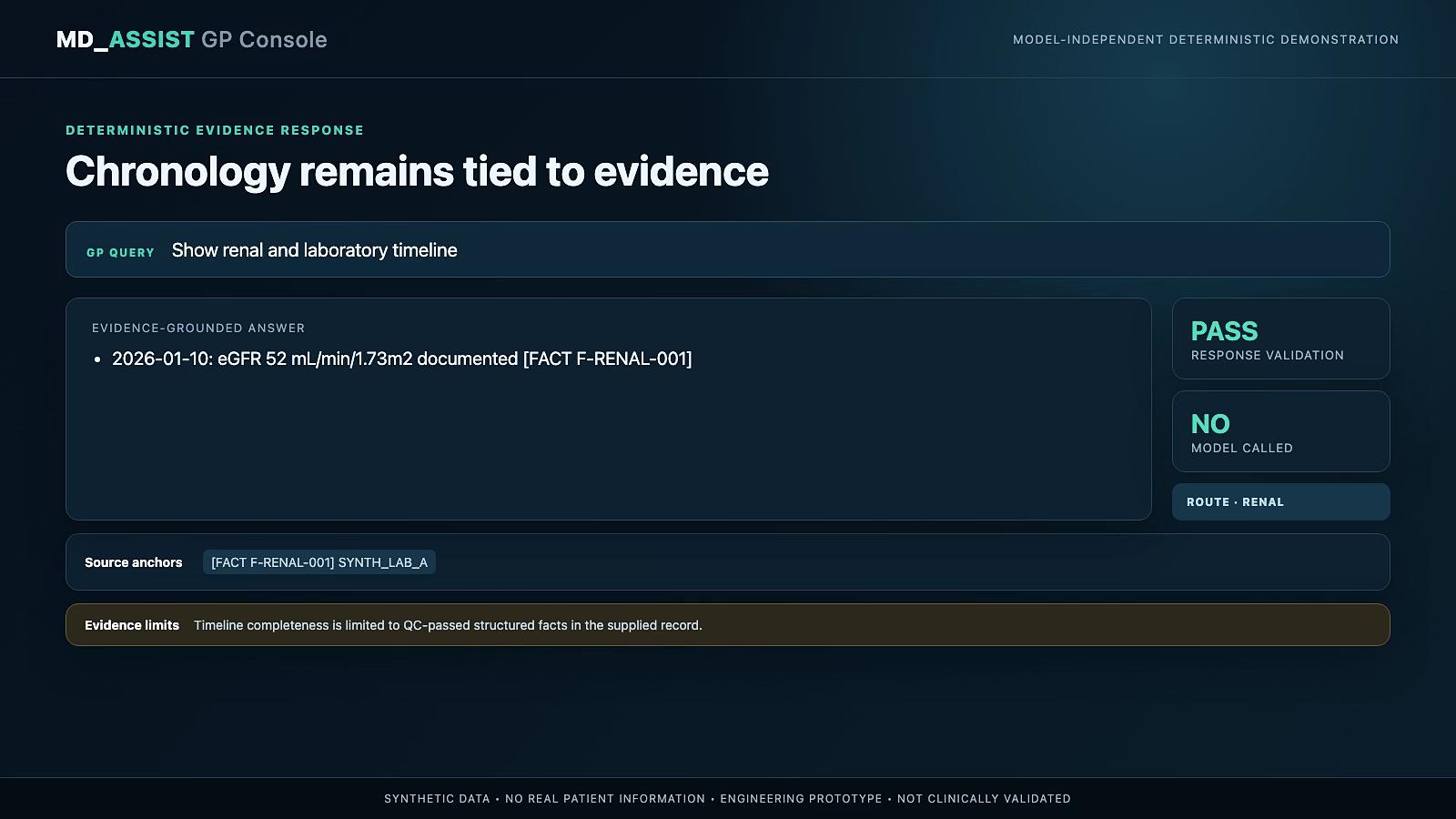
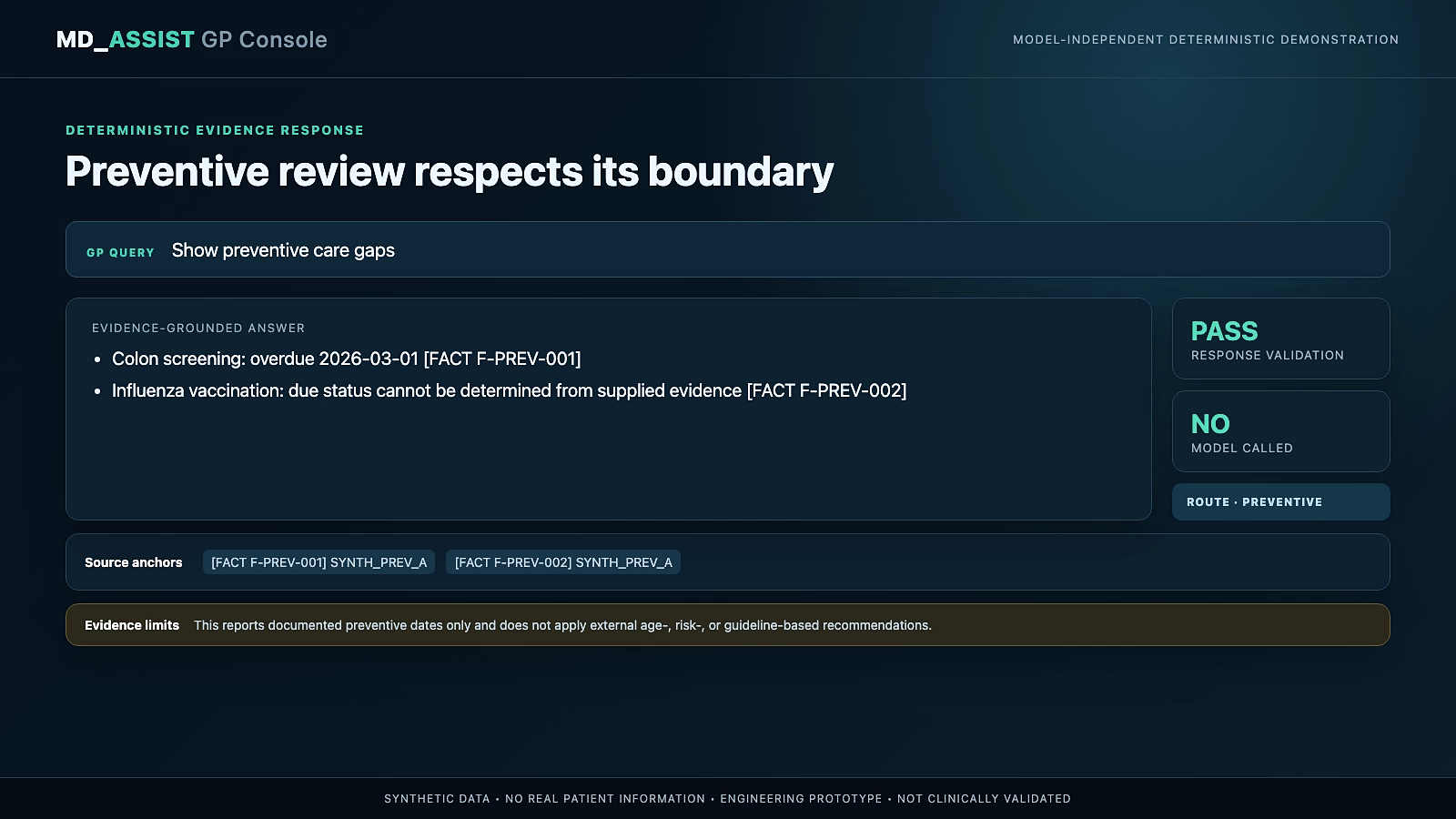
We designed BETA_TEST_SYNTH, a clean-room evaluation using fictional patient records rather than real medical information. With Codex supporting the engineering workflow, the framework evaluates patient isolation, deterministic fact retrieval, source attribution, duplicate and conflicting records, missing information, unsafe requests, prompt-injection attempts, and other difficult scenarios. MD_ASSIST must return verified, source-linked information when supported—and decline requests that are ambiguous, unsupported, or outside its authorized boundaries.

Earlier Beta 2A testing demonstrated encouraging progress. The available evidence showed deterministic responses for supported laboratory-history questions and governed abstentions for ambiguous, unsupported, diagnostic, treatment, and prompt-injection requests. GPT-5.6 and Codex helped examine these results, distinguish demonstrated capabilities from unverified claims, and define the additional evidence required for reproducible engineering evaluation.

In parallel, Codex has helped evolve MD_ASSIST beyond its original Mac-based environment. We have created Windows 10-compatible development packages containing native Windows executables, a Physician Console, startup and validation scripts, and separate compatibility and AVX2-optimized builds. This work establishes a foundation for evaluating MD_ASSIST on Windows hardware while preserving its governed behavior and safety controls.

GPT-5.6 and Codex are being used as engineering and development tools—not as substitutes for physicians or as autonomous clinical decision-makers. MD_ASSIST remains under supervised engineering evaluation and is not authorized for production or autonomous clinical use. Nevertheless, these developments represent meaningful progress toward a secure, reproducible, cross-platform system designed to organize and present complex medical information with clear provenance and appropriate safeguards.

Log in or sign up for Devpost to join the conversation.

posted an update —

MD_ASSIST submitted to OpenAI Build Week

The first working MD_ASSIST prototype is now complete and submitted!

This build demonstrates an end-to-end workflow that transforms fragmented, synthetic patient records into concise, source-grounded clinical context for pre-visit preparation.

Included in this release

  • A working clinician-facing prototype
  • Synthetic patients and medical records—no real patient data
  • Source-grounded responses with visible evidence references
  • Safety boundaries separating information preparation from medical judgment
  • Documented evaluations for repeatable testing
  • A complete public demonstration video

MD_ASSIST was developed as a solo project using Codex and GPT-5.6. Next, I’ll expand evaluation coverage, improve source traceability, and seek feedback from qualified healthcare professionals.

Thank you for following the journey—constructive feedback is welcome.

Log in or sign up for Devpost to join the conversation.

Submission history