-
-

MCP360 Logo
-
Logo
-

Inspiration
The Model Context Protocol (MCP) has made it easier for AI applications to connect with external tools, but using it at scale is still challenging. Developers often have to configure multiple MCP servers, manage different authentication methods, and maintain separate integrations for every service they want an AI agent to access.
We wanted to simplify that experience by building a single MCP gateway that gives AI agents access to a large collection of production-ready tools through one integration. Instead of spending time wiring APIs together, developers can focus on building better AI experiences.
What it does
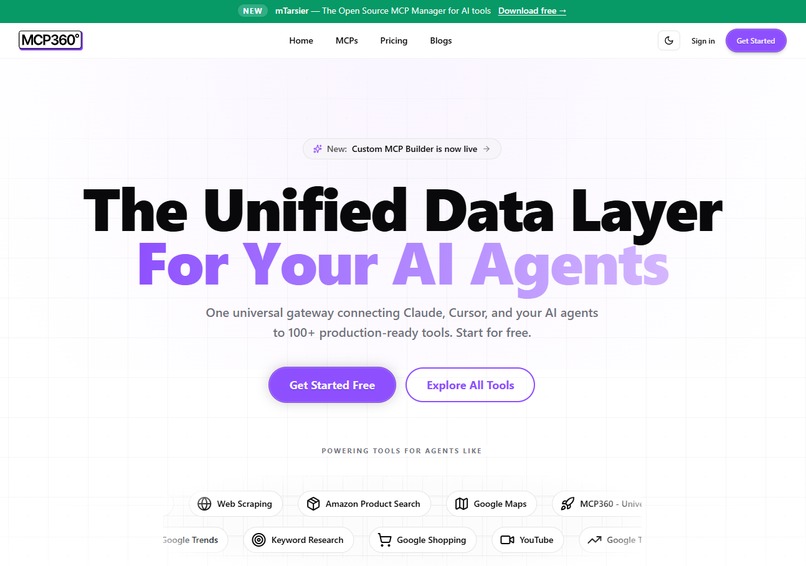
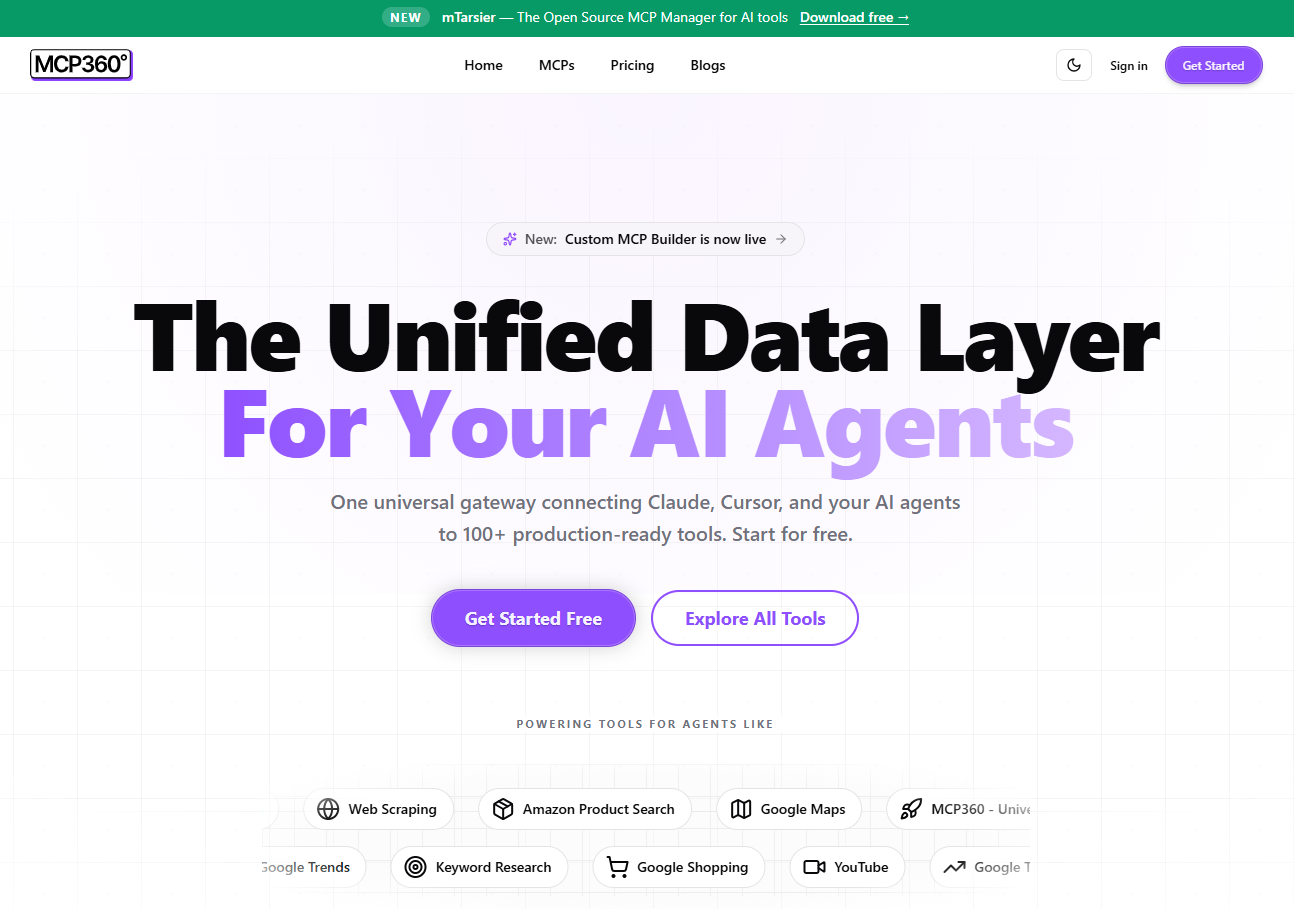
MCP360 is a unified MCP platform that provides AI agents with access to more than 100+ production-ready tools through a single MCP server.
The platform allows developers to:
- Connect an AI agent using one MCP endpoint.
- Discover available tools dynamically.
- Execute tools through a standardized interface.
- Authenticate using API Keys or OAuth, depending on the provider.
- Build and publish their own custom MCP servers.
- Use the same integration across MCP-compatible clients such as Claude Desktop, Cursor, Windsurf, VS Code, and other MCP-enabled applications.
Rather than installing and maintaining multiple MCP servers, developers connect once and access everything through a unified gateway.
How we built it
The project was designed around a gateway architecture that sits between MCP clients and external services.
The core components include:
- A centralized MCP Gateway that exposes a single endpoint.
- A tool registry that manages available integrations.
- A routing layer that forwards requests to the correct provider.
- An authentication layer supporting API Keys and OAuth.
- A standardized execution engine that normalizes requests and responses.
- A custom MCP builder for creating and publishing new servers.
The platform follows the official Model Context Protocol specification, making it compatible with existing MCP clients without requiring custom adapters.
Tech Stack
- TypeScript
- Node.js
- Model Context Protocol (MCP)
- REST APIs
- OAuth 2.0
- API Key authentication
- Docker
- GitHub
Challenges we ran into
The biggest challenge was creating a consistent interface for many different external services. Every provider exposes different authentication flows, request formats, rate limits, and response structures.
Another challenge was ensuring that one gateway could support both prebuilt integrations and developer-created MCP servers without sacrificing performance or flexibility.
Maintaining compatibility across different MCP clients also required careful testing because implementations can vary slightly between clients.
Accomplishments that we're proud of
- Built a single MCP gateway that exposes 100+ production-ready tools.
- Standardized communication across many different APIs through one interface.
- Added support for both OAuth and API Key authentication.
- Created a custom MCP builder so developers can extend the platform.
- Built a solution that works across popular MCP-compatible AI clients instead of targeting only one ecosystem.
What we learned
Building MCP360 reinforced how valuable standardization is for AI infrastructure. While the Model Context Protocol provides a common language between AI applications and tools, creating a reliable developer experience requires much more than implementing the specification.
We learned that authentication, routing, error handling, and API normalization are just as important as the protocol itself. Designing these layers carefully made the platform significantly easier to integrate and extend.
What's next for MCP360
The next phase of MCP360 focuses on making the platform even more extensible.
Our roadmap includes:
- Expanding the catalog with additional MCP integrations.
- Improving the custom MCP builder with a more visual development experience.
- Adding enterprise monitoring, governance, and analytics.
- Making tool discovery smarter through recommendations and metadata.
- Continuing to support new MCP clients as the ecosystem grows.
Our long-term vision is to make MCP360 the simplest way to connect AI agents with external tools through one standardized, developer-friendly platform.
Built With
- css
- react
- tailwind
- typescript

